
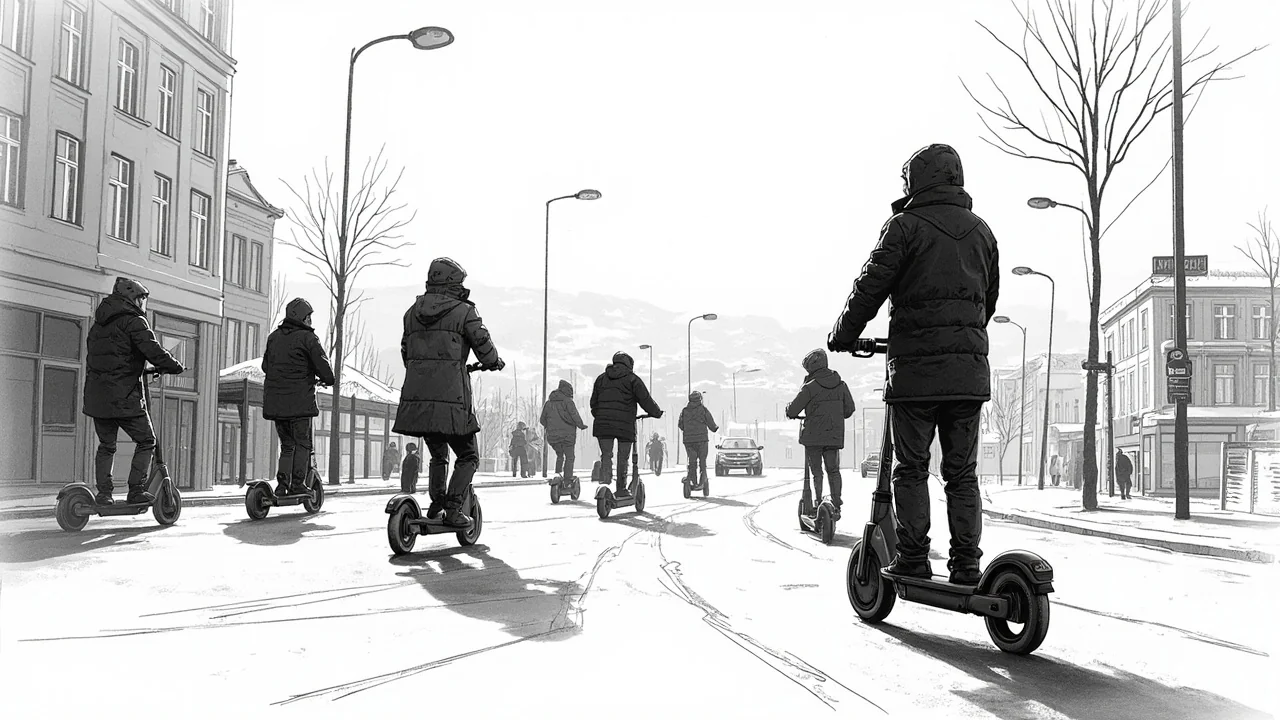
Oslo's city council has rejected a mandate for winter tires on rental e-scooters, sparking a fierce political clash over safety in the capital. The council voted down multiple proposals from the Labor Party (Ap) aimed at tightening regulations for the vehicles, including the tire requirement and a ban on nighttime use. The decision has left the city's main opposition party accusing the ruling Conservative (H) and Liberal (Venstre) coalition of negligence as winter approaches.
Samferdselspolitisk talsperson for Oslo Ap, Abdullah Alsabeehg, called the handling of the issue a "pure parody." In a statement, he blamed the current city government's policies for creating chaos. "After their deregulation, we have gone from control to total chaos," Alsabeehg said. "It is astonishing that they again refuse to take action to improve the situation."
A Clash of Safety Philosophies
The rejected proposals formed a core part of Ap's attempt to rein in a mode of transport they say has become dangerously unchecked. Beyond winter tires, the party sought to halve the number of rental scooters in the city and implement a complete ban on their use between 11 PM and 5 AM. Ap argues the latter measure is essential to prevent drunk driving. The party contends that keeping scooters available at night "invites drunk driving."
Mehmet Kaan Inan, a Conservative member of the Transport and Environment Committee, defended the city government's record. He pointed to existing regulations that have been tightened. "We will ban scooters from sidewalks, the speed has been reduced, and we have created many parking zones," Inan stated. He argued the core issue is not the number of scooters but how they are used.
Rising Injury Toll Fuels Debate
Central to Ap's criticism is a dramatic increase in serious injuries linked to e-scooters. Abdullah Alsabeehg directly connected this to the city government's decision to double the number of rental scooters. "The doubling of scooters has triggered an explosion in serious injuries," he claimed. "Emergency rooms are filled with knocked-out teeth, head injuries, and broken bones."
The number of scooters has been a political football. In autumn 2022, the previous Red-Green city government slashed the number of rental scooters from 20,000 to 8,000. Last November, the current Conservative-led council voted to double the fleet to 16,000. This expansion has primarily occurred in the city's outer boroughs, areas with longer travel distances and potentially more hazardous winter conditions.
Nighttime Access and Worker Concerns
The debate over a nighttime ban revealed a split in priorities. Ap views it as a straightforward safety measure. The Conservative response, however, introduced a different perspective rooted in practicality for shift workers. Mehmet Kaan Inan noted that a ban is not currently on the agenda. He revealed the city has received requests for nighttime access from certain groups.
"We have received a number of inquiries, including from shift workers who work nights, that they would like the opportunity to use scooters at night," Inan wrote. This highlights a tension between blanket safety restrictions and the utility of scooters as affordable, flexible transport for those with non-standard working hours. Ap has not publicly addressed this specific worker concern, focusing instead on the broader risk of alcohol-related accidents.
A History of Regulatory Swings
The political struggle over e-scooters in Oslo is not new. It represents the latest swing in a pendulum of regulation that has shifted with each change in city leadership. The drastic reduction under the Red-Green coalition reflected a safety-first, restrictive approach. The current government's expansion signals a philosophy prioritizing mobility and market availability, albeit with a revised set of rules on speed and parking.
This inconsistency creates a challenging environment for operators and users alike. Regulations on where scooters can be ridden, how fast they can go, and where they can be parked have been in constant flux since their introduction. The refusal to mandate winter tires adds another layer of uncertainty as icy conditions set in. Operators are not currently required to fit specialized tires, leaving the decision to individual companies.
What Happens Next?
The immediate consequence is a political stalemate. The Conservative-Venstre coalition holds the majority needed to reject Ap's proposals. This means the regulatory framework will remain unchanged as winter progresses. The onus now falls on scooter operators to voluntarily adopt winter tires or other safety measures. It also places responsibility on users to exercise extreme caution, or simply avoid scooters, during icy and snowy conditions.
Critics warn that without a mandated technical standard for winter grip, the city is relying on hope over enforceable policy. The coming months will test whether the current rules are sufficient. Data on wintertime accidents and injuries will be scrutinized. That data will likely fuel the next round of political debate, possibly in the lead-up to the next municipal elections.
The core question remains whether Oslo's approach—focusing on user behavior and parking over vehicle equipment—is adequate for a Nordic winter. For now, the city's streets will host thousands of scooters on standard tires, navigating the same ice and snow that prompts Norwegian drivers to make their seasonal tire switch. The political rift over this decision is deep, with one side seeing reckless disregard and the other pointing to practical governance and personal responsibility. The true test will be measured not in council votes, but in emergency room admissions from November to March.