
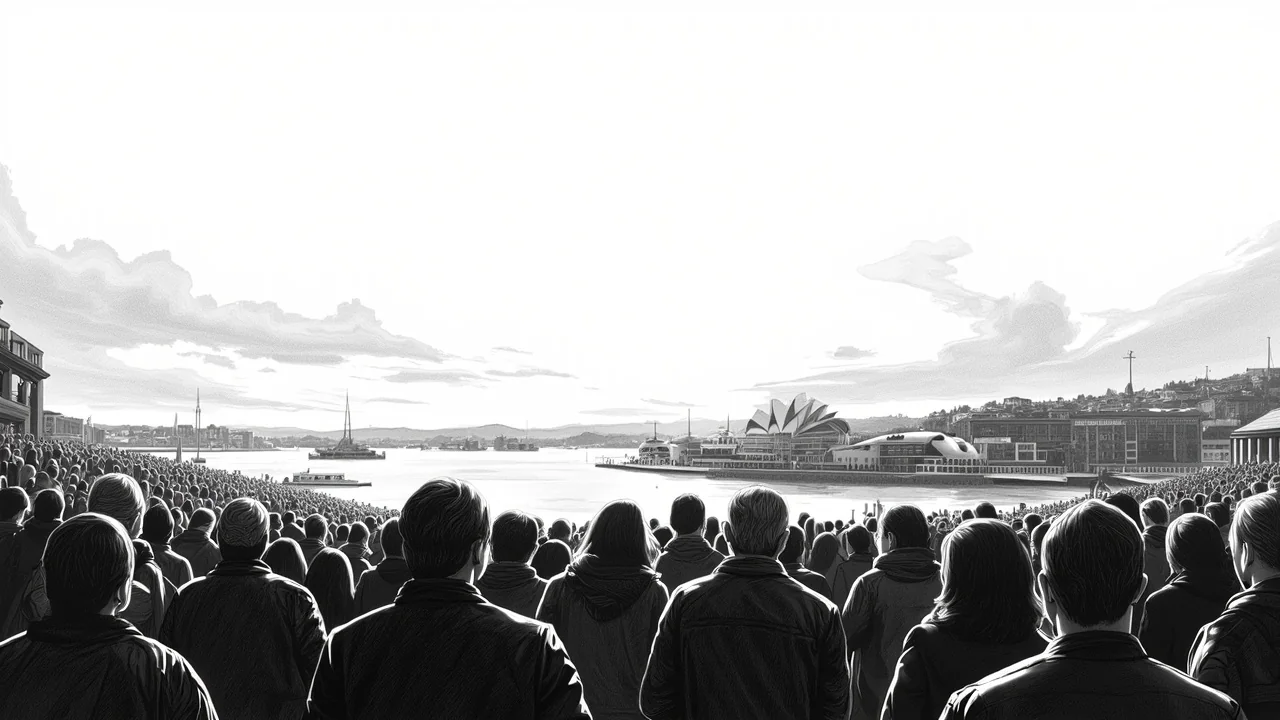
Oslo's Vippetangen area could become the city's most important public space if a key vote in the city council goes a certain way. Must we build at all? This fundamental question lies at the heart of a decision that will shape Oslo for generations. The relocation of international ferries is likely to be decided by the Oslo city council in February. The Planning and Building Agency recommends Kongshavn as the new location. This move could trigger a total transformation of Vippetangen, one of Oslo's most central and valuable areas. The choice is between extensive development or opening it up as a shared urban space for the entire city.
The Crossroads at Vippetangen
Vippetangen sits between Jernbanetorget and the National Theatre, directly connected to the Kvadraturen district. With good sun exposure, panoramic views over the Oslofjord, and a long, continuous coastline, it is among Oslo's most attractive plots of land. This area represents the missing piece in the so-called Fjord City plan. Yet, the framework here is entirely different from the rest of the Fjord City. The military is stationed at Vippetangen and does not want residential buildings in the area for security reasons. Additionally, Akershus Fortress is a national cultural heritage site that imposes strict demands on heights, volume, and foreground.
These fortifications are among Norway's most important national landmarks. In Bergen, concrete measures are now being considered to protect Bergenhus Fortress through the Directorate for Cultural Heritage's proposal to protect the surrounding areas. A massive housing and commercial development, as seen elsewhere along the fjord, is completely unrealistic at Vippetangen. Precisely this opens up for a different opportunity: to create a large, open public realm without dense construction.
A Historical Perspective on Oslo's Waterfront
Oslo's waterfront has changed enormously over the last 150 years. The fjord was once a common good. For example, there were public baths at Vippetangen and ice-skating rinks on the fjord when it froze over. With the massive port development in the 1900s, recreational areas along the sea were gradually displaced by industry, quays, and infrastructure. Later came the roads, which further reinforced the distance between the city and the fjord.
Today, both cars and industry are largely gone. Tjuvholmen, Aker Brygge, Bjørvika, Bispevika, and Sørenga have already been developed. Filipstad and Grønlikaia are next in line. The Fjord City plan's goal has been to free up areas for housing, business, and recreation and to connect the city more closely to the fjord through public pathways, green corridors, and sightlines. The question is whether we have actually succeeded.
The Fjord City Plan and Its Critics
When plans for Grønlikaia were recently criticized by the Council for Urban Architecture, points were raised about high density, large building volumes, and development that undermines both the fjord and the Ekeberg ridge. This critique highlights a tension in Oslo's waterfront strategy. The ambition to create vibrant, connected areas is clear, but the execution often leans toward intensive construction. Vippetangen presents a chance to pivot. Its unique constraints might force a different approach, one that prioritizes open space over built density.
If the ferries move to Kongshavn, attention will quickly turn to Vippetangen. The area's potential is immense, but so are the limitations. The military's presence and the fortress's protected status create a scenario where traditional development models may not apply. This isn't just about adding more apartments or offices, it's about defining what kind of urban experience Oslo wants to offer its citizens and visitors. The debate encapsulates a larger discussion on how modern cities balance growth with preservation and public access.
Military and Cultural Constraints
The Defense Ministry's stance against housing at Vippetangen for security reasons is a significant factor. Akershus Fortress, as a national monument, mandates careful consideration of any new structures. These constraints aren't necessarily obstacles, they can be seen as guidelines for a more thoughtful urban design. The fortress and its surroundings require a sensitive approach that respects historical significance while enabling public use. This aligns with broader trends in heritage conservation, where protecting vistas and contexts is as important as preserving buildings themselves.
In this light, Vippetangen could become a model for integrating historical sites with contemporary city life. Instead of viewing the military and cultural rules as barriers, planners might leverage them to create a unique, low-density public park. This would contrast sharply with the high-rise developments that have characterized other parts of the Fjord City. The area could serve as a breathing space, a connective tissue between the city center and the fjord, enhancing Oslo's identity rather than diluting it with more construction.
The Upcoming Decision and Its Implications
The city council's vote in February is more than a logistical decision about ferry terminals. It is a referendum on Oslo's values. Choosing to open Vippetangen as a public space would signal a commitment to communal areas over commercial or residential expansion. It would acknowledge that not every prime location needs to be built upon. Conversely, opting for development, even if limited, would continue the pattern seen at Grønlikaia and elsewhere, prioritizing economic activity over open landscapes.
The implications extend beyond Vippetangen. This decision will set a precedent for how Oslo handles its remaining waterfront areas. It will influence future plans for Filipstad and other zones. Moreover, it will define the city's relationship with its natural assets. A public space at Vippetangen could restore some of the fjord's historical role as a common good, accessible to all. It could become a central hub for festivals, recreation, and simple contemplation, strengthening the social fabric of Oslo.
As February approaches, the debate will intensify. Citizens, architects, historians, and policymakers will weigh in. The outcome will reveal much about Oslo's vision for itself in the 21st century. Will the city seize this chance to create a legacy of open space, or will it succumb to the pressure of development? The answer lies in the hands of the city council, and its effects will be felt for decades to come.