
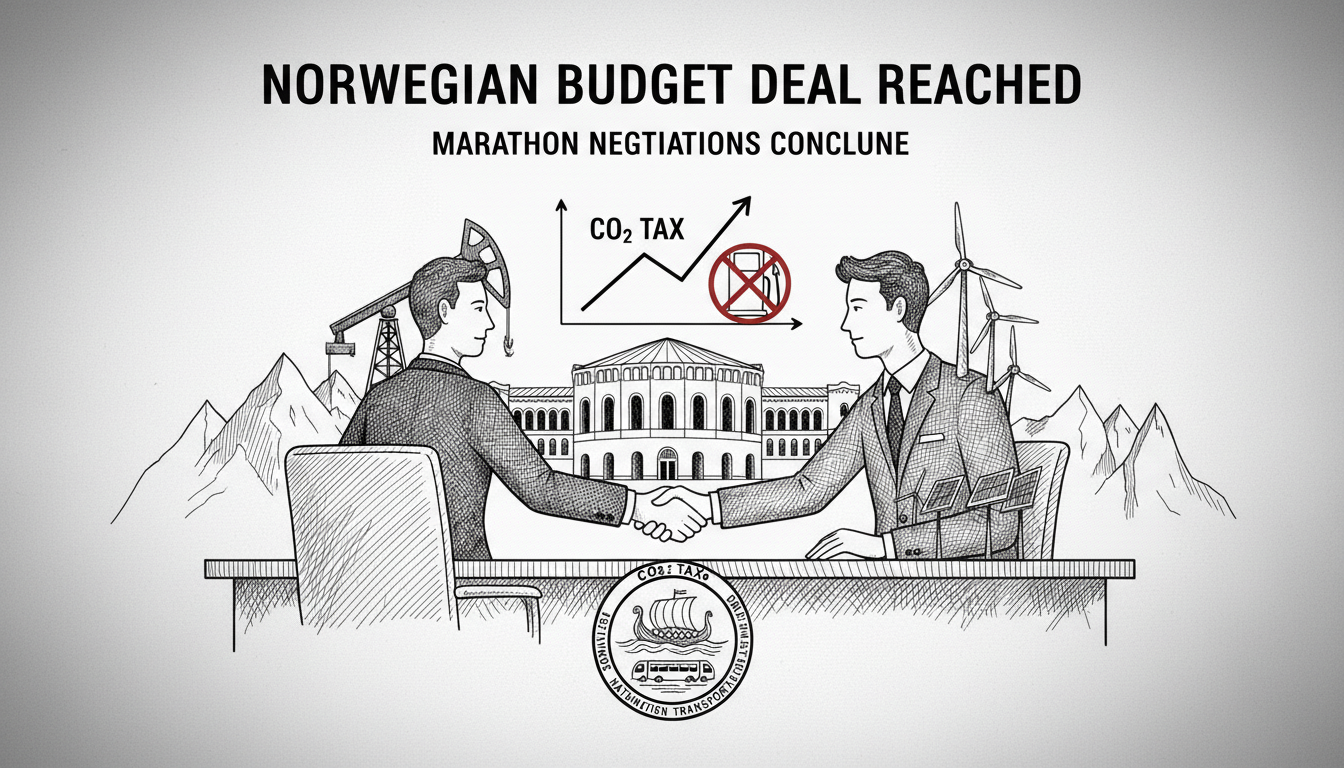
Norway's five-party coalition government reached a budget agreement in the early hours of Wednesday morning. The parties negotiated until 1:45 AM before announcing the deal. This agreement secures the parliamentary majority needed to pass the national budget later this week. The deal represents a complex balancing act between environmental ambitions and economic stability in a nation historically dependent on oil revenues.
The budget framework proposed by the Labour Party, Centre Party, and Red Party over the weekend remains intact. The government later secured support from the Socialist Left Party and the Green Party. This creates a unified five-party front for the crucial finance debate on Friday. The parliamentary leader for Labour, Tonje Brenna, confirmed the details in a press release. She stated that responsible spending and an unchanged withdrawal process from Norway's sovereign wealth fund were non-negotiable pillars for her party.
Environmental measures form a core part of the new agreement. The deal mandates a powerful push for climate initiatives. It includes plans to cut emissions and investigate a national price scheme for selling solar power. A significant expansion of protected forest areas is also part of the package. The government must present new measures to cut greenhouse gas emissions by May. The agreement also secures continued benefits for electric vehicle owners.
The Green Party hailed the budget as a major shift in Norwegian oil policy. Their finance spokesperson, Ingrid Liland, called it the start of the final chapter for the oil industry. The deal includes creating a commission to draft a strategy for the future of Norwegian oil. This commission will follow the model of Germany's coal phase-out commission. A key measure is an increased and escalating CO2 tax on offshore oil and gas production. This is designed to phase out the most polluting and least profitable oil fields earlier.
A major win for the Green Party is the introduction of a nationwide monthly public transport card from 2027. Starting next year, the card will be 100 kroner cheaper in counties that choose to participate. This 'Norway Card' aims to boost public transport use across the country.
In contrast, the Centre Party emphasized stability for traditional industries. Party leader Trygve Slagsvold Vedum stressed there would be no experiments with the oil fund or the oil and gas sector. He called these industries the backbone of the welfare state. The budget also cancels proposed increases to petrol and diesel taxes. Vedum argued that many Norwegians still rely on conventional cars for daily life. The agreement also continues policies like student loan forgiveness in rural districts and free ferry services for many island communities.
This budget negotiation highlights the ongoing tension in Norwegian politics. The nation is trying to transition its economy while maintaining the high living standards funded by fossil fuels. The final agreement is a patchwork of compromises. It offers something to environmentalists, rural communities, and industrial traditionalists. The real test will be in its implementation and its impact on Norway's long-term economic transformation.