
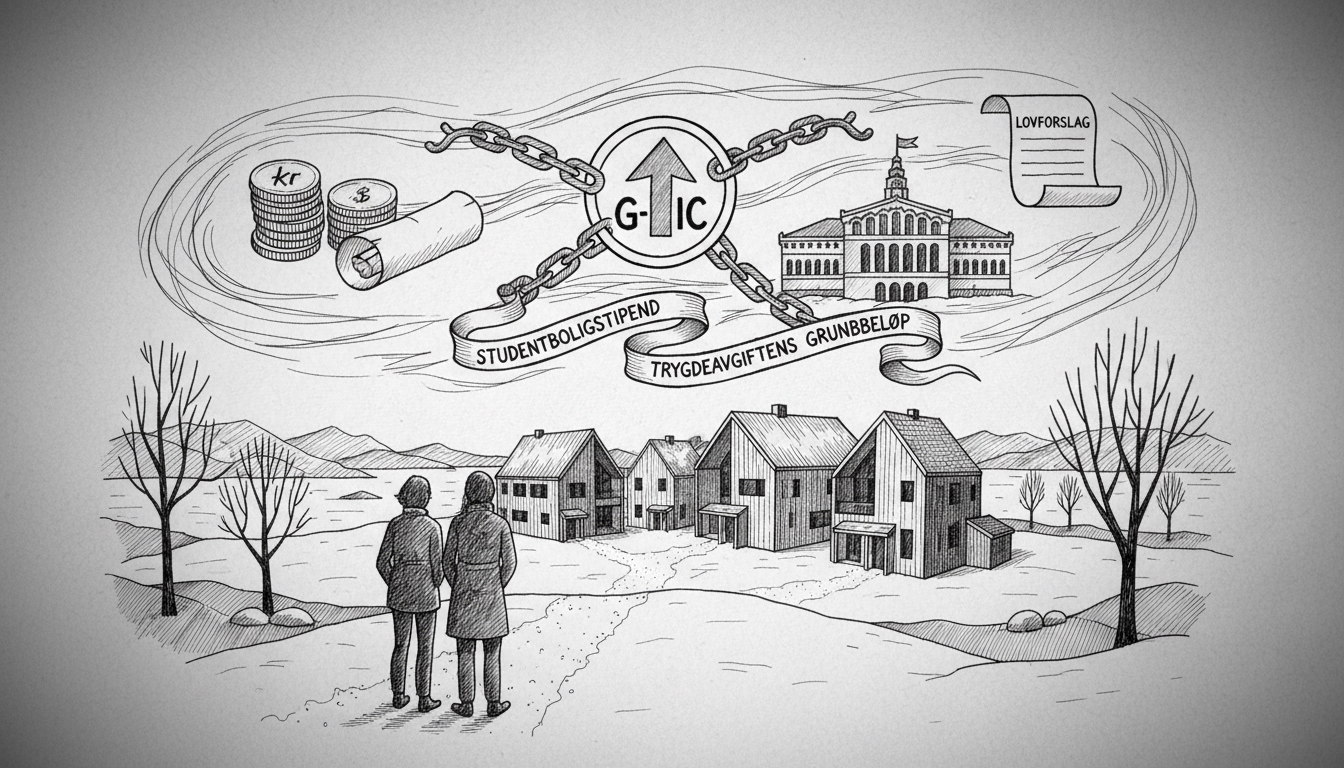
Norway's five-party red-green coalition government has reached a critical budget agreement. The deal directly ties the student housing stipend, known as the 'borteboerstipend', to the annual adjustment of the National Insurance Scheme's basic amount. This move aims to provide long-term financial predictability for students living away from home. The Storting has formally requested the government to present a legislative proposal to enact this change. The agreement explicitly states that future stipend rates cannot fall below current payment levels.
This policy shift represents a significant win for student unions and left-leaning parties. It institutionalizes a key welfare benefit by linking it to a central pillar of the Norwegian social safety net. The basic amount, or 'grunnbeløpet', is the foundational unit for calculating pensions, disability benefits, and other social security payments. Its value is adjusted annually by the Storting, typically in line with wage growth. By tethering the housing stipend to this mechanism, students gain protection against political whims and budget cuts. The stipend is crucial for enabling attendance at universities in cities like Oslo, Bergen, and Tromsø, where rental costs are high.
The decision carries clear political implications. It strengthens the coalition's credibility with younger voters and student demographics ahead of future electoral cycles. The agreement was finalized overnight, a common practice in Norwegian budget negotiations where parties often work late to reach a compromise. This outcome reflects the bargaining power of the Socialist Left Party and the Center Party within the coalition. Both parties have consistently pushed for stronger student welfare measures. The opposition Conservative Party and Progress Party have historically favored different models for student support, often emphasizing loans over grants. This new linkage creates a higher legislative hurdle for any future government seeking to reduce the stipend's value.
For international observers, this highlights the Norwegian consensus on education as a public good. The state actively invests in reducing barriers to higher education, viewing an educated populace as a national resource. This is particularly relevant for Norway's knowledge-based economy, which is gradually transitioning from its heavy reliance on oil and gas. The petroleum sector, centered on fields like Johan Sverdrup and Troll, still funds a substantial portion of the state budget. However, long-term economic strategy depends on innovation and skilled labor from universities. Securing student welfare is thus intertwined with broader national interests in the Arctic and global energy markets.
The practical effect will be a more automatic annual increase for the roughly 70,000 students who receive the stipend. It removes the need for yearly political battles over the specific rate. Students in expensive university towns will feel the most direct impact. The government must now draft the formal legislation for parliamentary consideration. This process will involve committee hearings and detailed scrutiny of the legal wording. The final law will define the exact formula linking the stipend to the basic amount. This Norwegian political news demonstrates how budget agreements can create lasting structural changes to social policy.