
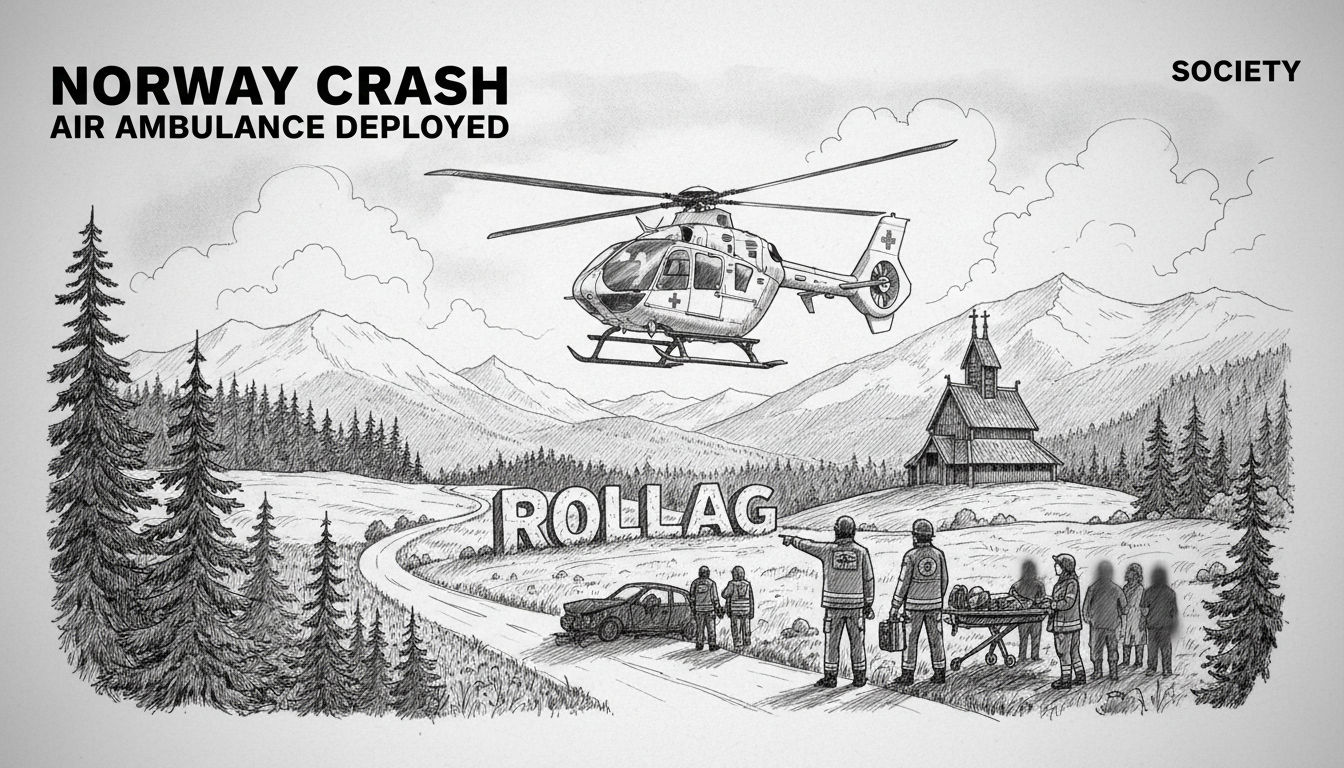
Norway's emergency services responded to a serious traffic accident on County Road 40 near Stærnes in Rollag municipality on Tuesday. A vehicle left the roadway, resulting in multiple casualties and prompting a major response. An air ambulance was dispatched to the scene, highlighting the critical role of rapid medical evacuation in Norway's rural regions.
"It is a car that has driven off the road and several people are involved," said Jan Kristian Johnsrud, operations manager for the South-East Police District. The police, fire service, and ambulance crews coordinated their efforts at the site. The fire department began directing traffic past the accident location on Fylkesvei 40, a vital transport link through Viken county.
The Critical Role of Air Ambulance in Rural Response
The immediate deployment of a Luftambulanse helicopter underscores a key component of Norway's emergency medical strategy. For municipalities like Rollag, which feature challenging terrain and distances from major trauma centers, air ambulances are often the difference between life and death. The service, which operates both helicopter and fixed-wing aircraft, can drastically reduce the time it takes to transport critically injured patients to specialized hospitals in Oslo or other urban hubs.
This incident brings into sharp focus the infrastructure supporting road safety in Norway's less populated areas. While the country boasts one of the world's lowest rates of road fatalities, accidents in rural districts present unique logistical challenges. The response protocol, which seamlessly integrates ground ambulances, police, fire services, and air assets, is tested in real-time during events like the Rollag crash.
A Vital Artery Disrupted
Fylkesvei 40 is not a minor local track; it is a significant county road that facilitates the movement of people and goods through the region. Any closure or major disruption causes immediate ripple effects, forcing detours and delaying commerce. The fire department's quick action to manage traffic flow was essential to mitigate these impacts, but even a well-managed incident can lead to hours of congestion on alternative routes.
The road's geometry, weather conditions common to the area, and driver behavior are all potential factors that traffic safety experts will examine. Norway has invested heavily in road safety engineering over decades, including improved guardrails, signage, and winter maintenance. Yet, the human element remains a persistent variable. The goal of reducing annual road fatalities to below 350 by 2030, from 117 in 2023, depends on continuous improvements in vehicle safety, infrastructure, and public awareness.
The Anatomy of an Emergency Response
When a call comes into Norway's emergency number, 112, it triggers a meticulously planned chain of command. Central dispatch operators assess the situation and deploy resources from the relevant agencies. In a serious traffic accident, the standard response includes police to secure the scene and investigate, fire and rescue to extract any trapped individuals and handle hazardous materials, and ground ambulances for initial medical care.
The decision to scramble an air ambulance is made based on the severity of injuries reported, the number of casualties, and the geographical location. The helicopter crew typically includes an anesthesiologist or a specially trained paramedic, effectively bringing an emergency room to the roadside. This capability is particularly crucial for injuries requiring neurosurgical or other highly specialized intervention available only in major cities.
The Human Cost and the Safety Mission
Behind the statistics and response protocols are individuals and families whose lives are altered in an instant. The mention of "several people involved" by the police operations manager signifies a community-impacting event. Rollag has a small population, and in such tight-knit municipalities, a traffic accident often resonates through the entire local society.
Norway's Vision Zero policy on road safety, which aims to eliminate all serious injuries and fatalities, frames these incidents not as inevitable accidents but as preventable system failures. Each serious crash prompts reviews by the Norwegian Public Roads Administration and the police to determine if road design, speed limits, or other factors contributed to the outcome. This systematic approach has driven Norway's progress, but as the Rollag incident shows, the work is never complete.
The presence of the air ambulance at the scene is a visible symbol of the nation's commitment to preserving life, regardless of where an incident occurs. It represents a significant financial investment by the state and health authorities to ensure equity in emergency medical care between urban and rural citizens. The effectiveness of this response will be measured in the hours and days following the crash, in the condition of those transported to hospital.
Looking Beyond the Crash Barrier
As traffic resumes its normal flow on Fylkesvei 40, the investigation into the cause of the crash will begin. Police will work to determine if speed, impairment, distraction, mechanical failure, or road conditions played a role. Their findings contribute to national data and inform future safety campaigns and infrastructure spending.
For the residents of Rollag and frequent users of County Road 40, the incident is a stark reminder of the risks inherent in daily travel. It reinforces the importance of Norway's stringent driving laws, including low blood-alcohol limits and vigorous enforcement of speed regulations, especially on winding rural roads that may not be engineered to modern safety standards.
The deployment of the Luftambulanse is a powerful testament to a society's values. It asks a fundamental question: What resources are we willing to commit to save a life in a remote location? Norway's consistent answer, demonstrated again on a road in Viken county, is to commit whatever is necessary. The ultimate success of that commitment, however, is judged not by the speed of the helicopter's response, but by the long-term outcomes for those it was sent to save, and by the relentless work to prevent others from ever needing it.