
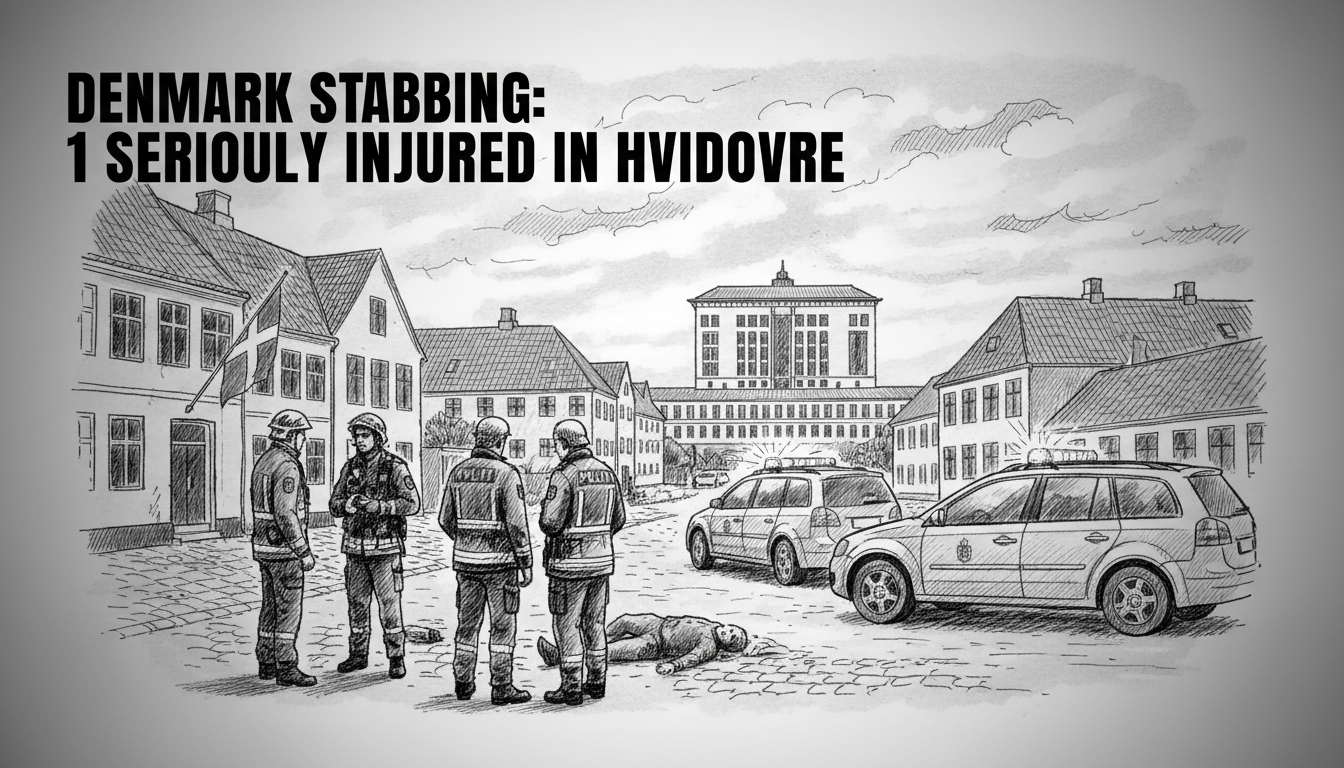
Denmark violent crime made headlines Friday evening as a person was seriously injured in a stabbing in Hvidovre. Police from Copenhagen Vestegns Politi descended on Gammel Køge Landevej 314B after the attack, which left the victim in critical condition. The major police presence on a key suburban road underscores the shock such incidents cause in a society where serious violence remains relatively rare.
I arrived at the scene as the blue lights of multiple patrol cars cast an eerie glow across the residential and commercial strip. The area was cordoned off, a jarring sight of police tape against the backdrop of an ordinary Copenhagen suburb. Neighbors gathered in hushed groups, their expressions a mix of fear and disbelief. This is not the kind of event that defines daily life here, but its occurrence sends ripples through the community and the wider Danish society news conversation.
A Suburb in Shock
Hvidovre, a municipality integrated into the greater Copenhagen area, is typically known for its hospital, its football club, and its quiet neighbourhoods. Gammel Køge Landevej is a bustling arterial road, lined with shops and apartments. The stabbing at number 314B disrupted that normalcy. Police have not released details about the victim or any potential suspects, stating only that the investigation is ongoing and appealing for witnesses. The term 'svært tilskadekommen'—seriously injured—used by authorities carries significant weight, indicating the gravity of the assault.
Local resident Anna Larsen, who lives a few blocks away, shared her reaction. "You hear about these things in other places, not here on your doorstep," she told me, her voice trembling slightly. "It makes you look at your own street differently. My children play outside. This is very frightening." Her sentiment reflects a common thread in Denmark social policy discussions: the profound impact of isolated violent acts on the public's sense of security, even in areas with low overall crime rates.
The Context of Violence in Danish Society
Statistically, Denmark enjoys low levels of violent crime compared to international averages. Data from the Danish Ministry of Justice shows that incidents of serious violence have remained stable in recent years, though public perception of safety can be sensitive to single, high-profile events. A stabbing in a suburban setting like Hvidovre challenges the common narrative and triggers immediate police and media focus. Copenhagen Vestegns Politi's large-scale response is standard protocol, aimed at securing evidence and reassuring the public.
Criminologist Professor Flemming Balvig, commenting on the nature of such crimes, notes that motives are crucial. "When a serious stabbing occurs, the immediate questions are about context," he explained in a previous analysis. "Was it a conflict between individuals who knew each other? A random act? Or linked to other criminal activity? The answer shapes not only the police investigation but the community's understanding and fear." The Denmark immigration policy and integration landscape often becomes a focal point in public discourse following violent crimes, especially if suspects or victims are from minority backgrounds, though no such details are available in this ongoing case.
Community and Police Response
The role of local institutions becomes paramount in the aftermath. Hvidovre Municipality, like others in Denmark, operates social services and community centers that can act as stabilizing forces. While police work to solve the crime, municipal social workers often engage in broader community support, addressing the unease that lingers after the police tape is gone. This dual approach—law enforcement and social care—is a hallmark of the Danish welfare system response to societal shocks.
A police spokesperson at the scene emphasized their commitment. "Our investigators are working diligently to establish the facts," the officer said. "We are following all leads and encourage anyone with information, no matter how small it may seem, to contact us." This appeal for public assistance is a key tool. In a closely-knit society, community cooperation with authorities is a significant factor in solving crimes and maintaining trust, a cornerstone of Copenhagen integration efforts and broader social cohesion.
Looking Beyond the Headline
As a reporter covering Danish society, I see stories like this through two lenses. First, there is the immediate human tragedy—a life altered by violence, a community shaken. Second, there is the longer-term conversation about safety, prevention, and social dynamics. Denmark's model is often scrutinized for its ability to handle social tensions and prevent violence. Incidents like the Hvidovre stabbing become case studies in that ongoing examination.
Does this event signal a worrying trend in Copenhagen crime? One incident does not make a pattern. However, it inevitably leads to public and political questions about resource allocation for police, the effectiveness of social prevention programs, and the underlying health of communities. These discussions are integral to Denmark's self-image as a safe, orderly society. The Danish welfare system is designed to mitigate the social marginalization that can fuel crime, yet its effectiveness is constantly tested.
The Path Forward for a Wounded Community
In the coming days, the focus in Hvidovre will slowly shift from the acute police response to a slower healing process. The victim's medical prognosis will become clearer. The police may announce an arrest, or the investigation may turn into a protracted search for answers. For the neighbors on Gammel Køge Landevej, normality will return gradually, but with a changed perspective.
The true test for any society is not whether crime occurs, but how it responds. Denmark's response is typically systematic: a thorough investigation, support for the affected, and a measured public discourse. The challenge is to address legitimate fears without succumbing to alarmism, and to seek justice without compromising the open, trusting nature of Danish community life. As the blue lights eventually fade from Gammel Køge Landevej, the work of understanding and mending this rupture in the social fabric continues, out of the headlines but close to the heart of what keeps a society secure.