
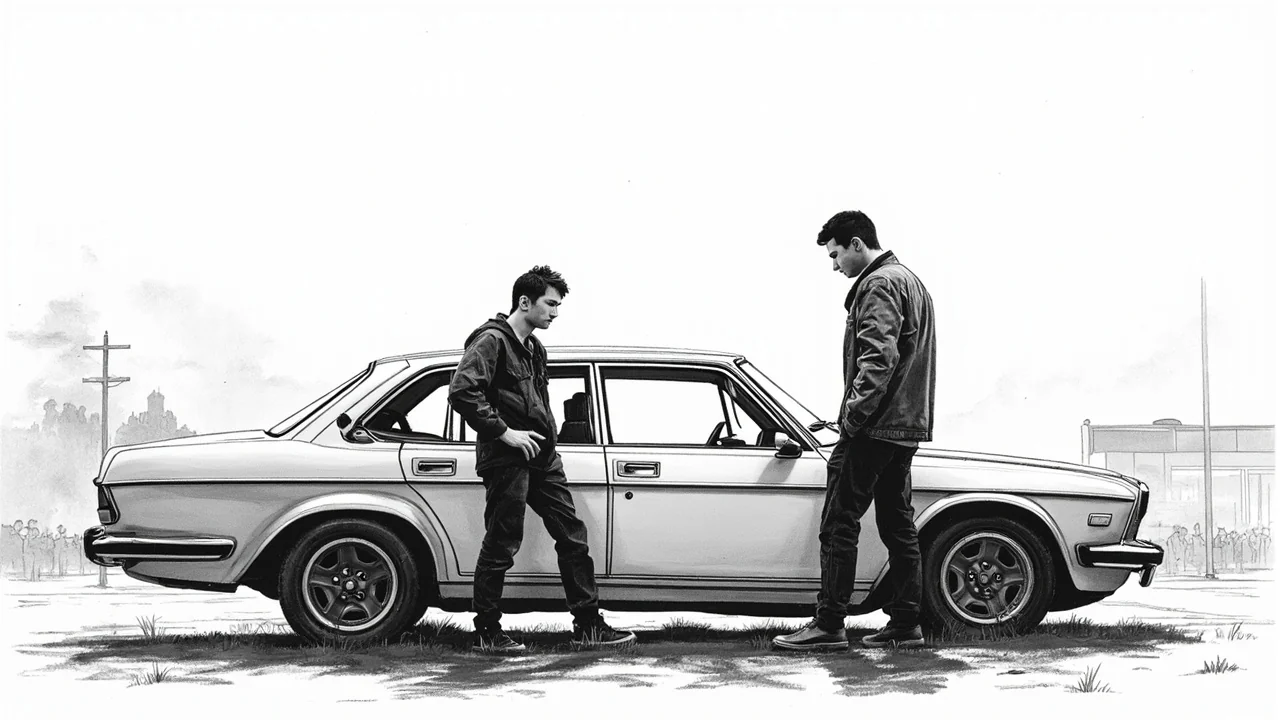
Norway’s road safety debate is now focusing on a radical proposal to raise the driving license age for young men. A vocational teacher’s suggestion that boys should wait until age 20 has ignited discussion on youth, risk, and traffic deaths.
Jarle Bruntveit has spent six years teaching transport and logistics at a high school in Haugesund. His daily work involves preparing students for careers as professional drivers. After seeing recurring patterns, he has reached a controversial conclusion. "The age limit for getting a driver's license should be raised to 20 years for boys," Bruntveit states. "They constantly expose themselves to danger."
His proposal is rooted in stark statistics from Norwegian authorities. A recent report from the Norwegian Public Roads Administration shows a significant gender gap in fatal accidents. Boys aged 16 to 24 are involved in fatal traffic accidents at a rate ten times higher than girls of the same age. Experts point to a lack of maturity and poor risk assessment as key factors.
A Teacher's Frontline Perspective
Bruntveit talks extensively about risk and traffic safety with his students, who aspire to become truck and haulage drivers. Despite this focused education, he witnesses a frustrating cycle. "Yet every year, there is at least one boy who loses his license right after he gets it," the teacher reveals. The losses happen after school hours, often related to speeding or reckless driving not connected to their professional training.
His suggestion is not about punishing all young men, he clarifies. It is a preventive measure based on observable biology and behavior. Brain development, specifically in areas governing impulse control and long-term consequence assessment, continues into the early twenties. Bruntveit believes the current system puts underdeveloped young men in control of powerful machines too soon.
Student Reactions: Frustration and Reflection
The proposal has received a chilly reception from its primary subjects: teenage boys approaching driving age. At a mandatory driver's education safety course called "The Risks of Car Driving," five 17-year-olds shared their views. None supported Bruntveit's idea, though some acknowledged the underlying reasoning.
"The proposal is strange," said one student. "But it might be true that boys take more risks." For many, a driver's license represents essential independence. Eskil Skogøy Wåge needs it to get to football practice and to drive friends on weekends. "I would have been really depressed if I had to wait until I was 20 to get my driver's license," he admitted.
The sense of unfairness was a common theme. Many argued for better education rather than blanket age restrictions. "It is unfair to punish all the boys because some boys have poorer impulse control than others," one argued. Another pointed to a double standard: "It must be equal between boys and girls. It would be completely wrong if girls could get a license when we are 18, while boys have to wait until they are 20."
The Gender Divide in Risk-Taking
The conversation extends beyond the driver's seat to social dynamics within the car. Young women often find themselves as passengers in cars driven by risky young male drivers. Emilia Sehic noted that her female friends sometimes feel afraid to speak up. "It is important that we girls dare to say something when the speed is too high," she stated.
Ida Holgersen Warvik shared a more positive experience, confirming that she has spoken up to male drivers driving carelessly. "I have said something, and it went fine," she reported. These anecdotes highlight the complex social pressures at play. The responsibility for safety is shared, but the statistical burden of causing accidents falls heavily on one group.
Driving school instructors see these dynamics daily. Arnt Fredheim, a driving school owner, begins his lessons with a focus on mindset. While not directly endorsing an age hike, he emphasizes that attitude is the first thing he assesses in a new student. The industry is caught between preparing responsible drivers and acknowledging the biological realities that teachers like Bruntveit emphasize.
The Search for Alternative Solutions
Raising the age limit is a simple, clear-cut policy solution, but its political and social feasibility is low. Critics argue it is discriminatory and fails to address the root causes of risky behavior. Alternatives center on enhanced training, technology, and graduated licensing systems.
Norway already has a mandatory safety course, as seen in Haugesund. Could it be expanded or made more impactful? Some suggest longer mandatory learner periods, stricter requirements for night driving or driving with peer passengers for new young drivers, or more psychological evaluation components. Technological solutions, like mandatory speed limiters or monitoring systems in cars driven by young people for their first years, are also discussed, though they raise privacy concerns.
The core of Bruntveit's argument is that education has limits against biology. You can tell a 17-year-old boy about the dangers of speeding, but his brain's reward system may still override that knowledge in a moment of impulse or social pressure. Proponents of his view ask whether society should structure rules to protect young people from their own underdeveloped neurology.
A Broader Cultural Question
This debate touches on deeper questions about maturity, responsibility, and gender in Norwegian society. At 18, Norwegians gain the right to vote, join the military, and enter into legal contracts. Denying them a driver's license while granting other adult privileges creates a confusing legal status. It also singles out one gender based on statistical propensity, a move that sits uncomfortably with principles of equality.
Is the solution to change the driver, or to change the environment? Road design, traffic calming in urban areas, and public transportation alternatives for rural youth are part of a broader systemic approach to safety. However, they do not eliminate the high fatality rate for young men on open roads.
Jarle Bruntveit knows his idea is unpopular. He is not a lawmaker, but an educator on the frontline. He sees the consequences of the current system in the faces of students who lose their licenses and in the national statistics. His proposal forces a difficult conversation. It asks whether Norway is willing to trade a symbol of youthful freedom for a measurable increase in safety, and whether that trade should apply only to its sons. As the data on fatalities continues to come in, the urgency of that question only grows.