
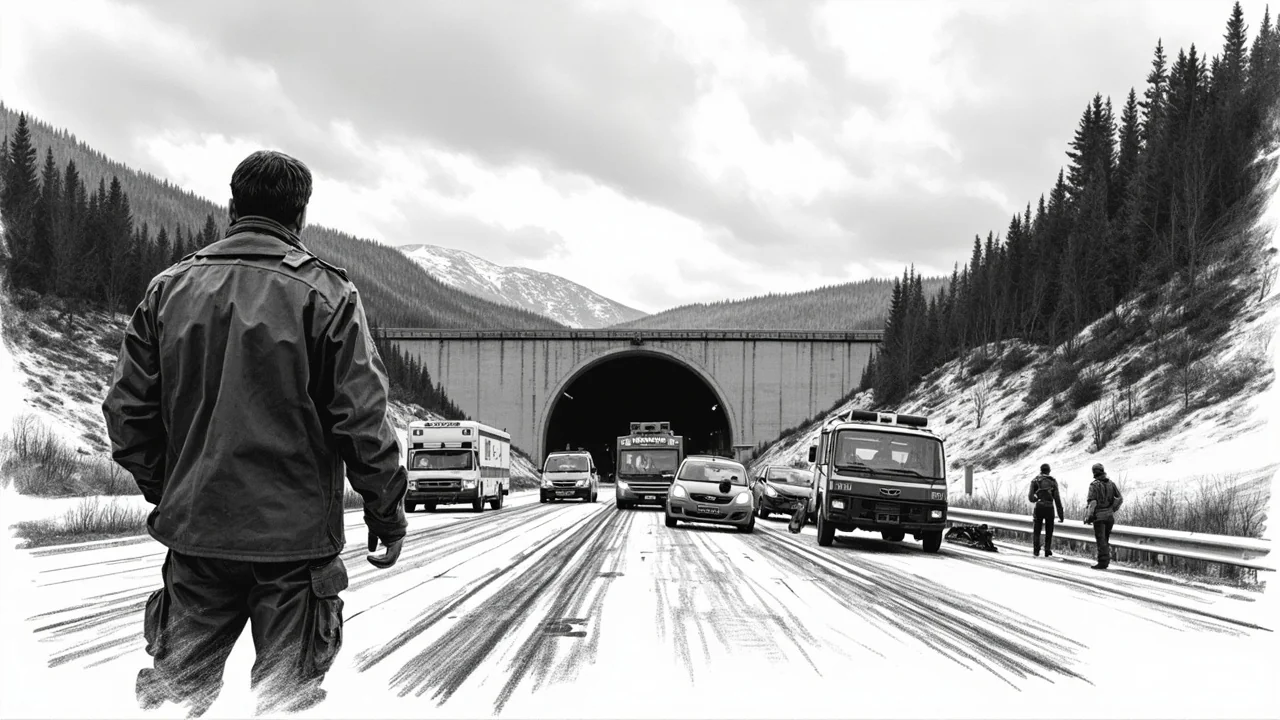
Norway's vital E18 motorway is completely closed near Tønsberg after two separate multi-vehicle crashes occurred within minutes in the same northbound lane. The accidents, combined with pre-scheduled maintenance that had already shut one tunnel bore, have created a total blockade of one of the country's busiest coastal arteries. Emergency services are on scene assessing injuries and attempting to clear wreckage, but police warn significant delays are inevitable.
Operations manager Espen Reite of the South-East Police District confirmed the situation in a statement. "We are working to get a recovery vehicle to the site so we can remove the passenger car that is blocking a lane," Reite said. "There is manual traffic control on site. Queues must be expected." The driver of the car blocking the lane is being checked by medical personnel. The second vehicle involved in the initial crash managed to get outside the tunnel.
A Cascade of Events on a Critical Corridor
The sequence began just before 1:00 PM local time with a collision involving up to eight vehicles in the northbound lane near the Hem Tunnel. Minutes later, a separate two-car crash occurred in the same stretch of road. One of those cars was rendered immobile, blocking a lane. This dual incident would be challenging under normal circumstances, but the E18 was already operating at reduced capacity. One bore of the tunnel complex was previously closed for planned maintenance, funneling all traffic into the remaining tube.
The two crashes inside this single operational tunnel bore created an insurmountable obstacle. With a disabled vehicle blocking a lane and emergency response requiring full access, police had no choice but to implement a full closure. This decision stops all traffic flow on a route critical for commuters, freight, and travel between Oslo and the southern coastal region.
The Strategic Importance of the E18
This is not a minor local road. The E18 is part of Norway's primary European road network, connecting the capital Oslo to Kristiansand and serving as a main link to the continent via ferries to Denmark. The stretch through Tønsberg in Vestfold county is a perennial bottleneck. It handles a dense mix of daily commuter traffic, heavy goods vehicles serving industry and ports, and tourist travel, especially during weekends and holidays.
Analysts point to this incident as a stark example of the vulnerability inherent in Norway's concentrated transport infrastructure. "Our main roads are like a chain; if one link breaks, the whole system seizes," said transportation analyst Henrik Larsen, who has studied Nordic traffic patterns for over a decade. "The E18 closure shows how scheduled maintenance, combined with an accident, can escalate from an inconvenience to a regional transport crisis. There are very few alternative routes that can handle the volume, and those will now be overloaded."
The economic impact of such a closure is immediate. Logistics companies face costly delays, commuters lose productive hours, and local businesses see disrupted supply chains. For a country that prides itself on efficient infrastructure, these events test the resilience of the network.
Emergency Response and Driver Frustration
On the ground, police and emergency crews face a complex task. Their priority is to ensure the safety of those involved in the crashes and provide necessary medical aid. Simultaneously, they must secure the scene for investigation and clear the wreckage as swiftly as safety allows. The call for a recovery vehicle indicates one car is too damaged to move under its own power, a process that takes time on a congested motorway, even when it is closed.
Manual traffic direction, as mentioned by police, is now in effect around the closure points. This involves officers redirecting the existing queue of vehicles off the motorway and onto local roads in Tønsberg, which are ill-equipped for sudden, high-volume diversions. Satellite navigation systems, used by most drivers, will likely direct thousands of vehicles onto the same small network of secondary roads, creating gridlock in the city center.
Drivers caught in the queue or planning journeys are advised by the Norwegian Public Roads Administration to seek real-time information via their traffic portals and to consider postponing non-essential travel. The typical advice during such major closures is to work from home if possible or expect journey times to multiply.
A Recurring Challenge for Norwegian Infrastructure
While this specific closure results from acute accidents, it highlights a chronic issue. Norway's geography, with its fjords, mountains, and limited flat land, forces major roads like the E18 through narrow corridors. Expanding capacity or building redundant parallel routes is often prohibitively expensive and environmentally challenging. Tunnels like the Hem Tunnel become critical single points of failure.
This incident will likely reignite debates about infrastructure investment and the scheduling of essential maintenance. Should more maintenance be done at night, at significantly higher cost, to minimize daytime disruption? Are current contingency plans for major road closures robust enough? The local municipality and the national road authority conduct periodic reviews of diversion routes, but their effectiveness is only proven during actual crises like this one.
For now, the focus remains on clearance and recovery. The duration of the closure remains uncertain, dependent on the extent of vehicle damage, the needs of any crash investigation, and how quickly the recovery operation can be completed. Even after the wreckage is cleared, the backlog of thousands of vehicles will take hours to dissipate. The ripple effects on regional travel will last long into the evening.
Looking Beyond the Immediate Crisis
Once the traffic finally begins to flow again, the questions will remain. This event serves as a real-time stress test. How well did the communication systems between police, road authorities, and traffic information services function? Were the diversion routes clearly signed and managed effectively? The answers will inform future planning.
For the average Norwegian, it is a reminder of the fragility of daily mobility. A few moments of inattention or adverse weather conditions on a key stretch of road can disrupt the lives of tens of thousands. It underscores the importance of driver vigilance, especially in tunnels and on roads under maintenance, where margins for error are slim. As the country continues to debate major new road and rail projects, the economic and social cost of today's shutdown will be part of the calculation. The true test of infrastructure is not how it performs on a good day, but how it withstands a bad one.