
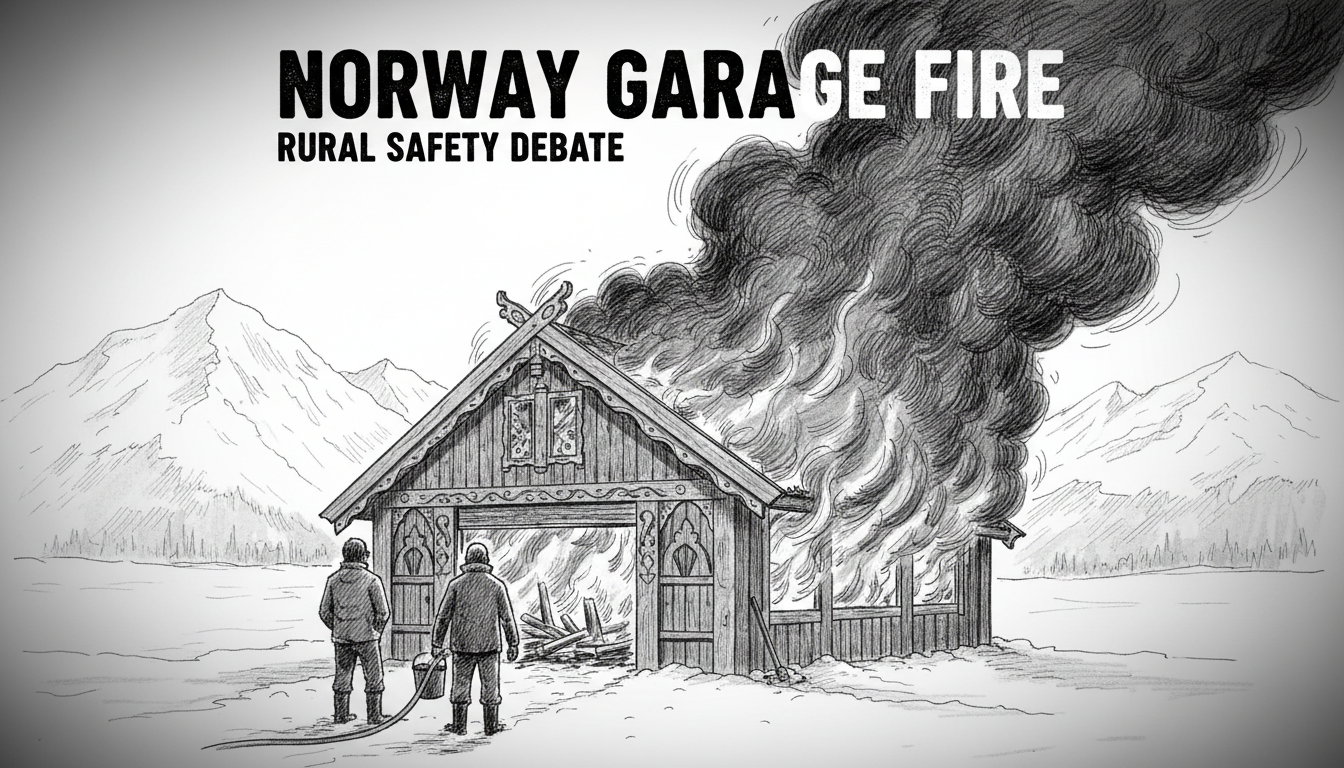
Norway fire services in Innlandet county responded to a garage blaze in Nord-Fron municipality on Wednesday, with initial reports warning of a risk of explosion. Emergency crews were dispatched to the scene in the Gudbrandsdalen valley, highlighting the persistent challenges of fire response in Norway's rural and mountainous regions.
Operational leader Pål Gjestvang from the police district confirmed the danger of spreading fire in his initial statement. The call came into emergency services just after midday, triggering a standard multi-agency response. Local volunteer fire brigades from the Nord-Fron area were first on the scene, supported by police and ambulance personnel. The garage, attached to a residential property on the outskirts of a small village, was fully engulfed upon their arrival.
A Race Against Time in the Valley
Firefighters faced immediate complications due to the building's construction and contents. Garages in rural Norway often store vehicles, fuel cans, propane cylinders for heating, and workshop materials—all significant fire loads. The potential for a gas cylinder explosion forced crews to establish a wide safety perimeter, evacuating neighboring homes as a precautionary measure. Thick, black smoke was visible for several kilometers across the valley floor.
"Our priority was containment and preventing spread to the main dwelling and nearby forest," a fireground commander later explained. The successful isolation of the fire to the single structure is being cited as a key operational success. No injuries were reported among residents or emergency responders, though the garage and its contents are considered a total loss. The cause of the fire is now under investigation by local police and fire authorities.
The Rural Response Challenge
This incident, while ultimately contained, underscores a systemic issue in Norwegian emergency preparedness. Nord-Fron, like many municipalities in Innlandet, covers a vast geographical area with a dispersed population. The county, formed in 2020 from the merger of Hedmark and Oppland, contains some of Norway's most remote settlements. Response times are inherently longer, and services often rely on a backbone of dedicated volunteer firefighters.
"Every minute counts in a fire, and in rural areas, those minutes are often consumed by travel," says Lars Holen, a fire safety consultant with expertise in Nordic building codes. "We have excellent, well-trained volunteers, but they may be coming from their workplaces or homes. The initial attack is crucial, especially when traditional wooden buildings are involved."
Gudbrandsdalen is famed for its historic wooden farms and stave church architecture, a heritage that also presents a vulnerability. Modern homes are built to strict codes, but older outbuildings, barns, and garages may not have the same level of fire retardation or detection systems.
Prevention and Preparedness in Focus
Fire safety experts point to two critical areas for improvement in rural districts: prevention and early detection. Simple measures like ensuring proper storage of flammable materials, regular checks on electrical systems in outbuildings, and installing heat or smoke alarms in garages and workshops can provide vital minutes.
"Most of these fires start small—an electrical fault, a spark from equipment," Holen notes. "An alarm that alerts the homeowner immediately can mean the difference between using a fire extinguisher and calling the fire brigade to a fully developed blaze." For remote properties, automated alarm systems that directly alert monitoring centers are increasingly recommended, though cost can be a barrier.
Municipalities also conduct regular community preparedness outreach. This includes educating residents on creating defensible space around properties, a concept more commonly associated with forest fire zones but applicable to any rural structure. Clearing dry vegetation and maintaining access for large emergency vehicles are simple yet effective steps.
The Volunteer Lifeline
The Norwegian model for rural fire service is heavily dependent on local commitment. In towns and cities, professional fire departments are standard. In districts like Nord-Fron, a core of professional staff is supplemented by on-call volunteers. These individuals undergo rigorous training but balance this duty with their primary careers and family lives.
Maintaining recruitment for these volunteer positions is an ongoing challenge for local councils. It requires a strong sense of community responsibility, a factor that remains high in valleys like Gudbrandsdalen but is not immune to broader societal shifts towards urbanization and busier personal schedules. Without these volunteers, the emergency response infrastructure in large parts of inland Norway would be unsustainable.
A Look at the Systemic Picture
Beyond the local response, this fire invites questions about national resource allocation and risk assessment. The Norwegian Directorate for Civil Protection (DSB) continuously maps risk and advises on preparedness. Their data clearly shows that while large-scale industrial or urban fires have greater economic cost, the individual risk of a destructive fire is spread across tens of thousands of rural properties.
Investment tends to follow concentrated populations and high-value assets. This creates a paradox where the risk per individual property might be higher in a remote area due to longer response times, but the total allocated resources are lower. It is a balancing act for policymakers, weighing the principle of equitable service provision against practical and financial constraints.
Some experts advocate for targeted national subsidy programs to help homeowners in vulnerable areas install modern detection and suppression systems. A small investment in prevention, they argue, can save millions in emergency response costs and priceless cultural heritage over time.
After the Smoke Clears
For the residents of Nord-Fron affected by Wednesday's fire, the immediate next steps involve insurance assessments and cleanup. The psychological impact of such a sudden, violent event at one's home, even confined to an outbuilding, should not be underestimated. The quick action of neighbors and the effective response of emergency crews, however, reinforce the community bonds that define life in the valley.
The investigation into the fire's origin will proceed methodically. Common causes include electrical faults in older wiring, spontaneous combustion of oil-soaked rags, or issues with heating appliances. The findings will be shared locally, serving as an inadvertent case study for prevention efforts.
This garage fire in Nord-Fron did not make national headlines. It was not a catastrophe. Yet, it serves as a perfect, quiet example of the daily risks managed by rural communities and the emergency services that support them. It highlights a system that works, but one that operates under constant strain, reliant on tradition, volunteerism, and the hope that prevention will offset the inherent vulnerabilities of distance and construction.
As Norway continues to debate the distribution of public services and the protection of its rural heartlands, the lessons from a burning garage in Gudbrandsdalen are worth considering. How does a modern society ensure equal safety for all its citizens, regardless of their postcode? The answer is forged not just in policy documents in Oslo, but in the training drills of volunteer firefighters and the preparedness of every homeowner with a workshop at the end of a long, forested drive.