
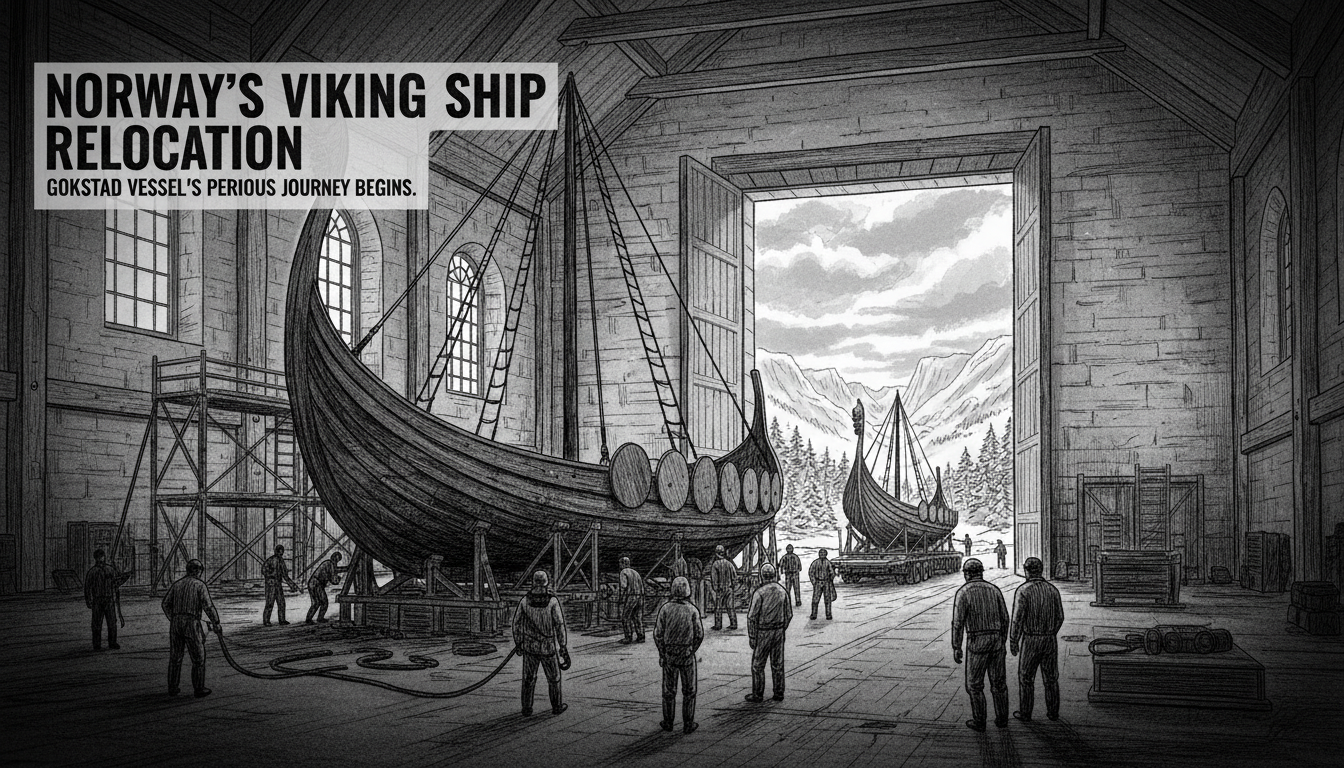
Norway's iconic Gokstad ship begins its carefully planned move to a new museum home this week. Museum director Aud V. Tønnessen confirmed the operation follows the successful transfer of the Oseberg ship last month.
The Gokstad vessel will travel from the old Viking Ship House to the new Museum of the Viking Age. Workers built a steel box around the ancient ship that will lift it via a custom crane system. The journey will proceed slowly toward its final destination.
Tønnessen acknowledged the inherent risks in moving such ancient, massive structures. "We have planned these operations for over ten years," she stated. "We are prepared to handle all types of scenarios that might occur during the process."
The Gokstad ship presents greater challenges than its predecessor. At 23 meters long, it's more fragile than the Oseberg ship. Conservator David Hauer explained the vessel will move at a slower pace as a result.
"Although the Gokstad ship weighs over a ton more than Oseberg, it has only half as many supports," Hauer said. "This means the supports carry much higher loads, and the ship tolerates less movement."
The ship's delicate condition dates back to its 1880 excavation. It was dismantled and reconstructed at Bygdøy, meaning it has never been moved in its current assembled state.
Hauer confirmed they anticipate potential damage during relocation. "We are prepared that damage might occur along the way, and then it must be repaired afterward," he said.
Built around 890 CE in Vestfold, the Gokstad ship represents Norway's largest discovered Viking vessel. It featured 16 oars on each side and space for up to 64 crew members.
Professor Jan Bill, an archaeology expert at the museum, noted the ship served as a burial vessel for a man in his 50s, likely a minor king of high status. Grave robbers during the Viking Age removed weapons and jewelry, but archaeologists found twelve horses, game boards, and two peacocks.
The new climate-controlled building stands wall-to-wall with the old structure. Its primary purpose involves preserving the ships' condition, which had been deteriorating in the previous facility.
The Tune ship will relocate in late May next year, followed by fragile Viking sleds. The museum will eventually display over 5,400 objects showcasing Norway's Viking heritage.
Museum officials plan to open the new institution in 2027. Tønnessen expressed excitement about creating "a world-leading museum and research institution with public attractions that provide unique insight into Viking life and society."
The Norwegian government has committed 35 million kroner to build the new Viking Age museum at Bygdøy. Danish firm AART architects won the architectural competition with their Naust proposal.
This ambitious relocation project demonstrates Norway's commitment to preserving its Viking heritage, though the fragility of these千年-old treasures makes every movement a calculated risk.