
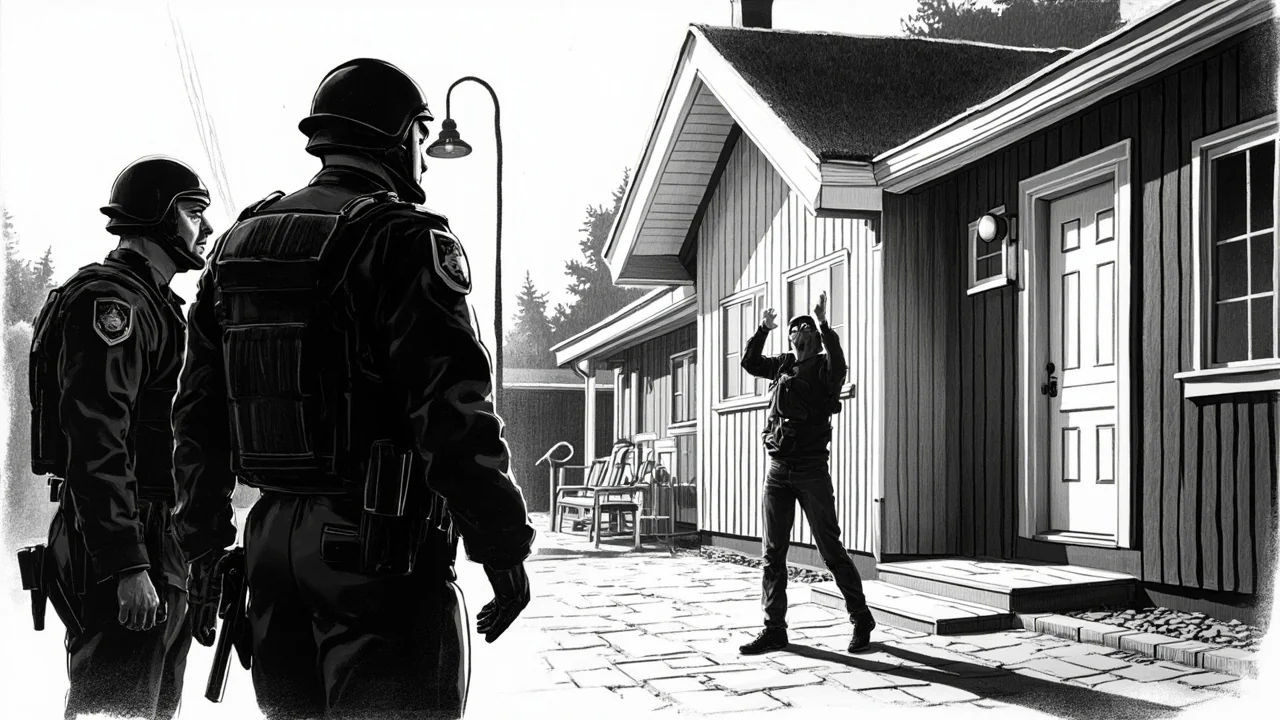
Norway's police oversight body has closed a case against officers who raided the wrong apartment last autumn. The Special Unit for Police Matters found no grounds to investigate claims that Nordland Police District personnel conducted an unlawful search. A citizen alleged police entered and searched a home they had moved out of without presenting a written court warrant. The unit's decision highlights the legal protections for officers acting on flawed intelligence, even when citizens face significant disruption.
A Search Based on Outdated Information
The incident occurred in Northern Norway's Nordland county. Police arrived at an address with a valid search warrant issued by a district court. The warrant named a suspect believed to reside at that location. However, the individual who filed the complaint had moved from the property. The officers, acting on the court-mandated address, proceeded with the search. The complainant stated police failed to present the written decision authorizing their entry, a potential procedural violation. The Special Unit's investigation focused on whether this rose to the level of criminal misconduct by the officers involved.
The Oversight Body's Rationale
In its assessment, the Special Unit for Police Matters obtained documentation confirming the search was court-ordered. "The search was conducted with a decision from the district court," the unit stated. Its central conclusion absolves the officers of blame for the core error. "The service personnel cannot be faulted for the address registered for the suspect in the case turning out to be wrong," the decision reads. This establishes a principle: police are not criminally liable for acting on incorrect official data. The unit acknowledged a possible procedural shortcoming but deemed it insufficient for charges. "Even though it may be unfortunate that the written decision was possibly not read aloud or presented, it is not considered a criminal service error."
The Legal Threshold for Police Accountability
This case turns on Norway's high bar for prosecuting police conduct. The Special Unit only pursues matters where there is a probable cause of criminal wrongdoing. Simple errors or procedural missteps do not automatically meet this threshold. Legal experts note the system prioritizes intent and gross negligence. "The oversight mechanism is designed to catch criminal abuse of power, not every operational mistake," says a professor of law at the University of Oslo, who requested anonymity due to ongoing research. "When courts issue warrants based on state registries, police are generally shielded if that data is old or wrong. The citizen's recourse typically lies in a civil claim for damages, not a criminal case against the officer."
A Systemic Challenge in a Digital Age
The incident points to a persistent issue in law enforcement: reliance on central population registries that are not always updated in real time. Norway's National Population Register is generally reliable but lags during moves, especially in transient populations. Police operations are planned using this data. When a suspect has recently relocated, raids on old addresses can and do occur. The frequency of such wrong-address raids is not publicly tracked, making systemic analysis difficult. This gap in data itself concerns transparency advocates. "We lack the metrics to know if this is a rare mistake or a symptom of a wider problem with registry reliance," the law professor adds.
The Citizen's Path to Redress
For the individual affected, the criminal complaint route is now closed. Their alternative is to file a claim for financial compensation through the Norwegian System of Compensation from the State. This process, separate from police discipline, assesses whether the state's actions caused undue harm or loss. Success depends on proving the search was conducted unlawfully or negligently. The oversight unit's finding that the warrant was valid complicates such a claim. The citizen's argument would hinge on the alleged failure to present the warrant, not the fact of entering the wrong home. This legal nuance often leaves affected parties feeling the system protects its own.
Balancing Operational Efficiency and Civil Liberties
Police authorities argue that requiring officers to independently verify registry information before every search would cripple operations. Speed is often critical in evidence preservation. The current framework assumes court-issued warrants are based on the best available information. From an operational perspective, the system worked as designed: a judge approved a warrant, and officers executed it. The error originated earlier in the chain, possibly with outdated registry data or the suspect's own failure to report a new address. Shifting accountability to the executing officers, the police argue, would create unacceptable risk aversion.
A Question of Trust and Procedure
The case's outcome may erode public trust, particularly in communities where police contact is already fraught. The perceived message is that police can enter the wrong home without individual accountability. The oversight unit's mention of the un-presented warrant is a minor critique in an otherwise exonerating decision. For the rule of law, the presentation of a warrant is a fundamental ritual. It demonstrates the authority is not arbitrary. Skipping this step, even with a valid warrant in hand, undermines this transparency. While not criminal, it is a failure of procedure that the unit itself labeled "unfortunate."
Looking Ahead: Policy Implications
This single case is unlikely to trigger policy change. For reform to happen, a pattern of similar incidents would need to be documented. The decentralized nature of police districts and the case-by-case work of the Special Unit make pattern identification challenging. Potential reforms could include requiring officers to make cursory checks for signs of current occupancy beyond registry data. Another proposal is a formalized, low-threshold compensation scheme for citizens subjected to wrong-address raids, acknowledging the disruption even if the warrant was valid. Neither proposal has significant political traction currently.
The closed case in Nordland serves as a stark lesson. It clarifies that in Norway's legal landscape, the justice system's need for operational efficacy often outweighs accountability for collateral intrusion. The officers involved will face no further scrutiny. The citizen whose home was entered must accept the intrusion as an unfortunate byproduct of law enforcement. The system has spoken, reinforcing where the balance of power and protection lies when official data fails. The ultimate question remains: in a society built on trust, how many such "unfortunate" errors can it absorb before that trust begins to fracture?