
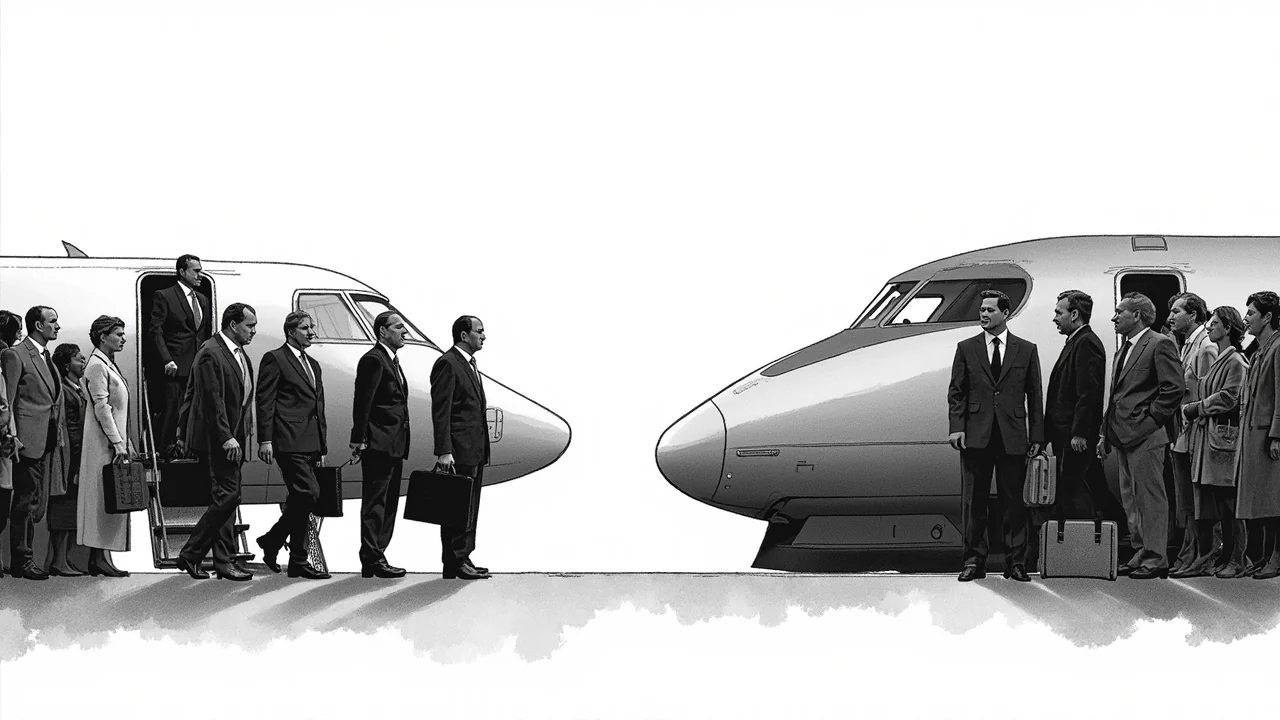
Norwegian politicians in Kristiansand have exempted themselves from strict climate travel rules imposed on municipal employees. The city council passed a policy mandating staff always prioritize trains for work trips, citing climate over cost and time. Council members, however, reserved the right to fly to attend political meetings, citing tight schedules.
This decision highlights a growing tension in Norwegian public life between ambitious climate goals and practical governance. It raises immediate questions about leadership by example and the feasibility of green transition policies when those who create them do not fully adopt them.
A Two-Tier Travel Policy
The Kristiansand city council's new directive is unambiguous for municipal staff. The rule states that employees must travel as climate-friendly as possible. Train travel is the mandated first priority for all work trips. The policy explicitly instructs staff to place greater weight on climate impact than on travel time or ticket price.
For the politicians who voted for this rule, a different standard applies. Council members can choose air travel when necessary to reach political meetings on time. This exception is framed as a practical necessity due to their packed schedules and the demands of political work across Norway's long geography.
The policy creates a clear hierarchy: one rule for the governed, another for the governors. It arrives as Norway pushes aggressive climate targets, including a national goal to cut emissions by 55% by 2030 compared to 1990 levels. Transport is a key sector in this effort.
Leadership and the 'Do As I Say' Problem
Political analysts see the Kristiansand case as symptomatic of a broader challenge. "When politicians create rules they themselves do not follow, it undermines public trust in both the policy and the political class," says Arne Holm, a political scientist at the University of Agder. "It feeds a narrative of elitism, where green sacrifices are for ordinary people, not decision-makers."
The contradiction is particularly sharp in Norway, a nation whose wealth is built on fossil fuels yet whose population largely supports strong climate action. The state-owned railway company, Vy, has seen record passenger numbers, but air travel remains deeply embedded in business and political culture, especially for routes along the coast where train connections can be slow.
For municipal employees in Kristiansand, the rule means potentially longer journeys. A train trip from Kristiansand to Oslo takes roughly four and a half hours. A flight takes about 50 minutes, plus airport transit. The council's policy orders staff to choose the former, regardless of the time cost.
The Practicality of Pure Principle
Council defenders argue the exception is not hypocrisy but pragmatism. Elected officials have a different set of constraints, with meetings often scheduled back-to-back in different cities. "The reality of political work sometimes requires efficient travel to fulfill our democratic duties," said one council member from the Conservative Party, who asked not to be named. "We are not against the train rule; we are for getting the work done."
This argument touches on a genuine logistical issue. Norway's political system involves numerous committee meetings, party gatherings, and consultations often held in Oslo. For a politician from Kristiansand, a day-trip by train for a two-hour meeting in the capital becomes virtually impossible.
However, critics counter that this very schedule is a choice. "Meetings could be scheduled with more consideration for travel time, or remote participation could be normalized," argues Lena Simonsen, a local Green Party politician who opposed the travel policy exception. "If we are serious about the climate crisis, we must change how we operate, not just how our employees vacation."
A National Pattern in Local Government
The Kristiansand controversy is not isolated. Similar debates have emerged in other Norwegian municipalities and at the national level. The Norwegian government's own official travel guidelines encourage, but do not mandate, train travel over flights for domestic trips. Ministers and high-level officials frequently fly between Oslo and other major cities like Bergen, Stavanger, and Tromsø.
This creates a trickle-down effect. If national leaders do not consistently choose rail, it becomes harder for local politicians to justify it to themselves, and harder still to enforce it on their staff. The mixed signals weaken the overall policy objective.
Furthermore, Norway's geography presents a real challenge. The rail network, while scenic and improving, does not serve all communities equally well. Coastal and northern regions rely heavily on air connections. A blanket ban on flights is not practical, but a clear, fair hierarchy is difficult to design.
The Employee Perspective and Workplace Morale
For the Kristiansand municipal staff now bound by the rule, the reaction is mixed. Some applaud the clear environmental stance. Others resent what they see as a double standard that will inconvenience them while their bosses avoid the same hassle.
"It's one thing to have a green policy," said a mid-level manager in the city's planning department, speaking anonymously. "It's another to see the people who made that policy not living by it. It feels less like a shared mission and more like a restriction only for some."
This impacts workplace morale and the perceived legitimacy of internal policies. Environmental policies are most effective when embraced as a collective value, not imposed as a one-sided mandate. The council's exception risks framing climate-friendly travel as a burden, not a benefit.
The Path Forward: Consistency or Exemption?
The Kristiansand case forces a difficult question: Should climate rules be absolute, or should they accommodate the realities of certain roles? A possible middle path involves stricter accounting and offsetting. Politicians who fly could be required to document why the train was not feasible and to purchase high-quality carbon offsets for their flights.
Another solution is technological. Investing in better video conferencing facilities could reduce the need for some travel altogether. Norway, with its high-tech economy and good broadband coverage, is well-positioned to lead in this area.
Ultimately, the debate is about integrity. Norway's climate commitments are among the world's most ambitious. Meeting them will require changes in behavior from every sector of society. Political leaders are crucial in modeling that change. When they create a separate category for themselves, they send a message that the rules are not truly urgent or universal.
As the country grapples with its oil-dependent economy and its green aspirations, these small, symbolic decisions matter. The sight of a politician on a train, working on a laptop, is a powerful signal. The sight of a politician creating a rule for others while avoiding it themselves is perhaps more powerful, and deeply damaging to the collective project of building a sustainable future.
The Kristiansand council may revisit its policy. The criticism has been swift and pointed in local media. For now, it stands as a case study in the gap between climate rhetoric and climate action, a gap measured in the kilometers between the train station and the airport.