
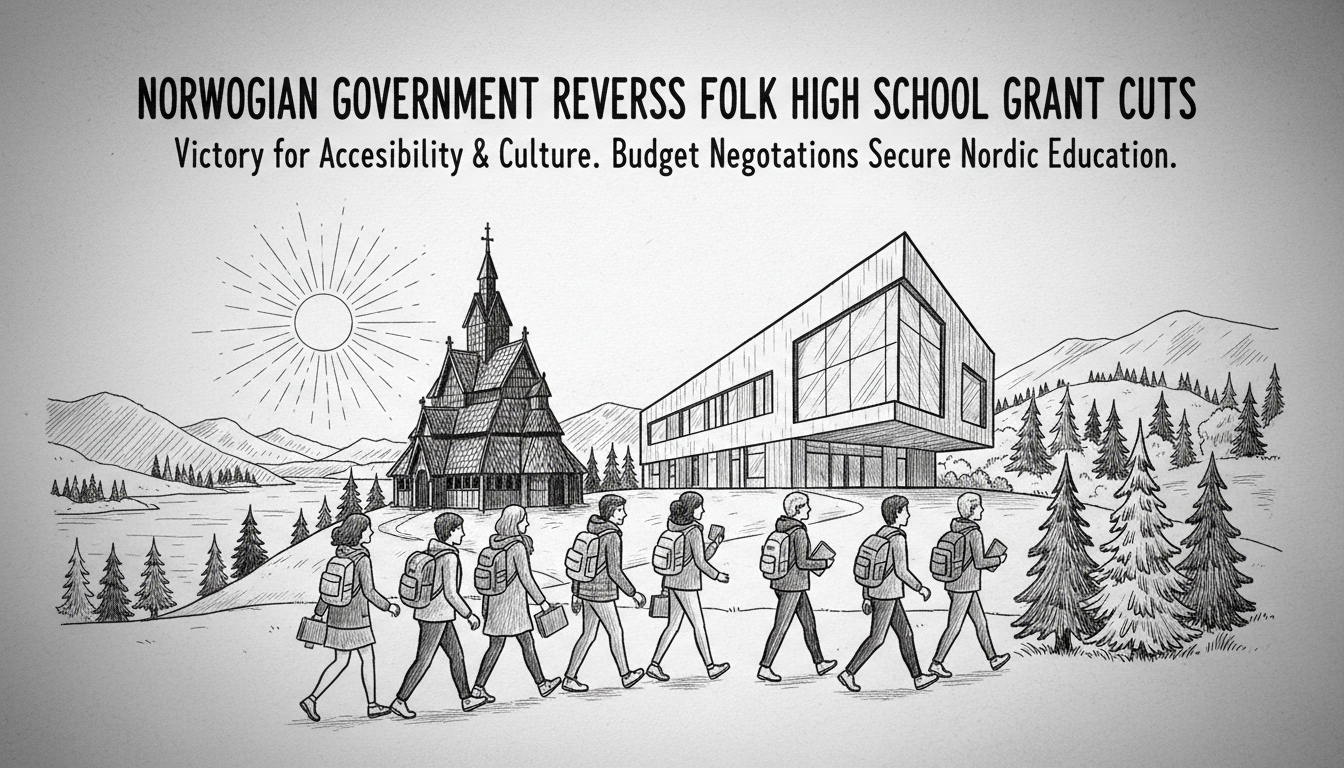
The Norwegian government has reversed its proposed cuts to student grants for folk high school attendees. This decision follows intense budget negotiations in the Storting, Norway's parliament. The original plan would have reduced the grant portion from the State Educational Loan Fund. Four opposition parties united to demand the reversal during budget talks. The final agreement preserves the current system where 40 percent of a student's loan converts to a non-repayable grant. This policy directly impacts thousands of young Norwegians each year.
Anne Tingelstad Wøien, head of the Norwegian Folk High School Council, welcomed the news. She said the outcome should be celebrated at every folk high school in the country. In a public statement, she called it a massive relief and a major victory. She emphasized that the decision protects accessibility for all students, regardless of economic background. The folk high school year can continue to focus on community, exploration, and the joy of learning, she noted.
The reversal resulted from pressure by the Socialist Left Party, the Centre Party, and the Red Party. These parties negotiated with the ruling Labour Party on the state budget. All three submitted alternative budget proposals rejecting the grant cut. The turbulent final week of negotiations ended with the government conceding. The opposition's coordinated stance proved effective in shifting the budget outcome.
This decision carries significant weight for Norwegian education and social policy. Folk high schools are a unique Nordic institution, deeply embedded in Norwegian culture. They offer a gap year focused on personal development, arts, sports, and specific subjects outside the traditional academic track. Schools are often located in scenic areas like the Sognefjord or near the Arctic coast. Their funding model is crucial for maintaining the principle of universal access, a cornerstone of the Nordic model.
The debate touches on broader questions about public spending priorities. The government initially framed the cut as a necessary fiscal measure. Critics argued it undermined a cherished educational tradition that promotes social cohesion. The successful pushback shows the political strength of cultural and educational institutions in Norway. It also highlights the fragility of budget agreements in a minority government scenario.
Looking ahead, the preserved funding ensures stability for the folk high school system. Administrators can now plan for the upcoming academic year without financial uncertainty for prospective students. The episode demonstrates how targeted political engagement can alter government policy. It serves as a reminder that budget proposals are often starting points for negotiation, not final decisions. The outcome reinforces the folk high school's role as a national institution open to all.