
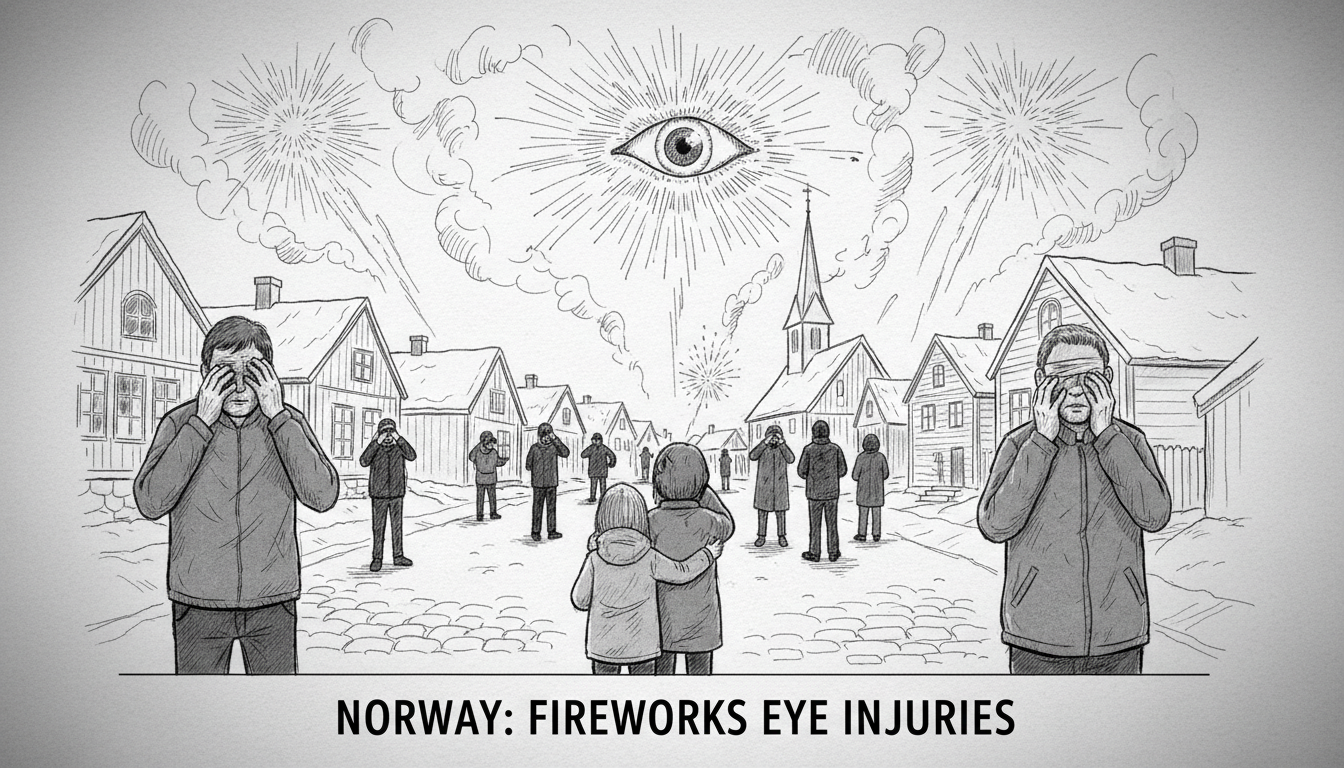
Norway's New Year's Eve celebrations have left 10 people with eye injuries, marking a concerning rebound in fireworks-related harm. Two of the victims suffered severe damage, and critically, none of the injured were wearing protective eyewear. The figures, compiled by ophthalmologist Lasse Mulstad Skrivervik at Haukeland University Hospital, signal a reversal from last year's historic low and re-ignite a fierce national debate about banning private pyrotechnics.
This year's total of 10 eye injuries is higher than the seven recorded last year. It aligns more closely with the figures from the 2022/23 and 2023/24 celebrations, which also saw 10 injuries. Since comprehensive national tracking began in 2005, fireworks have caused 301 eye injuries in Norway. 'Every single eye injury from fireworks is one too many,' Skrivervik stated unequivocally. His annual survey, conducted by contacting health institutions across the country on New Year's Day, provides a grim annual snapshot.
A Pattern of Preventable Harm
The profile of the injured follows a familiar, tragic pattern. Of the two most severe cases, one is a man and one a woman; the woman was a bystander. Alcohol was involved in these incidents. Alarmingly, one of the ten injured is a child under 10 years old who was also watching, not handling, fireworks. 'Most of the injuries happened from using multi-shot cake batteries,' Skrivervik explained. 'For some injuries, we don't have information on what type of firework it was.' In two cases, the injuries resulted from an exploding effect battery.
The data consistently shows that bystanders, including children, are at significant risk. This fact challenges the argument that injuries are solely the result of reckless behavior by the person lighting the fuse. A stray projectile or malfunctioning firework can instantly change a life. The absence of protective glasses across all cases underscores a persistent public safety communication failure. Despite annual warnings from health authorities and the Directorate for Civil Protection (DSB), the message fails to translate into widespread behavioral change.
The Regulatory Seesaw: Bans, Restrictions, and Tradition
Norway's relationship with private fireworks is complex, caught between a deep-seated tradition of celebratory independence and clear public health evidence. The current legal framework is a patchwork of restrictions. Private use is generally banned except on New Year's Eve, and certain powerful or erratic projectile types like stick rockets have been prohibited since 2009. That ban followed a peak in serious injuries in 2005 and is credited with a subsequent sharp decline in the most catastrophic cases.
However, the sale of legal fireworks—primarily fountains, volcanoes, and cake batteries—is a lucrative seasonal industry. Municipalities can grant permits for professional displays, but the right for individuals to create their own spectacle remains culturally significant for many. The debate intensifies every January when injury figures are released. Pro-ban advocates, led prominently by medical professionals, point to the preventable suffering and burden on emergency services. Opposition often centers on personal freedom, tradition, and the economic impact on retailers.
Skrivervik is among the most vocal proponents of a full ban. His position is not based on a single year's data but on the cumulative toll of two decades. 'Every eye injury from fireworks is one too many,' he reiterates, a simple statement that carries the weight of clinical experience. The medical community's argument is straightforward: no other consumer product that causes such predictable, severe trauma to users and uninvolved spectators would be tolerated.
Analyzing the Economic and Social Calculus
Beyond the immediate human cost, fireworks injuries impose a financial burden on Norway's public healthcare system. Treating a severe eye injury involving retinal detachment, corneal burns, or intraocular foreign bodies requires specialized surgery and long-term rehabilitation. The cost of a single case can run into hundreds of thousands of kroner. When multiplied by 301 incidents over 19 years, the total public expenditure is substantial.
Proponents of private fireworks often argue for personal responsibility. Yet, the involvement of alcohol in serious cases complicates this, as it impairs judgment and coordination. Furthermore, the risk to bystanders removes the element of choice; a child watching does not consent to that risk. Some municipalities have experimented with 'firework-free zones' or promoted community displays as a safer alternative. The success of these measures is mixed, as they rely on voluntary compliance and do not address the root availability of the products.
The seasonal nature of the injuries also strains hospital departments. Ophthalmology units must have staff on high alert during the holiday, ready for emergency surgeries that can mean the difference between sight and blindness. This pulls resources from other elective and emergency care. The argument from health administrators is that this annual surge is a predictable, and therefore preventable, drain on the system.
A Look at the Nordic Context
Norway's struggle is not unique in the Nordic region, but its regulatory approach sits in the middle of the spectrum. Denmark maintains relatively liberal rules, allowing private fireworks for several days around New Year's, resulting in comparable injury rates. Finland has stricter controls, and Sweden has effectively implemented a near-total ban for private citizens, permitting only minor novelty items. In Sweden, organized public displays are the norm, and serious fireworks injuries have plummeted.
This comparative policy landscape is often cited by Norwegian public health researchers. They ask why Norway cannot follow its neighbor's lead, given the similar cultural attitudes towards celebration and safety. The Swedish model demonstrates that a national tradition can evolve without losing its communal joy. The spectacle remains, but the risk is centralized and managed by professionals with proper safety protocols, insurance, and protective barriers.
The Political Path Forward
The issue periodically erupts in the Storting, Norway's parliament. Proposals for a full ban are typically introduced by the Socialist Left (SV) or Labour Party, but they have yet to gather a broad, sustained majority. The coalition governments of recent years, often involving the Conservative (Høyre) or Centre (Sp) parties, have been hesitant to impose what is framed as a 'nanny state' restriction. The Centre Party, with its strong rural base, often defends the tradition as a harmless celebration.
However, the consistent data from Haukeland and other hospitals creates steady pressure. Each severe injury to a child generates media coverage and public outrage, momentarily shifting the political calculus. The Directorate for Civil Protection continuously recommends caution and the use of protective gear, but stops short of advocating for a legislative ban, leaving that to elected officials. The question is whether the cumulative toll of 301 injuries—and the certainty of more next year—will eventually tip the balance.
As the fireworks debris is swept from Oslo's streets and other towns, the debate smolders on. For ophthalmologists like Lasse Mulstad Skrivervik, the new year begins with the same urgent message. The numbers from this year are not an anomaly but a return to a damaging norm. The solution, in his professional view, is clear. The political and public will to implement it remains the only missing component. As Norway looks ahead to 2026, the nation must decide if the bright flash of private fireworks is worth the permanent shadows it can cast.