
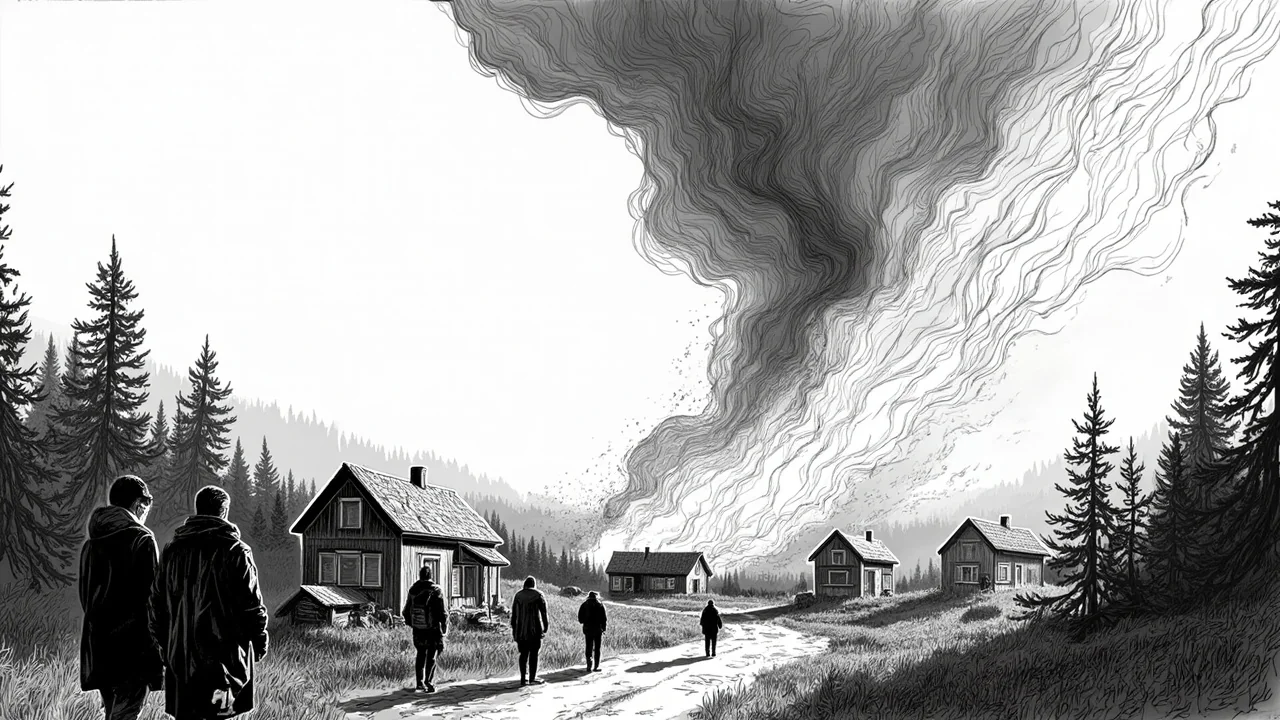
Norway's emergency services fought a fast-moving terrain fire on Askøy island near Bergen Sunday night. The blaze forced the immediate evacuation of over 100 residents and tested the response systems of a nation increasingly facing climate-driven wildfires.
Trond Thomassen was driving home to Askøy after a trip when he was stopped mere meters from his house. He received a blunt order: evacuate immediately. "It's chaotic," Thomassen said. "I don't know where it's burning. I can't see my house from here." His experience mirrored that of dozens of neighbors on the north side of Hanøyvegen road, who were told to leave as flames spread through dry heather and trees.
A Rapid and Complex Response
Emergency services were alerted to smoke and fire in the Hauglandshella area of Askøy just before 7 PM Sunday. Police quickly confirmed fires burning in three separate areas of rugged terrain. "The terrain it is burning in is challenging," said Stian Kvam, a watch leader at the 110 emergency center for the region. "It is dry in the terrain, and the fire jumps from heather to trees, which makes it a difficult area to gain control in. There is also wind, which is not good.
This assessment triggered the critical decision to evacuate. Police officers went door-to-door, informing residents they needed to be ready to leave if the wind shifted. The operation focused on buildings north of Hanøyvegen, near Storavatnet lake. Police operations leader Tore-Andre Brakstad noted the fire was on the north side of the lake on Hanøy. The priority was human safety over property.
Technology on the Front Lines
Facing limited visibility and a dangerous, spreading fire, responders deployed a key technological tool: an aerial drone. "We do not know how large an area is burning, but we are sending in a drone to get a better picture," Kvam explained during the response. This move highlights how Norwegian crisis management is integrating new technology. Drones provide real-time thermal imaging and mapping, allowing commanders to see fire fronts invisible from the ground and deploy resources more effectively.
The challenging geography of Askøy—a mix of steep slopes, forests, and scattered homes—makes traditional firefighting difficult. Ground crews faced a fire that hopped across dry vegetation, fueled by winds. The drone's overview was essential for understanding the blaze's true scale and direction, a common tactic now in Norway's evolving wildfire playbook.
The Climate Context
This incident is not an isolated event. It occurred amid a forecast for extreme weather that amplified the danger. The Norwegian Meteorological Institute predicted locally strong wind gusts of 27-30 meters per second from the southeast from Sunday night into Monday afternoon. A small to full storm was expected on the coast and mountains of Askøy. These conditions create a classic, dangerous scenario for wildfire spread: dry fuel, rugged terrain, and high, shifting winds.
Norway, like the rest of the Nordic region, is experiencing longer, drier summers that increase wildfire risk. While large forest fires have historically been more associated with countries like Sweden and Finland, southern and western Norway are seeing increased frequency and intensity. This shift is pushing municipalities to re-evaluate preparedness. The dry heather and peatlands in coastal areas can ignite easily and burn deeply, making them notoriously difficult to extinguish completely.
Community in Crisis and Return
For evacuees like Thomassen, the event was a sudden rupture of normal life. The uncertainty of not knowing the fire's location or the threat to one's home creates significant psychological stress. Emergency communications in such scenarios are critical. Authorities must balance providing urgent instructions with maintaining calm. The door-to-door approach by police, while labor-intensive, is often necessary in rural and island communities where digital alert systems may not reach everyone instantly or where specific, localized evacuation zones are required.
By 8:36 PM Sunday, a measure of relief arrived. Police announced there were no more open flames and that the fire department believed the situation was under control. The crucial order was given: evacuated residents could return to their homes. The swift containment prevented a potential catastrophe, especially given the forecasted storm-force winds that could have whipped any remaining embers into a new, more dangerous blaze.
Analysis: A System Tested
This fire, while ultimately contained, serves as a live test for Norway's emergency response to a growing threat. The integration of drone technology is a positive step, moving beyond reliance solely on ground observations and helicopter patrols, which can be limited by weather, cost, and time. The proactive evacuation, while disruptive, shows a precautionary principle in action—prioritizing life over the inconvenience of a false alarm.
However, it also exposes ongoing challenges. The "chaotic" feeling described by residents points to the inherent confusion of rapid-onset disasters. Communication in the initial phases is often fragmented. Furthermore, fighting terrain fires in Norway's landscape remains a brute-force, physically demanding task. There are limits to what technology can do when facing a wall of flame in dry, steep woodland.
Experts in Nordic crisis management often point to the need for increased public awareness. Residents in risk zones need to understand fire behavior, have personal evacuation plans, and heed official warnings immediately. The dry spring and early summer in parts of western Norway this year have left vegetation tinder-ready. This fire on Askøy is a stark reminder that the threat is real and present, not just a concern for the continental forests of the interior.
Looking Ahead
The Askøy blaze ended without loss of life or destroyed structures. It can be recorded as a successful, if alarming, response. But the question it raises is larger: Is Norway fully prepared for a wildfire season that mirrors the devastating ones seen in Sweden in 2018 or 2022? Resources, specialized equipment, and inter-agency coordination for large-scale wildfires are different from standard firefighting.
Investment in predictive modeling, more robust aerial firefighting capabilities, and community education programs will be vital. As the climate continues to shift, the events on a Sunday night near Bergen may transition from an incident to a recurring pattern. The technology used, from drones to advanced weather modeling, will be part of the solution. But the first line of defense will always be the prepared community and the rapid, decisive action of emergency responders who face the flames directly.