
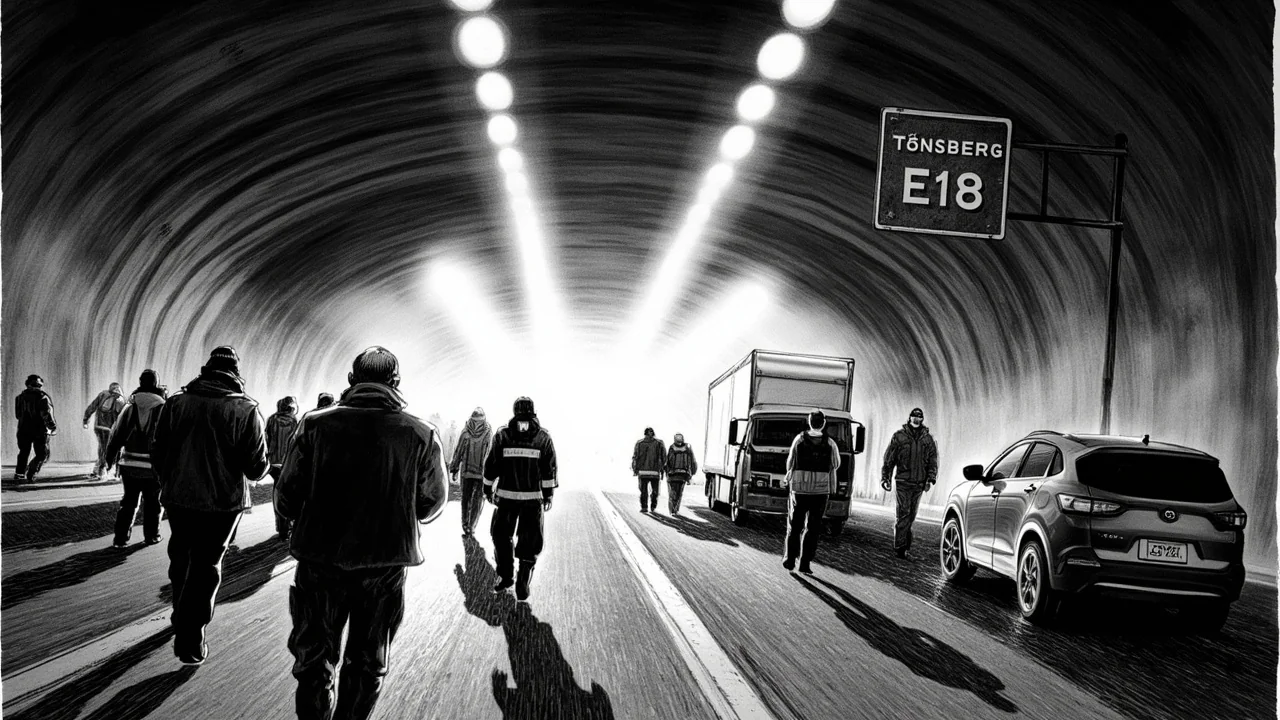
Norway's vital E18 motorway reopened to traffic at 2:27 PM on Tuesday after a chaotic closure caused by two separate crashes within the Hem Tunnel in Tønsberg. The incidents, involving up to ten vehicles, created a perfect storm of disruption. They coincided with pre-planned maintenance that had already reduced tunnel capacity. Emergency services first responded to a multi-vehicle collision involving up to eight cars just before 1:00 PM. A second crash between two cars occurred in the same tunnel approximately one hour later. The driver of a vehicle blocking one lane received medical attention at the scene. The successive accidents forced police to close the entire E18 section for over an hour, severing a critical transport artery on Norway's populous southeastern coast.
A Cascade of Collisions on a Critical Corridor
The Hem Tunnel, a 1.4-kilometer twin-bore passage under Tønsberg's urban area, forms part of the E18's backbone between Oslo and Kristiansand. Its strategic importance cannot be overstated for regional commuters and national freight. Tuesday's disruption began with the initial multi-vehicle pile-up, the precise cause of which remains under police investigation. Witness reports and initial police statements suggest a chain-reaction collision, a common hazard in tunnel environments where driver perception and reaction times are challenged. The closure of one tunnel bore for scheduled maintenance effectively halved the available road space, funneling all northbound and southbound traffic into a single tube. This created a high-density traffic environment where any incident would have immediate and severe consequences.
Emergency Response and Traffic Gridlock
Police, fire, and ambulance units from Tønsberg and surrounding Vestfold county mobilized swiftly to the first crash scene. Their primary tasks were to secure the area, treat the injured, and begin the complex process of clearing wreckage from the confined tunnel space. The driver requiring medical attention was assessed on-site; the severity of any injuries has not been publicly disclosed. While responders worked, traffic backing up from the tunnel entrance quickly spilled into Tønsberg's city streets. Navigation apps showed solid red lines along alternative routes like County Road 308, which became clogged with diverted vehicles. The Norwegian Public Roads Administration (Statens vegvesen) activated electronic warning signs miles in advance, but for many motorists, the delay was unavoidable. The second crash, occurring while the tunnel was still in a vulnerable state, compounded the crisis and forced the full closure.
Analyzing Norway's Tunnel Safety and Traffic Resilience
This incident highlights persistent challenges within Norway's extensive road tunnel network, the longest in the world. "When you combine high traffic volume, reduced capacity from maintenance, and an initial incident, you have a textbook scenario for major disruption," said Lars Engebretsen, a traffic safety researcher at the Institute of Transport Economics (TØI). "Tunnels are safe, but they are unforgiving environments. A minor fender-bender can escalate quickly, and escape routes are limited." The Hem Tunnel, opened in 1994, meets modern safety standards with ventilation, lighting, and emergency exits. However, experts note that driver behavior remains the most variable factor. The psychological pressure of tunnel driving, coupled with potential distractions or insufficient following distance, often underpins these multi-vehicle events. The Tønsberg episode will likely renew discussions about dynamic speed limits in tunnel approaches and enhanced incident detection technology.
The Economic and Logistical Ripple Effect
Beyond commuter frustration, an E18 closure carries measurable economic weight. The corridor is a lifeline for the transport of goods to and from the ports of Tønsberg, Larvik, and the greater Vestfold region. Hour-long delays disrupt just-in-time logistics for industry and perishable goods transport. While a single incident has a contained impact, it exposes the vulnerability of a transport network with limited redundancy. "Our highway system, particularly in the densely populated southeast, has few true alternatives," noted business analyst Marius Thorenfeldt. "When the E18 or E6 stops, so does a significant portion of regional economic activity. This isn't just about traffic; it's about supply chain reliability." The incident occurred outside peak holiday travel periods, averting a potential tourism sector impact. During summer, such a closure could strand thousands of families heading to coastal holiday homes.
Policy Implications for Future Infrastructure Projects
For policymakers in Oslo and local planners in Vestfold, this disruption serves as a real-time stress test. It underscores arguments for continued investment in road network resilience. Planned projects, like the proposed double-deck solution for the E18 through Tønsberg or the long-discussed coastal highway (Kystriksveien), aim to add capacity and redundancy. Critics argue that simply building more roads induces more traffic. Proponents counter that strategic upgrades at critical choke points, like urban tunnels, are essential for national security and economic stability. The Storting's ongoing debates over the National Transport Plan will inevitably reference these recurring disruption events. The balance between maintenance schedules, which are unavoidable for safety, and traffic flow management is a constant engineering and political challenge.
A Return to Normalcy with Unanswered Questions
By mid-afternoon, traffic flow had normalized, and the maintenance work in the one tunnel bore resumed. Clean-up crews cleared the final debris, and the digital traffic signs switched from red warnings to standard speed limits. For the drivers involved, the day ended with insurance claims and repair schedules. For the authorities, the work begins on a detailed collision report. Key questions remain: Was the maintenance signage adequate? Did traffic volumes exceed safe thresholds for the single open bore? Could variable message signs have been used more effectively to warn of stopped traffic ahead? The answers will inform future operations. The Hem Tunnel incidents, while resolved in a few hours, reveal the fragile equilibrium of Norway's modern transport infrastructure. As the country continues to rely on its intricate network of tunnels and mountain passes, managing the human factor within these engineered environments remains the paramount, and most difficult, task.