
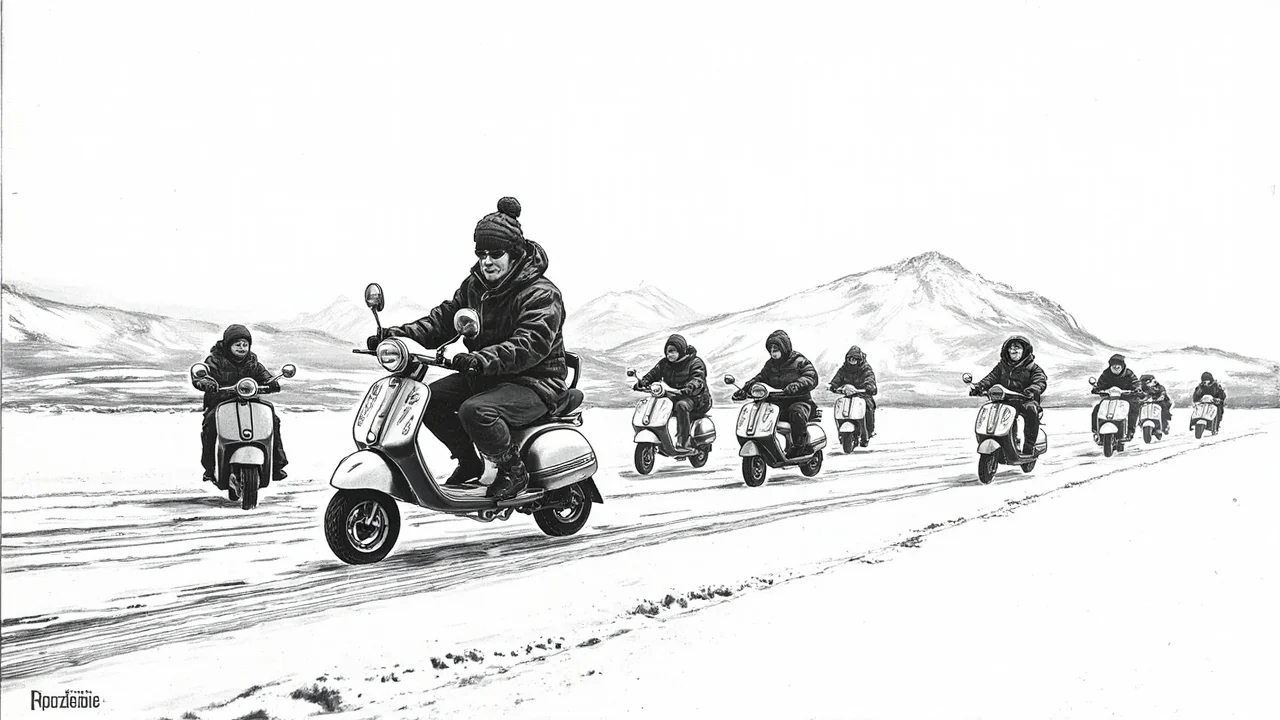
Norway's capital Oslo faces a new winter safety dilemma as e-scooters remain on snow-covered streets without mandatory studded tires. The city's Labour Party demands immediate action, calling the current situation "potentially lethal" for riders and pedestrians alike.
"It is fundamentally life-threatening to ride around on an e-scooter without studded tires," said Abdullah Alsabeehg, a representative from Oslo Arbeiderparti. "The companies must be required to document functioning winter tires if they are to be available for use."
Alsabeehg's warning comes as Oslo experiences its first significant snowfall of the season. The Labour Party has formally requested that the city council implement emergency measures, arguing that commercial operators must take responsibility for winter safety. Beyond rider injuries, Alsabeehg highlights broader urban consequences: obstructed snow clearing, blocked sidewalks for baby strollers, and accessibility issues for wheelchair users.
A Clash of Regulatory Philosophies
Haakon Riekeles, Oslo's City Councilor for Environment and Transport, presents a contrasting regulatory approach. In an email statement, Riekeles argued that politicians shouldn't micromanage equipment specifications like tire types.
"The municipality sets overarching and strict safety requirements that apply year-round," Riekeles wrote. "Operators must consider weather and road conditions and ensure equipment is in order. Users of e-scooters must assess conditions and grip, like other road users."
This philosophical divide represents a classic Norwegian regulatory tension: specific prescriptive rules versus broader performance-based requirements. Riekeles maintains that existing enforcement mechanisms already address improper parking that hinders snow removal, stating that the city's environmental agency fines illegal parking and maintains dialogue with rental companies.
Industry Response and Safety Calculations
Three major operators serve Oslo's market: Bolt, Voi, and Ryde. Jonas Skøld, Operations Manager for Voi Norway, emphasized that rider safety remains their "super important" priority, with continuous weather monitoring determining when to remove fleets entirely.
Regarding studded tires specifically, Voi presents a counterintuitive safety argument. "We have equipped our e-scooters with all-season tires," Skøld explained. "Snow disappears faster where e-scooters are meant to be used, and studded tires on dry asphalt are not good."
The company suggests studded tires might create "a false sense of security" on surfaces that frequently transition between snow, ice, and bare pavement in urban environments. This stance reflects a broader Scandinavian debate about winter tire efficacy, where studded tires excel on ice but perform poorly on dry roads and contribute to particulate pollution from road wear.
The Urban Management Challenge
Beyond the tire debate lies a more practical municipal headache: snow clearance. Alsabeehg argues that improperly parked scooters create physical barriers for snowplows, delaying essential winter maintenance across neighborhoods like Frogner, Grünerløkka, and Majorstuen.
"If companies accept that e-scooters are left in the middle of streets, the companies should be fined—it's illegal parking," Alsabeehg stated. "Clearing the streets is not people's responsibility; it's the companies' responsibility."
Voi disputes this characterization of the problem. Skøld claims their designated parking zones are coordinated with municipal snow-clearing routes. "Parking zones are not where they plow," he said. "It's in our interest to get rid of the snow so that..."—implying that operational continuity benefits both the company and the city.
This coordination claim, however, depends on perfect user compliance with parking rules, a persistent challenge for shared mobility systems worldwide.
The Norwegian Context: Liability and 'Ansvar'
The debate touches deep cultural values around responsibility, or "ansvar," in Norwegian society. Norway's strict liability rules in traffic law place significant responsibility on vehicle operators to ensure safe operation according to conditions. The question becomes how this principle applies to rental companies providing vehicles versus individual users making trip-by-trip decisions.
Unlike private car owners who must fit winter tires by law between specific dates in much of Norway, shared vehicles operate in a regulatory gray area. The current framework places the onus on users to assess whether a particular scooter is appropriate for conditions—a system critics say is unrealistic during quick, app-based rentals.
Looking North: Arctic Precedents
Other northern Norwegian cities with longer, harsher winters have already implemented stricter regulations. Tromsø, located 350 kilometers north of the Arctic Circle, has historically imposed seasonal bans or strict operational requirements on e-scooter companies during winter months. The experience in these cities suggests that purely voluntary measures by operators often prove insufficient when icy conditions persist for weeks.
Oslo's milder but more variable coastal winter—with frequent freeze-thaw cycles—presents a different challenge where conditions can change hourly, complicating any simple seasonal rule.
The Path Forward: Regulation or Innovation?
The Labour Party's demand for documented winter tires suggests a move toward more equipment-specific regulation, similar to requirements for other vehicles. This could involve certifying certain tire types or mandating traction performance standards during municipal licensing processes.
Technological solutions might also emerge. Some mobility companies in other countries are testing automatic speed reduction in icy conditions or app features that warn users about poor road grip. However, these systems require accurate, hyperlocal weather data and reliable surface condition detection—significant technical hurdles.
Riekeles's position suggests the city may prefer strengthening existing broad safety requirements and enforcement rather than mandating specific technologies. This could mean higher penalties for companies whose improperly parked vehicles obstruct snow clearance or more aggressive fleet reduction mandates during severe weather warnings.
A Microcosm of Larger Urban Transitions
This winter safety debate represents a microcosm of Oslo's larger struggle to integrate new mobility forms into its urban fabric. The city has ambitious goals to reduce car traffic and emissions, with e-scooters theoretically offering a last-mile solution for public transport users. Yet their winter operation exposes friction points between innovation, safety, and traditional municipal service delivery.
The outcome will signal how Norway balances its reputation for technological adoption with its equally strong commitment to safety and orderly urban management. As snowfall continues in neighborhoods from Ekeberg to Holmenkollen, Oslo's residents, politicians, and scooter companies are all watching—and waiting for the other to slip up first.
Will Norwegian regulators impose specific winter equipment rules on shared mobility, or will they trust companies and users to navigate icy conditions under broader safety principles? The answer may determine whether e-scooters become a year-round transport option or remain fair-weather gadgets in Scandinavia's challenging climate.