
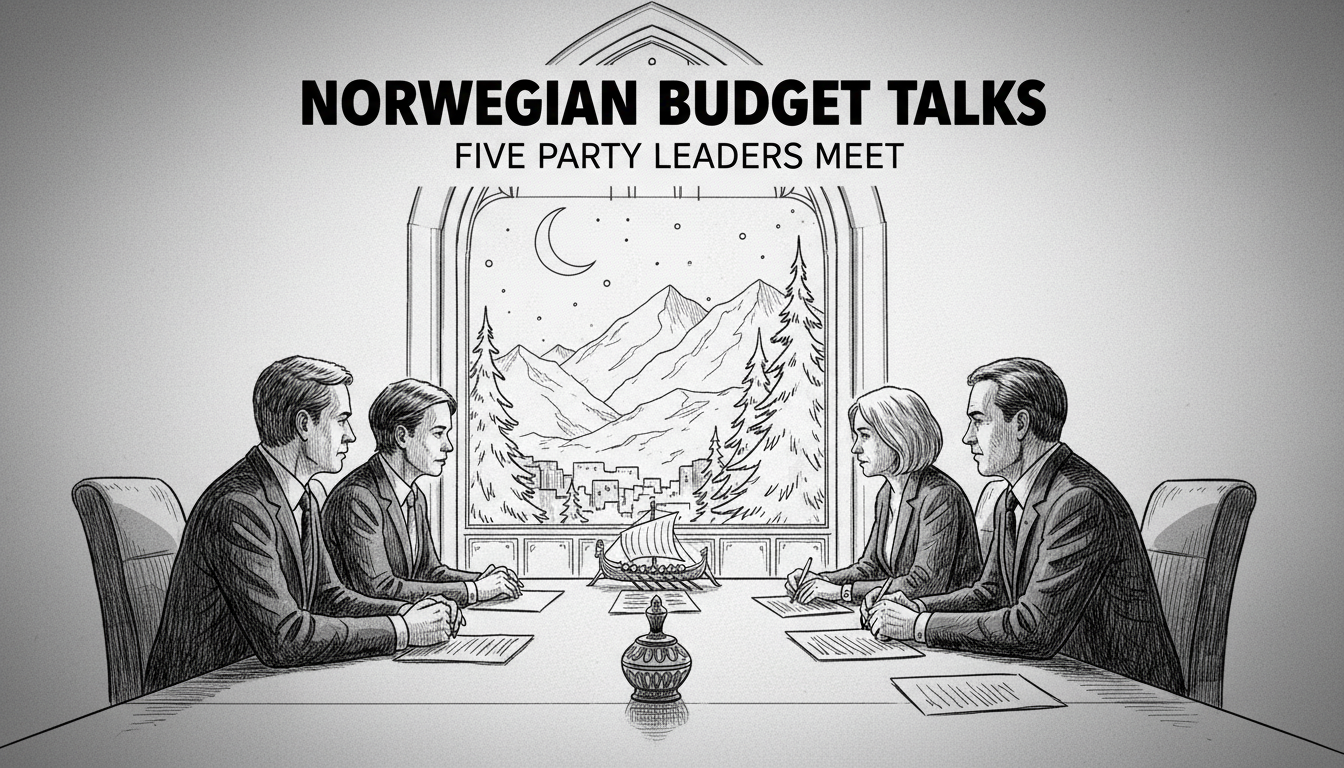
The leaders of five Norwegian political parties gathered late Tuesday night in Oslo. They met at the Storting office of Labor Party politician Tonje Brenna. The meeting aimed to break a deadlock over the national budget. The Labor Party, the Center Party, and the Red Party have already agreed on a budget framework. This trio lacks a parliamentary majority without support from the Socialist Left Party and the Green Party.
Red Party leader Marie Sneve Martinussen spoke to reporters outside the building. She said her goal was to secure a majority for the existing agreement. 'I was asked to come here to discuss how we can reach a landing. The Red Party's goal is to get a majority for the deal we have with the Labor Party and the Center Party. All five must contribute for us to reach a landing,' Martinussen stated. The phrase 'reach a landing' is a common Norwegian political term for concluding difficult negotiations.
Green Party leader Arild Hermstad emphasized climate policy as his non-negotiable priority. 'For our part, it has always been important to make breakthroughs on climate,' he said. Socialist Left Party leader Kirsti Bergstø was cautiously optimistic before entering the talks. 'Now we will go in and talk together, and I hope it will be a good conversation. Will there be an agreement tonight? Time will tell. We have some things that must be put in place,' Bergstø remarked. The discussions are critical for the stability of the current minority government coalition.
These negotiations directly impact Norway's economic direction and its vast sovereign wealth fund. The budget will set spending priorities for the coming fiscal year. It will influence everything from public services in cities like Bergen and Tromsø to investments in the Arctic region. The talks also determine funding for key national industries. Norway's oil and gas sector, centered on fields like Johan Sverdrup in the North Sea, is a constant focus. So is the growing maritime sector operating from fjords like the Sognefjord. Political consensus is needed to manage these resources and the transition to greener energy.
The current situation highlights the complexities of Norway's proportional representation system. No single party holds a majority in the 169-seat Storting. Governments must build fragile alliances across the political spectrum. This often leads to marathon negotiation sessions in government buildings near Karl Johans gate in central Oslo. The involved parties span from the center-left Labor Party to the far-left Red Party. Bridging their policy differences on taxation, oil exploration, and climate spending is a formidable task. Failure to agree could trigger a government crisis or force a significantly revised budget.
For international observers, these talks reveal the pragmatic nature of Norwegian politics. Despite ideological differences, parties often find compromise to ensure governance. The outcome will signal Norway's short-term fiscal policy. It will show how the country balances its oil wealth with ambitious climate goals. The budget will affect investments in Northern Norway and the High Arctic. It will also set the tone for Norway's role in European energy markets. The next few days will determine whether the five party leaders can indeed 'reach a landing' or if the political waters remain choppy.