
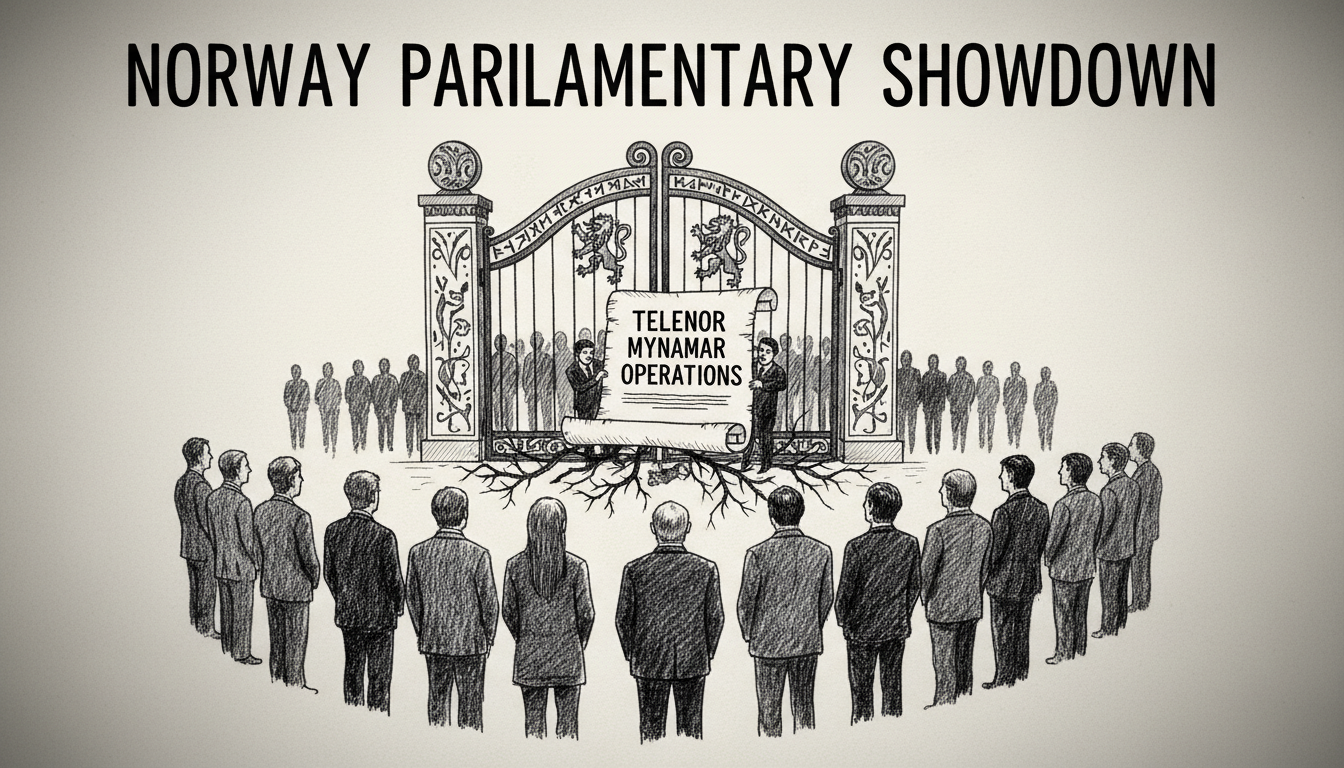
The Norwegian government faces a potential constitutional confrontation with its own parliament. The Storting's Control and Constitutional Committee is moving towards a formal control case after the government refused to hand over sensitive documents related to Telenor's operations in Myanmar. This refusal blocks an investigation into what government ministers knew about the state-owned telecom giant's alleged sharing of customer data with the military junta.
Committee leader Per-Willy Amundsen stated the situation is now heading for a formal parliamentary hearing. The committee originally sought answers to 31 questions about Telenor's activities. The core issue involves what relevant ministers actually knew about the data transfer following the 2021 military coup. Telenor, majority-owned by the Norwegian state, faces serious accusations of human rights violations for allegedly providing extensive sensitive customer information to the regime.
Norway owns nearly 60 percent of Telenor, primarily through the Ministry of Trade, Industry and Fisheries, with additional shares held by the Government Pension Fund. The committee specifically demands access to the confidential 'ownership dialogue' between the ministry and Telenor's leadership. Last week, the government formally rejected releasing these documents, prompting a renewed demand and another negative response.
'I am terribly surprised,' Amundsen said in a statement. 'This does not put the government in a good light. It prevents us from doing our job.'
Committee member Lars Haltbrekken called the situation serious. 'If we are to conduct proper oversight of the government, we must know what signals the minister gave Telenor,' he said. 'I truly hope the government has nothing to hide. It should see itself served by being open with the committee.'
Trade and Industry Minister Cecilie Myrseth defended the refusal in writing. She argued that a vital part of state ownership involves maintaining a confidential and trusting dialogue with companies, similar to dialogues companies have with other major shareholders. She stated this ownership dialogue must remain confidential to function properly.
Opposition members strongly reject this argument. 'That argument I do not buy,' Haltbrekken countered. 'The control committee consists of a limited number of people. That information is subject to confidentiality naturally applies to us too.'
Amundsen expressed surprise that the government still relies on ownership legislation. 'It does not hold water. Here there are accusations of gross human rights violations. Then ownership legislation must yield. We must of course have access,' he asserted.
Committee member Hege Bae Nyholt echoed this sentiment. 'We must get the information we need. This makes our job difficult. Human rights trump ownership. And the Storting stands above the government,' she stated.
This standoff represents a significant test of Norway's parliamentary oversight mechanisms. The Storting's control committee possesses substantial authority to scrutinize government actions, but its power relies on access to information. The government's refusal, citing commercial confidentiality, sets a concerning precedent for parliamentary control over state-owned enterprises involved in international controversies.
The Telenor Myanmar case has been a persistent scandal for Norwegian foreign and business policy. It raises fundamental questions about the ethical responsibilities of a state that champions human rights globally while owning companies operating in authoritarian contexts. The data transfer allegedly targeted Myanmar's pro-democracy resistance movement, directly contradicting Norway's stated foreign policy values.
What happens next carries weight beyond this single case. If the government prevails, it could weaken future parliamentary oversight of state-owned giants like Equinor in the oil sector or Statkraft in energy. The committee's next move likely involves escalating to a full parliamentary hearing, forcing ministers to testify publicly. This political drama unfolds as Norway balances its massive sovereign wealth fund's ethical guidelines with the operational realities of its commercial crown jewels.
The Ministry of Trade, Industry and Fisheries has not responded to media inquiries on the latest development. The stalemate continues, with constitutional principles and human rights allegations hanging in the balance.