
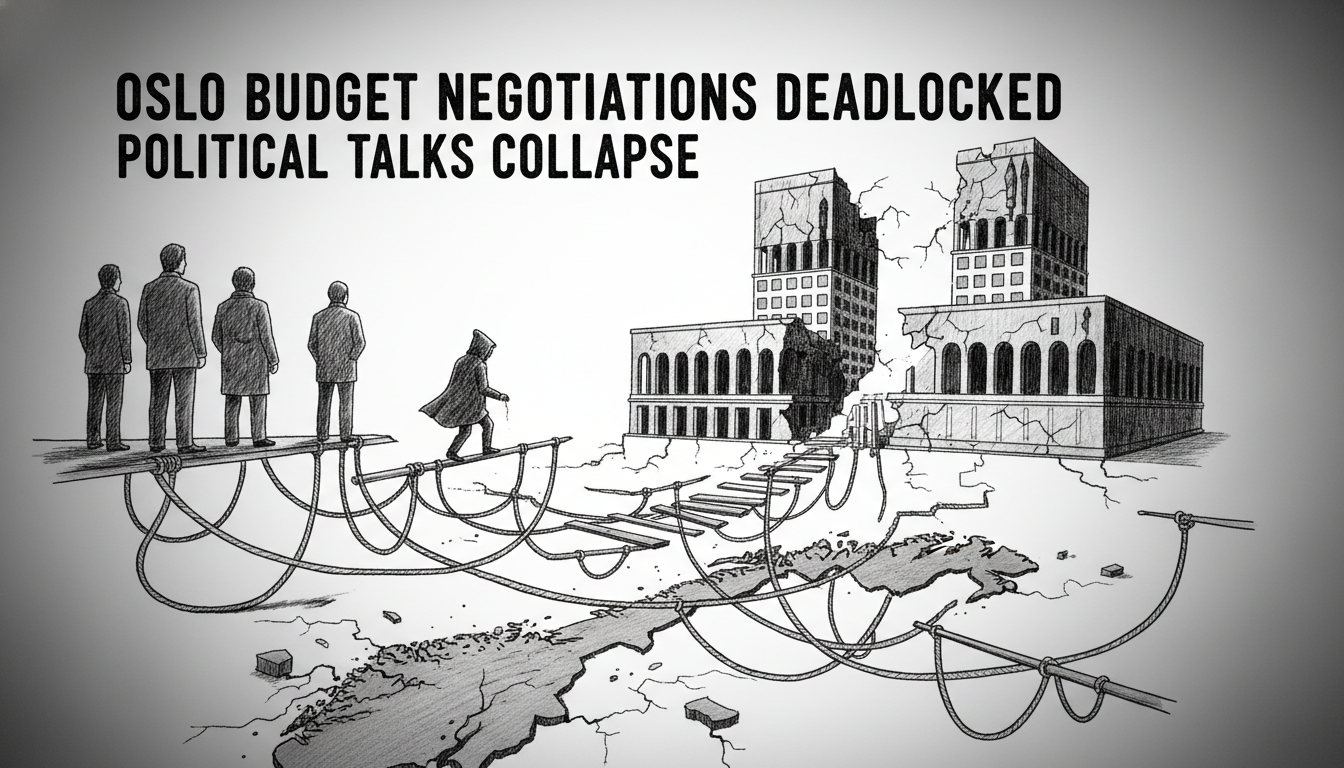
Negotiations over Oslo's municipal budget have reached a complete standstill. The talks between the city's governing coalition and its potential support parties have broken down entirely. Central sources confirm the parties are not communicating. This deadlock now threatens to force the city council into a complex parliamentary maneuver to pass its financial plans. The situation creates immediate uncertainty for public services and infrastructure projects across the Norwegian capital.
The city council, led by a minority coalition, presented its draft budget in September. Since then, officials have been negotiating with the Progress Party (Frp) and the Christian Democratic Party (KrF). These talks aimed to secure a majority in the City Council. The goal was to avoid relying on opposition votes from the left. Sources now state the parties are far from an agreement. They also indicate no clear path exists to bridge the divide.
This impasse has direct implications for Oslo's residents and businesses. A failed budget process can delay decisions on schools, public transport, and cultural funding. It also impacts the city's long-term investment in climate initiatives and housing. The so-called 'blågrønn' or 'blue-green' budget slalom refers to a scenario where the council must seek votes from both the right and left. This is a precarious and unstable way to govern Norway's largest municipality.
The deadlock reflects deeper tensions in Norwegian local politics. Oslo's government is a coalition of the Conservative Party (Høyre) and the Liberal Party (Venstre). It depends on external support from smaller parties to pass its budget. The Progress Party often pushes for lower taxes and reduced spending. The Christian Democrats typically focus on social welfare and family policies. Finding common ground between these differing priorities has proven impossible this season.
What does this mean for the city's operations? If no agreement is found, the council must present a revised budget. It may then need to negotiate with the Labour Party (Arbeiderpartiet) or the Socialist Left Party (SV) to get it passed. This would mean compromising on key policy points. Such a scenario weakens the governing coalition's mandate. It also creates political instability that can deter investment and planning.
The standoff is not just a local Oslo issue. It serves as a microcosm of the challenges facing Norway's political landscape. Minority governments are common at both the national and municipal levels. They require constant negotiation and consensus-building. When that process fails, it highlights the fragility of the current political alliances. The outcome in Oslo could signal similar difficulties for the national government in the Storting when it deals with its own budget later.
Observers note that budget negotiations often go down to the wire in Norwegian politics. The deadline for passing a municipal budget is typically in December. There is still time for last-minute breakthroughs. However, the complete breakdown in communication between the parties is a serious development. It suggests fundamental disagreements on the city's financial direction. The council may now be forced to choose between significant concessions to the right or seeking an unlikely alliance with the left.
The situation also has a symbolic weight. Oslo is the capital and its budget is closely watched. A failure to govern effectively here damages confidence in the center-right bloc's ability to manage complex urban economies. It puts pressure on the national leadership of the involved parties to intervene. The coming weeks will test the political skill of Oslo's city council leader. They will also test the willingness of smaller parties to enable stable governance or force political crisis.