
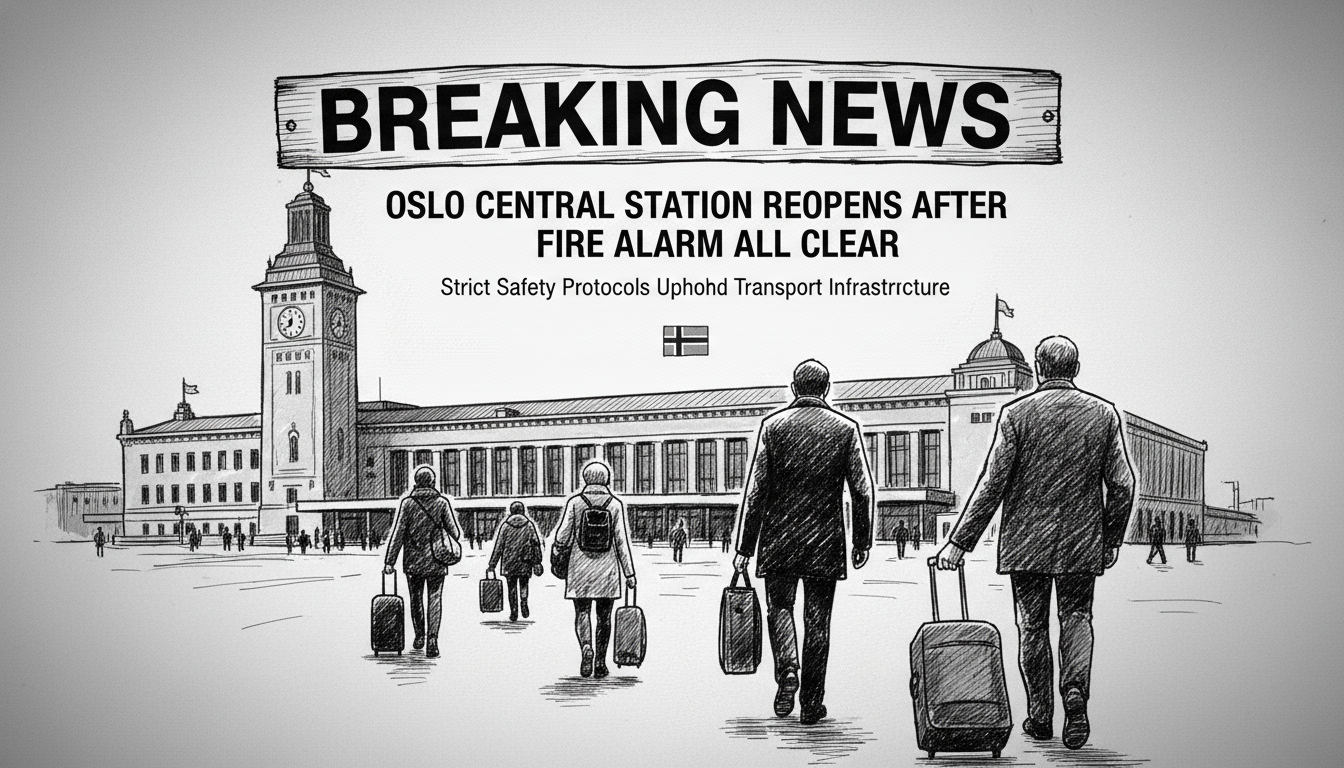
Oslo Central Station, the primary railway hub for Norway's capital, reopened to all traffic shortly after a morning fire alarm prompted a temporary closure. The alarm sounded just before 8:30 AM, leading to a swift response from emergency services. Station operator officials confirmed the all-clear after a standard safety inspection.
A press officer for the transport authority stated that fire crews checked the alarm as a precaution. 'They are investigating a fire alarm. It does not appear to be anything, but they must check for safety's sake,' the official said. Normal operations resumed at Jernbanetorget, the station's main plaza, by 8:22 AM.
This incident highlights the critical infrastructure role of Oslo Central Station. It serves as the nerve center for Norway's extensive rail network, connecting regional lines with the national system. Any disruption here has immediate ripple effects across commuter and long-distance travel. The station handles hundreds of thousands of passengers daily, making its operational stability a matter of national economic importance.
Norway's public safety protocols for transportation hubs are among the most stringent in Europe. A fire alarm at a major terminal like this triggers an immediate, coordinated response. The system prioritizes passenger safety over convenience, a principle deeply embedded in Nordic regulatory culture. The brief closure, while disruptive, follows a standard playbook designed to prevent catastrophe.
For international observers, this event underscores the efficiency of Norwegian crisis management. The response was measured and procedural, not chaotic. It reflects a society that invests heavily in its public infrastructure and the systems to protect it. The transparency of the official statement is also typical, providing clear public information without unnecessary alarm.
What does this mean for Norway's transportation policy? It reinforces the ongoing investment in resilient infrastructure. The Storting, Norway's parliament, consistently allocates funds for maintenance and safety upgrades across the transport sector. This is not just about trains. It connects to broader discussions about urban security, emergency preparedness, and the seamless function of a modern society.
The quick resolution also speaks to the high level of public trust in Norwegian institutions. Commuters largely accept such brief disruptions as a necessary part of robust safety standards. This social contract between the state and its citizens is a key feature of the Nordic model. It allows for decisive action in moments of potential crisis without public panic.
Looking ahead, minor incidents like this often feed into larger reviews of safety protocols. Data from the response will be analyzed. Could procedures be even faster without compromising safety? This is the constant question for Norwegian engineers and planners. The answer usually involves more technology, better training, and continued investment—a cycle that maintains Norway's world-class infrastructure status.