
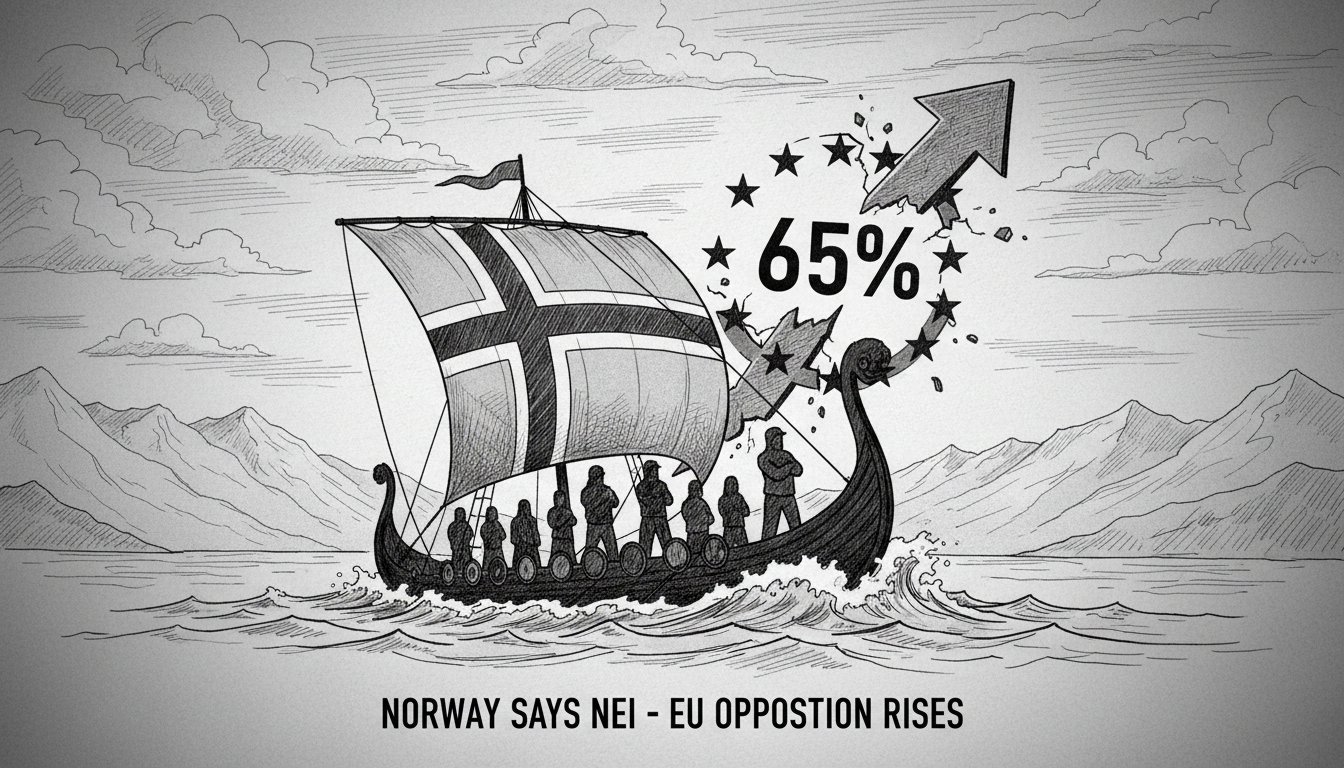
A new opinion poll reveals a clear and growing majority of Norwegians oppose joining the European Union. Nearly two-thirds of decided respondents say Norway should not apply for EU membership. This marks a significant increase in opposition compared to the last survey just months ago. The shift follows recent EU trade restrictions that directly impact Norwegian industry.
Specifically, 64.8 percent of decided respondents answered 'no' to the question of Norwegian EU membership. Only 35.2 percent said 'yes'. The survey shows a 6.2 percentage point increase in opposition since the previous poll in April. This is the fourth such survey conducted in three years, tracking a clear trend. The latest poll was completed one week after the EU announced import restrictions on ferroalloys. This move affects key Norwegian industrial sectors.
The survey involved 791 people interviewed across the country in late November. Eighteen percent of those asked said they remained undecided on the issue. This substantial bloc could influence any future national debate. The results present a clear challenge for any political faction advocating closer EU ties. They reflect a deep-seated skepticism toward further European integration.
Norway's relationship with the EU is governed by the European Economic Area (EEA) agreement. This grants access to the single market but requires adherence to many EU rules without formal voting rights. The country has rejected EU membership twice in national referendums, in 1972 and 1994. The current political landscape makes a third vote highly unlikely in the near term. The governing coalition, led by the Labour Party and Centre Party, maintains a clear stance against membership.
The recent EU trade decision on ferroalloys appears to have resonated with the public. It underscores the complex reality of Norway's economic ties to Europe. The country enjoys market access but remains subject to EU regulatory power without representation. This 'fax democracy', where Norway adopts rules made in Brussels, is a frequent criticism from both left and right. The poll suggests such criticisms remain potent.
Energy and Arctic policy are central to Norwegian sovereignty debates. Control over vast offshore resources in the North Sea and the Barents Sea is a non-negotiable point for most parties. The Storting, Norway's parliament, would need to initiate any membership application process. Current sentiment in the chamber strongly favors the status quo. Several key committee chairs have repeatedly stated that EU membership is not on the national agenda.
For international observers, this poll confirms Norway's enduring ambivalence toward the European project. The country balances deep economic integration with a fierce protection of political independence. The rising 'no' sentiment indicates that recent EU actions are viewed through a lens of national interest. It is a straightforward calculation for many Norwegians. The costs of full membership are seen to outweigh the benefits, especially when market access is already secured.
The data suggests the EU question remains settled for now. Political energy is focused elsewhere, particularly on managing the nation's vast sovereign wealth fund and the green transition of its oil and gas sector. The government's focus is on domestic industry and Arctic development, not constitutional debates about Europe. This poll reinforces that political reality.