
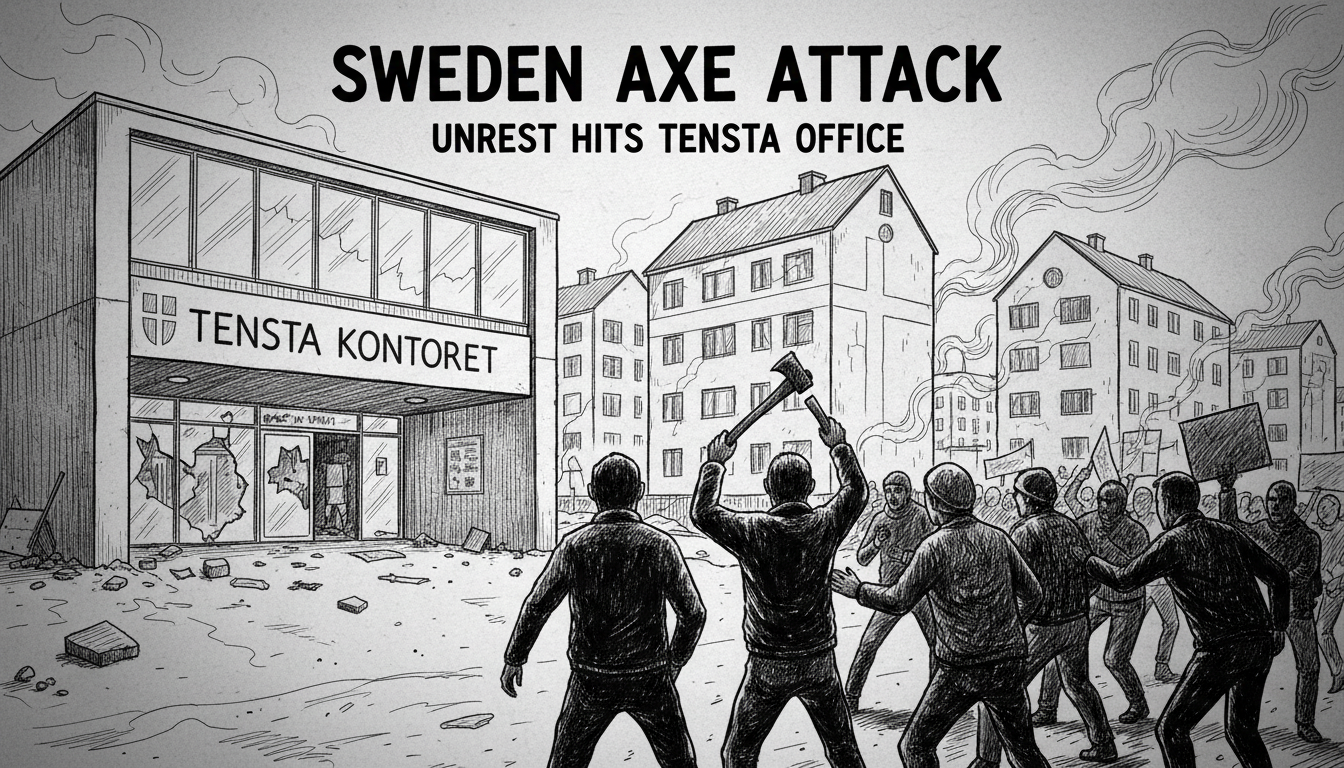
Sweden's latest violent public incident unfolded inside a quiet municipal office in northwest Stockholm. Just after 2 p.m. on a Friday, a man armed with an axe went on a rampage in Tensta's local civic center. He smashed glass panels and doors while terrified staff barricaded themselves in locked rooms. Police arrived within four minutes, arresting a man in his 20s. No one was physically injured, but the psychological shockwaves are still being felt.
"It was a great deal of shattered glass and this person, completely alone in the reception," said police spokesperson Daniel Wikdahl. "There were no other people there." The suspect now faces preliminary suspicions of aggravated unlawful threats, aggravated vandalism, and a serious violation of Sweden's strict knife law, which also governs axes. For residents of Tensta, a suburb long grappling with a tough reputation, the attack is another worrying data point in a complex social story.
A Community Already on Edge
Tensta is more than just a location on a map. It’s a symbol of Sweden's ambitious integration projects and their ongoing challenges. Built during the Million Programme in the 1970s, this district of about 20,000 people is known for its high immigrant population—over 80% of residents have foreign backgrounds. It's also an area marked by socioeconomic struggles. While specific 2023 unemployment data for Tensta is hard to pin down, it has historically been significantly higher than the Stockholm county average, sometimes reported as double. This creates a backdrop of frustration and limited opportunity that community leaders say cannot be ignored.
"When something like this happens, everyone feels it," says local activist Amir Al-Massri, who runs a youth sports initiative. We speak at a café near Tensta Centrum. "People are asking, 'Is our public space safe?' But they are also asking, 'What drove this young man to such despair?' It's fear and sadness mixed together." The municipal office itself is a place where people go for help—with housing permits, social services, and employment support. That it became a target feels particularly resonant.
Understanding Sweden's Struggle with Public Violence
While this attack was isolated, it touches a nerve in the national conversation. Statistics on weapon-involved incidents in public places are troubling. In Stockholm County, police have reported increasing numbers of violent crimes involving weapons in recent years. A 2023 report noted thousands of incidents involving knives, firearms, and other weapons. Each event, especially one as dramatic as an axe attack in a government office, fuels debate about gang crime, mental health support, and social segregation.
Experts see incidents like this as symptoms of deeper issues. "We must look beyond the single act," says sociologist Dr. Lena Kofoed, who studies urban marginalization. "In areas with high unemployment, social exclusion, and a sense of hopelessness, you see higher rates of both organized crime and acute, chaotic outbursts. The individual may have personal struggles, but he acts within a context. The question for Sweden is how to break this cycle." She emphasizes that investment in schools, youth programs, and mental health resources in suburbs like Tensta is not just social policy—it's crime prevention.
The Human Story Behind the Headlines
Back in Tensta, daily life continues amidst the unease. At the Rinkeby-Tensta Folkets Hus, a community cultural center, a women's sewing group meets as usual. "We heard the sirens," says Fatima, a long-time resident who didn't want to give her full name. "It’s scary, of course. But we cannot let this define us. Tensta is also full of families, hardworking people, and children dreaming of being doctors. This is one man's action, not our community's heart."
This tension between a negative event and a community's self-perception is key. Tensta has vibrant street art, popular kebab spots, and a strong sense of local identity. Every summer, it hosts a cultural festival that draws visitors from across Stockholm. The narrative, say residents, is too often written from the outside. "The news vans will leave soon," says Amir Al-Massri. "But we live here. Our work to build a better place doesn't stop."
Looking Ahead: Safety Versus Support
The immediate response from authorities will focus on security. Could there be more panic buttons, better glass, or security personnel at municipal offices? These are practical questions. The longer-term response, however, is murkier. It involves Sweden's ongoing struggle to integrate immigrant populations, provide meaningful job prospects, and offer early intervention for mental health crises.
National and city-level initiatives, like the "Stockholm Safety Pact," already pour resources into so-called "vulnerable areas." The results are mixed and slow to materialize. For the young man now in custody, his path through the Swedish justice system begins. He will be assessed, and his motives investigated. Was it a planned attack, a spontaneous outburst, or a cry for help gone horribly wrong? The answers matter for the legal case and for understanding how to prevent a next time.
Sweden prides itself on openness, trust, and a strong social safety net. Incidents like the Tensta axe attack shake that self-image. They force a uncomfortable look at the gaps between neighborhoods, between the included and the excluded. As the glass is cleaned up and the office slowly reopens, the harder work remains. It's the work of mending not just broken windows, but broken trust and frayed opportunities in the very places designed to provide support. The true test for Stockholm will be whether this event becomes just another statistic or a catalyst for deeper, more effective connection with its suburbs.