
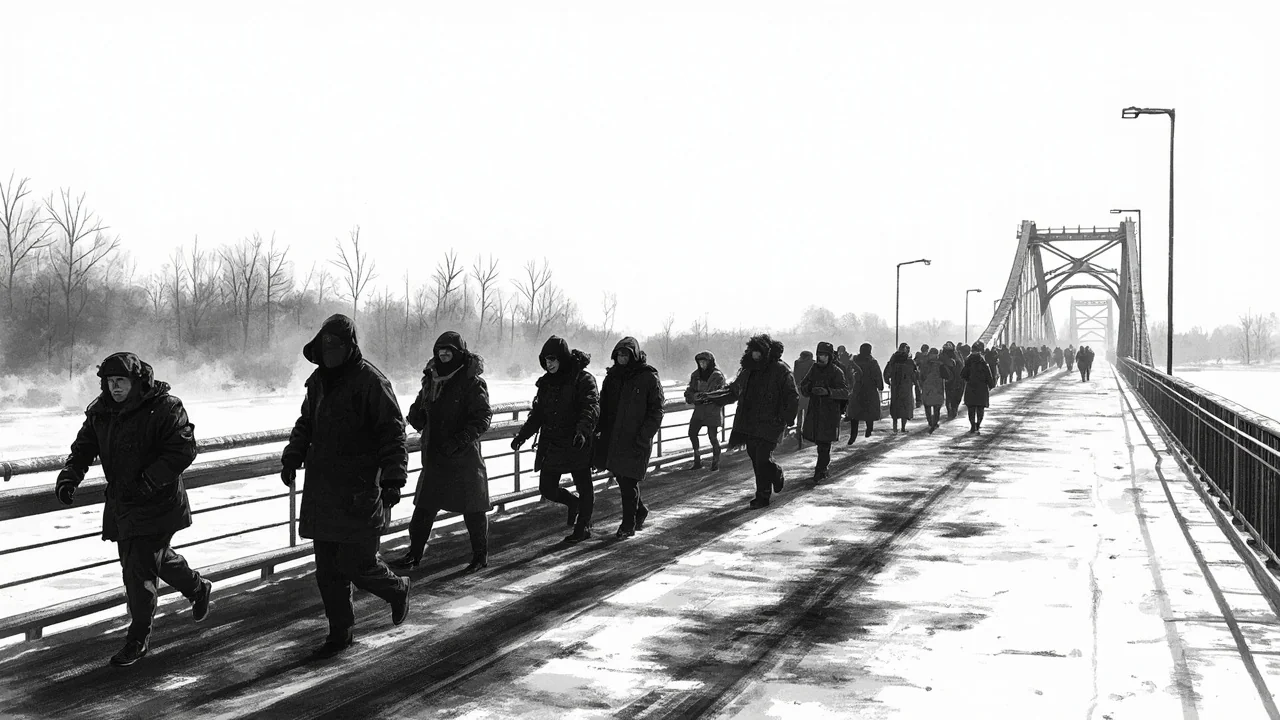
Sweden's public transport faced a sudden winter test when a key Gothenburg bridge froze shut. The Hisingsbron bridge, a vital artery connecting the island of Hisingen to central Gothenburg, was completely closed during the Wednesday morning rush. Technical failures with the bridge's barriers, literally frozen in place, brought trams and buses to a standstill for over an hour, stranding thousands.
Malin Ulfhager, a press spokesperson for Västtrafik, the regional transit authority, described the chaotic scene. "There were trams stuck on the bridge that had let off their passengers," she said. "External traffic controllers had to help buses turn around on the bridge itself."
The closure, which began before 8 AM, sent immediate ripples across the city's morning rhythm. With temperatures hovering around freezing, the malfunction highlighted the vulnerability of even modern infrastructure to classic Swedish winter conditions. For commuters, it was a harsh reminder of nature's ability to disrupt the best-laid plans.
A City Forced to Adapt
Public transport officials acted quickly to implement contingency plans. By 9 AM, traffic was slowly resuming on the bridge. But the interim solution was a return to the city's aquatic roots. Västtrafik redirected commuters to the water, putting on extra ferry departures between Stenpiren in the city center and Lindholmen on Hisingen.
The sight of crowded ferries in the chilly morning mist became an unexpected tableau. For many, it was a slower, colder alternative to their usual tram ride. The ferry, while picturesque, is not a volume solution for the tens of thousands who cross Hisingsbron daily. The disruption was more than an inconvenience; it was a logistical puzzle for a city that prides itself on efficiency.
"It's one of those mornings where you just sigh and accept it," said Erik Lund, a programmer who was 45 minutes late to his office at Lindholmen Science Park. "You check the app, see the red lines everywhere, and know your day starts with a boat trip. It feels very old-school Gothenburg."
The Human Cost of a Frozen Mechanism
The impact extended beyond individual tardiness. Delivery schedules were thrown off. School routes for children on the island were complicated. Parents faced unexpected childcare challenges. The bridge is not just for cars; it carries tram lines 5, 6, 8, and 9, and several crucial bus routes. Its function is central to the city's economic and social life.
At a kiosk near Järntorget, a major tram interchange, server Anya Petrova served a steady stream of frustrated customers seeking hot coffee. "Everyone was talking about it," she noted. "People were coming in groups, having met on the ferry or while waiting for buses that never came. There was a kind of shared annoyance that brought people together."
This communal friction is a recurring theme in Swedish winters. Society is built on a promise of reliability. When public systems falter, even briefly, it challenges a fundamental social contract. The incident wasn't a major disaster, but it was a sharp, localized breakdown of the expected order.
Infrastructure in the Nordic Climate
Experts point to this event as a small-scale case study in a larger conversation. Sweden invests heavily in maintaining its infrastructure against harsh weather. Yet, as urban systems grow more complex, so do their potential points of failure. A simple frozen locking mechanism on a bridge barrier can cascade into a city-wide transport headache.
"We design for extreme cold, for snow load, for ice," says Lars Bengtsson, a civil engineer and commentator on urban planning. "But sometimes it's the smallest, most mundane component that fails. The lesson is about holistic maintenance. It's not just about the concrete and steel, but every moving part that interacts with the climate."
The Gothenburg region has experienced a rise in these micro-disruptions. Milder winters with more frequent freeze-thaw cycles can be harder on mechanics than sustained deep cold. This creates a new set of challenges for engineers and planners trying to future-proof the city.
Looking Beyond the Thaw
By late morning, the story was over. The barriers were freed, trams rolled, and the extra ferry services were stopped. The digital traffic maps turned from red back to green. Yet, the memory of the disruption lingers in the collective consciousness of Gothenburg's commuters.
It prompts questions about redundancy and resilience. Is one bridge, however well-engineered, too critical a link? Debates about a potential additional fixed connection across the Göta älv river have persisted for decades. Incidents like this add fuel to that fire, framing it not just as a question of growth, but of basic stability.
For now, the city moves on. But the next forecast of freezing rain will likely see hundreds of commuters checking the Västtrafik app with a little more anxiety. The event was a brief return to a time when water, not steel, was Gothenburg's main connector. It served as a reminder that in Sweden, winter always has the final say, testing systems and patience in equal measure. The true measure of a city's mettle isn't in avoiding the freeze, but in how quickly it thaws the resulting paralysis.