
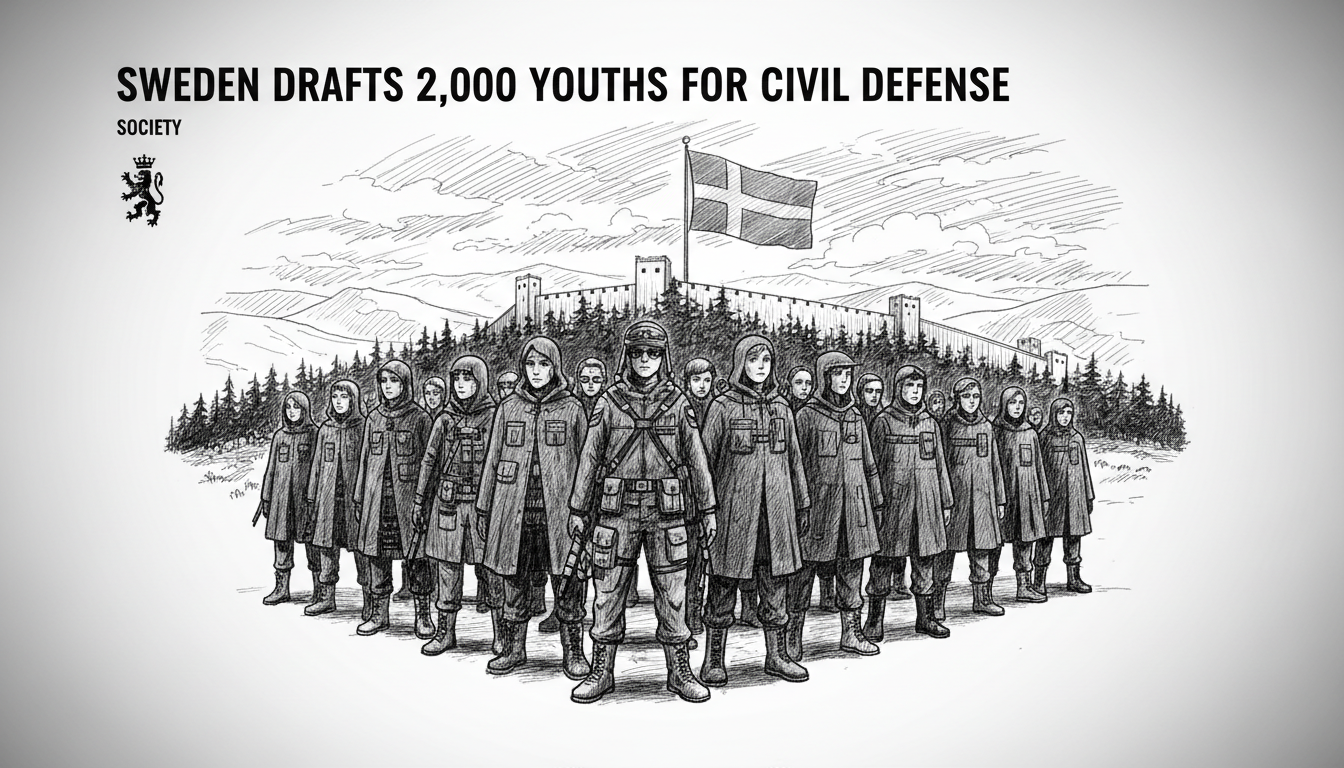
Sweden's revived civil conscription will call up to 2,000 young people annually by 2029, training them for rescue services and shelter management without bearing arms. The Swedish Civil Contingencies Agency (MSB) announced the expansion this week, marking a significant shift in the nation's 'total defense' strategy.
Imagine opening a letter from the government the spring you turn 18. For decades in Sweden, that meant a summons for military conscription. Next year, that envelope could contain a different call to service. Instead of a rifle, you might train to operate heavy rescue tools in a fire station or manage a crisis in one of Stockholm's massive underground shelters. This is the new reality for Sweden's youth as the country rebuilds its civil defense from the ground up.
A Civilian Call to Arms
General Director Mikael Frisell of MSB framed it as a modern form of patriotism. "I hope and believe these positions can be attractive for today's youth," Frisell said at a press conference. "That one can contribute and do something for their nation without carrying a weapon." The program begins in earnest next year, with a new, longer basic training course slated for 2027. Initially, about 200 young people per year will be called for municipal rescue service roles. The ambition is to scale up to between 1,500 and 2,000 conscripts annually by 2029. Training for shelter management will involve several hundred individuals.
The move isn't happening in a vacuum. Sweden reinstated military conscription in 2017 after a brief seven-year pause. A changed security landscape in the Baltic region prompted the reversal. Now, the focus is widening. "Total defense' is a term you hear constantly in policy circles here," says Lena Kjellsson, a Stockholm-based security analyst. "It’s the idea that resilience isn't just about soldiers. It's about electricians keeping the grid running, nurses trained for mass casualties, and volunteers who can manage a shelter. Civil conscription feeds directly into that."
From Midsummer Celebrations to Crisis Response
The practical implications touch the fabric of local communities. A conscript might train with the rescue services in a suburb like Sundbyberg or Husby, learning skills that are desperately needed year-round. Sweden faces wildfires, intense snow storms, and flooding. A permanent pool of trained young people could change response times dramatically.
I spoke to Erik, a 19-year-old from Södermalm who completed military service last year. "I learned discipline and first aid, but my role was very specific," he told me. "My friend who wants to be a paramedic would jump at a civil service chance. It's direct, practical help. It feels more connected to everyday life." This sentiment is what MSB is betting on. In a nation with a strong culture of volunteerism—from the 'friluftsliv' outdoor associations to neighborhood watch groups—the idea of mandated civil service sparks debate.
The Shadow of the Shelters
Perhaps the most evocative part of the new plan is the training for large shelter management. Stockholm's metro system famously doubles as the world's largest nuclear shelter. Others are tucked beneath public buildings and residential blocks. These cold war-era structures need trained staff to manage populations during a prolonged crisis. "It's not just opening a door," explains Frisell. "It's logistics, sanitation, and maintaining order under extreme stress."
This taps into a deep-seated Swedish preparedness mindset, the 'beredskap' culture familiar to anyone who has seen a well-stocked basement. Yet formalizing it through conscription is new. Some human rights advocates have quietly questioned the compulsory nature of the program, especially for roles that could be filled by professionals. The government argues that the scale of potential modern crises—from hybrid warfare to pandemics—requires a guaranteed, large-scale workforce.
Building a Resilient Generation
What does this mean for a generation already navigating climate anxiety and global instability? For some, it offers structure and valuable skills in a shaky job market. The training could lead to certifications in emergency medical response, logistics, or crisis communication. For others, it represents an intrusion, another obligation in a carefully planned life.
The MSB is conscious of the need to make it appealing. The training will be substantial, aiming to create true specialists, not just temporary helpers. "We are building a system for the long term," Frisell emphasized. The success of the program may hinge on whether young Swedes see it as a meaningful civic duty or an outdated imposition. As one student at Stockholm University told me, "If it's well-organized and we actually learn things that help in careers, maybe it's okay. But if it feels like a lost year, people will resent it."
Sweden's experiment is being watched closely across the Nordic region. Norway has a long history of civil defense service, while Denmark has debated similar models. In an era of converging threats, the Swedish model offers a case study in mandating civilian preparedness. Will it create a more resilient society, or will it struggle against the values of a generation that prizes individual choice? The first letters go out next year, and the answer will take shape in fire academies and deep underground bunkers, one conscript at a time. Is this the future of citizenship in an uncertain world?