
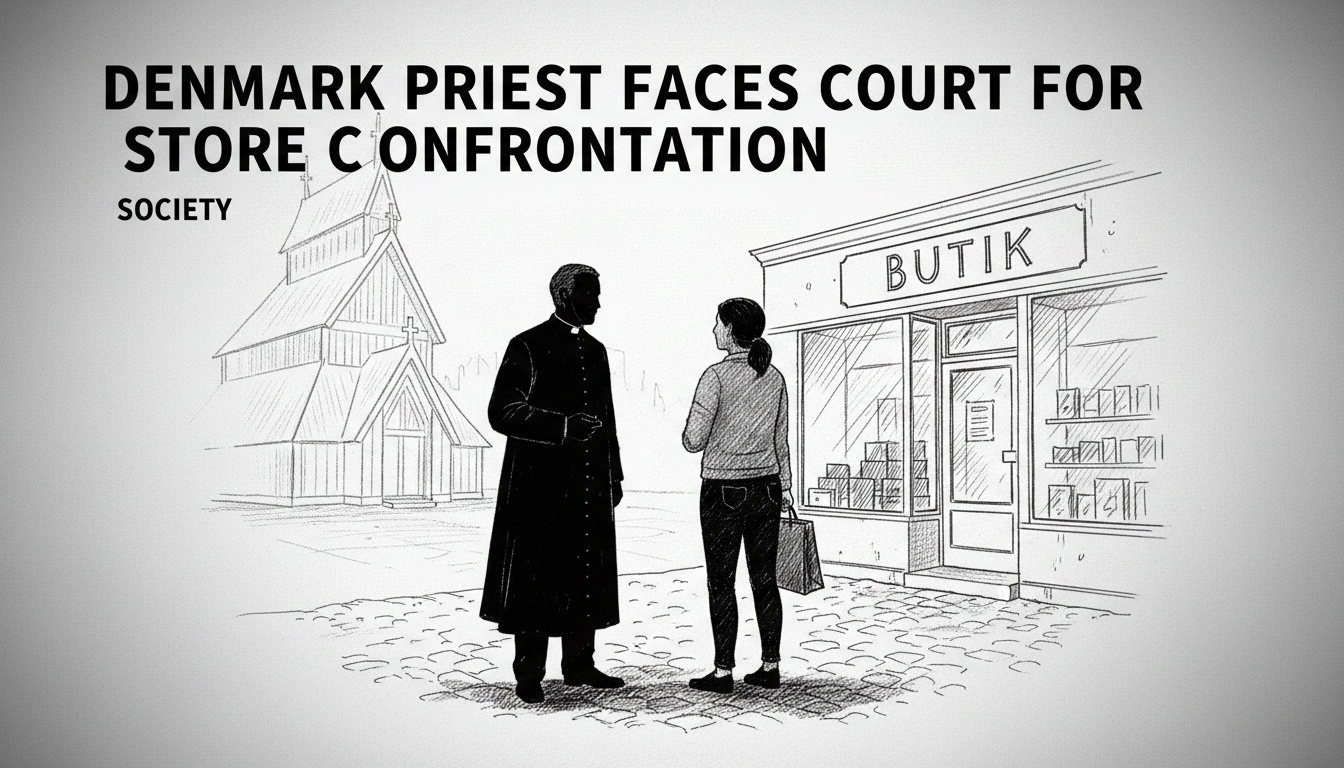
Denmark crime news is focusing on a North Jutland courtroom this month as a free church priest stands trial. The Hjørring court will decide if his actions against a woman in a store crossed the line from religious intervention into criminal coercion. This case forces a difficult conversation about the limits of religious authority in a society built on personal liberty. It probes where pastoral concern ends and unlawful control begins under Danish law.
A priest from a northern Danish free church is formally charged with unlawful coercion. The specific allegation states he physically pulled a woman from a commercial store and confiscated her mobile phone. These actions, if proven, represent a direct challenge to individual autonomy protected by the Danish legal system. The upcoming trial will dissect the moment belief-driven action potentially became a criminal act.
A Clash of Values in a Secular State
Denmark maintains a unique balance between a strong Lutheran heritage and a fiercely secular, rights-based society. The Evangelical Lutheran Church remains the official state church, supported by about 73% of the population through tax. Alongside it, independent free churches operate with doctrinal autonomy. All religious institutions, however, must operate within the framework of Danish civil law. This case tests that boundary in a tangible, physical way. It moves beyond theological debate into the realm of bodily autonomy and personal property.
“The core legal question is one of consent and proportionality,” explains a Copenhagen-based legal scholar specializing in civil liberties. “Danish law on unlawful coercion protects the individual’s right to self-determination. A religious motive does not grant a carte blanche to override that right through physical force or seizure of property.” The burden of proof will rest on the prosecution to demonstrate the priest’s actions were intentional and constituted an illegitimate restriction of the woman’s freedom.
The Anatomy of an Allegation
The alleged incident, pulling a woman from a store and taking her phone, contains multiple potential legal violations. The physical act of removal could constitute force or the threat of force. Taking the phone involves the unlawful control of another person’s property, which compounds the charge. From a social perspective, the setting is significant. A public store is a secular, communal space with implicit norms of conduct. A confrontation there differs from one within a private church building.
Community reactions in North Jutland have been mixed, reflecting the delicate nature of the case. Some express strong support for the priest, viewing his actions as potentially necessary for a member's spiritual welfare. Others voice deep concern, seeing the allegations as an overreach that undermines trust. Local social services and integration centers often deal with complex community conflicts, but a criminal court case elevates the matter to a national principle. The trial will require the court to reconstruct the event's precise dynamics, assessing the woman’s perception of threat and the priest’s stated intent.
Religious Freedom Versus Individual Rights
This trial sits at the intersection of two fundamental pillars: religious freedom and inviolable personal rights. Denmark’s constitution guarantees freedom of religion. This allows free churches to practice and preach according to their beliefs. Conversely, the same legal system enshrines protections against personal violence and coercion. The court’s task is not to judge theology but to judge actions. Where does pastoral care, which can sometimes involve firm guidance, become unlawful in a secular legal sense?
Ethicists watching the case suggest the moral and legal analyses, while related, are distinct. “One can debate the ethical justification of strong intervention from a religious viewpoint,” notes a professor of ethics from Aarhus University. “However, the law provides a clear baseline for all citizens, regardless of faith. The court’s role is to uphold that baseline, determining if a line was crossed from persuasive counsel into criminal compulsion.” The verdict may establish a clearer precedent for how similar conflicts are handled by authorities across Danish municipalities.
A Broader Look at Community and Control
While an isolated case, it touches on broader themes in Danish society about community belonging and personal freedom. Denmark’s social model emphasizes collective responsibility and a strong welfare system. Within that, the right to individual autonomy remains sacred. All forms of authority, including religious leadership, are subject to scrutiny. This is especially true when actions affect vulnerable individuals. The case inevitably prompts reflection on the mechanisms of support and accountability within religious communities themselves.
Could the incident reflect a failure of other, non-coercive support structures? Danish social policy typically encourages resolution through dialogue and municipal support services. The leap to alleged physical intervention suggests a breakdown in those processes. The court proceedings will likely explore what preceded the store incident. They may examine whether other avenues were exhausted or ignored. This gives the case a dimension beyond the immediate criminal charge, hinting at community dynamics and conflict resolution.
The Path to a Verdict
The Hjørring court will hear evidence from both the prosecution and the defense later this month. Key to the trial will be witness testimony, potentially including store employees or other bystanders. The woman’s account of feeling coerced will be central. The priest’s defense will likely articulate his motivation, arguing his actions were a necessary form of help, not criminal coercion. Judges must weigh intent against impact, and belief against the law’s black-letter definitions.
Legal experts anticipate a verdict that will be narrowly tailored to the specific facts. A conviction for unlawful coercion can result in a fine or, in more severe cases, a conditional prison sentence. The broader consequence lies in the signal it sends. A conviction affirms that secular law sets the ultimate boundaries for physical conduct, even for religious figures. An acquittal might be interpreted as recognizing a degree of leeway for drastic intervention in perceived crises. The judgment will be studied by legal and religious communities across Denmark.
A Society’s Balancing Act
This North Jutland case is more than a local crime report. It is a microcosm of Denmark’s ongoing negotiation between its cultural heritage and its modern legal principles. The nation comfortably integrates faith and secular life, but clear red lines exist. The alleged actions—physical removal and property seizure—test those lines in a dramatic, concrete way. The outcome will resonate in other free churches and communities, clarifying the limits of permissible intervention.
As the court date approaches, the story compels a difficult question. How does a society honor the sincere, if controversial, convictions of its religious members while unconditionally protecting the bodily and personal freedom of every individual? Denmark’s answer, delivered from a courtroom in Hjørring, will define where the state draws that line for everyone. The verdict will not end the debate, but it will provide a crucial legal reference point for the next time faith and freedom collide.