
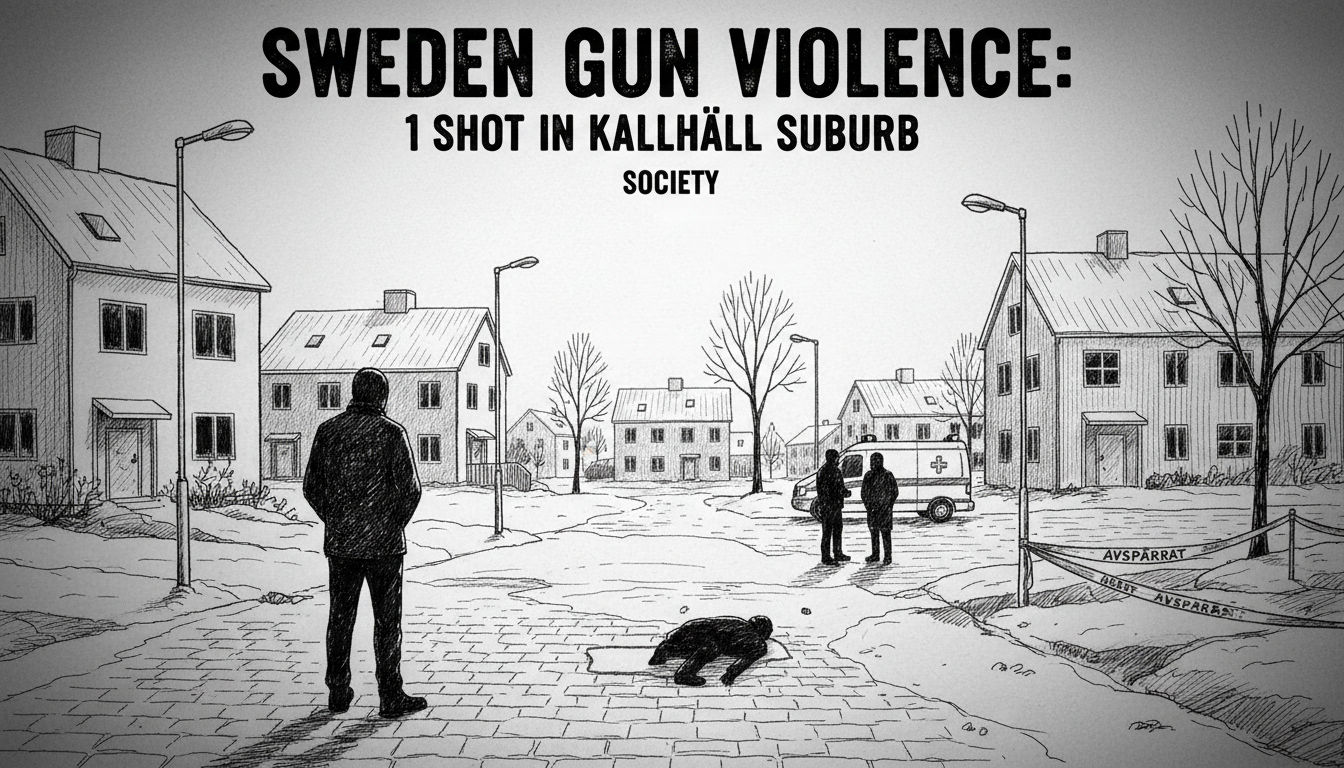
Sweden gun violence struck the Stockholm suburb of Kallhäll on a Wednesday evening. Police found a single victim, conscious and able to speak, after responding to reports of a shooting. The incident has triggered a major investigation and renewed a painful national conversation about safety in Swedish neighborhoods.
"We went to the location and found a shot person," said police spokesperson Nadya Norton in a statement. The scene was quickly secured in the residential area of Kallhäll, part of Järfälla Municipality northwest of Stockholm. Officers launched a preliminary investigation for attempted murder and aggravated weapons offenses. A search operation for the perpetrator or perpetrators began immediately, involving forensic work, witness interviews, and door-to-door canvassing.
For residents of Kallhäll, the sound of police sirens cut through the ordinary evening. This suburb, like many others in Greater Stockholm, represents the complex face of modern Sweden. It's a mix of apartment blocks, townhouses, and green spaces, home to a diverse population. Incidents like this send shockwaves far beyond the crime scene tape, touching every neighbor who wonders if their street is next.
A Suburb in the Spotlight
Kallhäll is not a name that typically dominates Swedish crime news. It's a community better known for its commuter rail station and proximity to nature than for gang violence. This shooting forces it into a narrative that many suburbs fear. The immediate police response was sizable, a standard procedure now for any firearm incident in the region. Forensic teams worked under portable lights, a stark contrast to the quiet residential backdrop.
The victim's condition, described as "awake and talkative," offered a small relief in a grim situation. It allowed investigators to gather crucial initial information. However, the physical and psychological wounds from such an event run deep, both for the individual and the community. Every shooting leaves a mark on the social fabric, a point of reference for when things changed.
The Broader Trend of Gun Violence
This incident did not happen in a vacuum. Sweden has grappled with a rising trend in gun violence for several years. In 2023, the country recorded approximately 4.0 lethal firearm incidents per million population. While this number might seem abstract, it represents a real and persistent challenge. Stockholm County consistently accounts for a significant portion of Sweden's reported firearm offenses.
Experts point to a confluence of factors. The availability of illegal firearms, often linked to organized criminal networks, is a key enabler. These groups frequently settle disputes with violence, creating cycles of retaliation. Underlying issues like socioeconomic gaps, segregation in housing, and challenges with youth integration are often cited as root causes that allow criminal networks to recruit. It's a problem that demands more than just a police response.
"We need to understand this as a societal failure on multiple levels," says sociologist Erik Lundgren, who studies urban violence. "The police work is crucial for immediate security, but if we don't create legitimate opportunities for young people in these areas, the gangs will continue to provide an alternative identity and income. It's about jobs, schools, and social trust."
Government Response and Public Sentiment
The Swedish government has implemented various measures to combat the violence. These include stricter gun control laws, enhanced penalties for weapons offenses, and increased police resources dedicated to gang crime. Initiatives like "visitation zones," where police can stop and search individuals without specific suspicion in designated high-risk areas, have been controversial but are part of the toolkit.
Public sentiment is a mix of fear, frustration, and resilience. In cafes and on social media, Swedes debate the changes in their society. Many express concern that the iconic image of a safe, peaceful Sweden is fading. Others argue that the problem, while serious, is often concentrated and should not define the entire country. For those living in affected suburbs, the debate is less abstract. It's about letting children play outside and feeling safe on the walk home from the bus stop.
Life in Stockholm's Suburbs
To view places like Kallhäll only through the lens of crime is to miss their full story. These are vibrant communities where most people live peaceful lives. They are hubs of Swedish immigration news, where new arrivals and multi-generational Swedes build futures side-by-side. You'll find bustling food markets, community centers offering language classes, and soccer fields filled with kids on weekends.
Swedish society trends show a nation constantly adapting. The challenge is ensuring that growth and diversity are matched with inclusion and opportunity. When they are not, fissures can appear. Criminal elements exploit these fissures. The shooting in Kallhäll is a violent symptom of a deeper, more complex condition affecting not just Sweden, but many European nations.
Looking Ahead: A Search for Solutions
As the investigation in Kallhäll continues, the broader search for solutions persists. Experts like Lundgren advocate for a "carrot and stick" approach. The "stick" is effective law enforcement to dismantle networks and remove weapons from the streets. The "carrot" is substantial, long-term investment in social infrastructure: mentorship programs, youth clubs, job training, and support for local entrepreneurs.
Community policing, where officers build relationships and trust within neighborhoods, is also seen as vital. It can improve intelligence gathering and prevent violence before it occurs. This Swedish lifestyle of safety and trust, so deeply valued, requires active maintenance. It cannot be taken for granted.
The coming days will reveal more about the specific circumstances in Kallhäll. Was it a targeted attack? A case of mistaken identity? A conflict that spilled into public view? Each possibility tells a different story about the nature of the threat. For now, the people of Kallhäll are left with uncertainty and a heightened sense of vulnerability.
Sweden's journey with gun violence is ongoing. Each incident, from the most devastating to those where the victim survives, adds another data point to a troubling chart. The nation's response will shape its identity for years to come. Can it leverage its famous model of social welfare and innovation to solve this modern crisis? The answer will be written in communities just like Kallhäll, on streets where safety should never be a question, but sometimes, on a Wednesday evening, becomes one.