
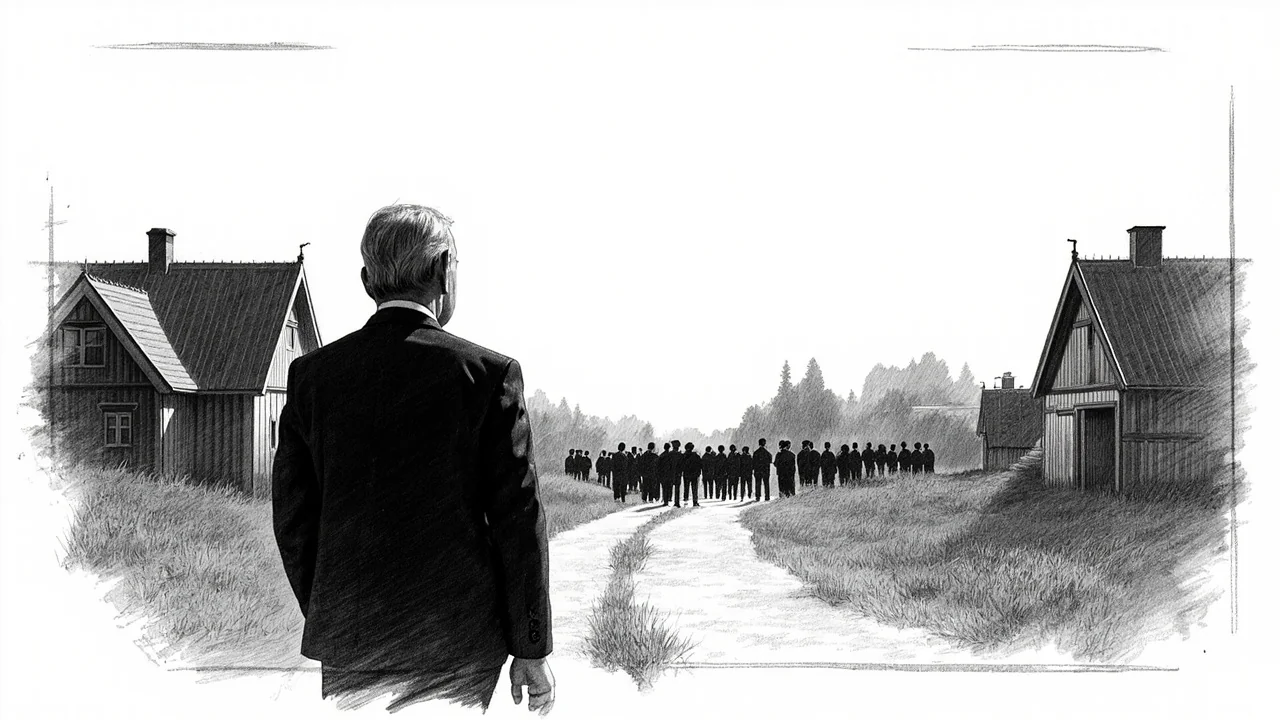
Sweden's Justice Minister Gunnar Strömmer visited the northern city of Boden on Friday following a deadly Christmas morning attack. His visit to the site where a 55-year-old woman was killed has ignited a fierce national debate about psychiatric care and public safety. The tragedy has exposed what many describe as critical gaps in Sweden's mental health and justice systems, placing intense pressure on the government in Stockholm.
A Christmas Morning Tragedy
The incident occurred on the morning of December 25th. A man in his twenties rang the doorbell of a villa and was let inside. He then attacked a 55-year-old woman and her two teenage daughters. The woman died from her injuries sustained in the assault. Several hours later, police intervened and shot the suspect dead. The sudden violence in a residential area has left the community of Boden in a state of profound shock and grief. Minister Strömmer participated in a somber memorial at Medborgarplatsen, lighting a candle for the victim.
Systemic Questions Emerge
In the aftermath, troubling details about the suspect's history have surfaced. According to information provided by the man's mother to local media, the suspect had recurring contact with psychiatric services. Crucially, he was reportedly involuntarily admitted to a psychiatric facility just days before the murder. He was released after only one day. This sequence of events forms the core of the burgeoning political controversy. It raises immediate questions about the assessment protocols and legal frameworks governing compulsory psychiatric care in Sweden.
"I see how informed individuals point out that there are justified questions about whether psychiatry has sufficient legislative scope to compulsorily care for dangerous persons," Justice Minister Gunnar Strömmer said during his visit. "In my part of the system, within the justice system, this is already a discussion being conducted to a very high degree." His statement directly acknowledges a pre-existing, heated debate within government corridors in Rosenbad and the Riksdag building. The minister met with representatives from the local municipality, police, church, and women's shelter to discuss the community's response and the broader systemic issues.
The Policy Dilemma at the Heart of Government
This tragedy strikes at a complex intersection of Swedish law, healthcare policy, and civil liberties. The Swedish Compulsory Mental Care Act (LPT) sets a high threshold for involuntary detention. It requires that a person poses an immediate and serious danger to themselves or others due to a severe psychiatric condition. The reported release of the suspect after a single day suggests that healthcare practitioners may not have found grounds to meet that strict legal criterion at that time. This creates a formidable policy dilemma for the Swedish government: how to balance individual rights with community protection.
Historically, reforms in Swedish mental health care have emphasized patient autonomy and limited institutionalization. The current system is designed to prevent the historical overuse of compulsory care. However, high-profile incidents like the Boden attack inevitably lead to calls for a legislative reevaluation. Critics argue the law leaves too little room for preventative action when warning signs are present. The government, led by Prime Minister Ulf Kristersson, must now navigate these choppy waters. Any proposal to widen the scope for compulsory care will face intense scrutiny from human rights advocates and opposition parties in the Swedish Parliament.
A Community's Trauma and National Reckoning
Beyond the policy debate, the human cost of the attack is immense. The victim's two daughters witnessed the violence and are now left without their mother. The community of Boden, a city of approximately 17,000 residents, is grappling with a shattered sense of security. Such intimate violence feels alien in a quiet neighborhood, making the trauma more acute. The national media focus, while amplifying the call for policy change, also forces a small community to relive its horror on a public stage.
Minister Strömmer's presence was a symbolic gesture of national solidarity. Yet, local representatives likely sought more than symbolism. They require concrete assurances and resources for support services and crime prevention. The incident also fuels ongoing national concerns about police resources and response capabilities outside major urban centers. Was the police intervention that ended the threat hampered by geographic or logistical challenges? These are operational questions that internal reviews will need to address.
The Path Forward for Swedish Policy
The Boden murder is a catalyst, not an isolated event. It echoes previous cases where perpetrators had known contact with psychiatric services. Each instance places cumulative pressure on the Swedish government to act. The discussion Strömmer referenced is now poised to move from internal debate to public legislative action. The likely next step will involve formal inquiries from the Justice Committee or the Health and Social Affairs Committee in the Riksdag. Ministers may be summoned to answer questions about potential reforms to the LPT or about coordination between healthcare and justice systems.
The political calculation is delicate. The governing coalition must assess whether there is a parliamentary majority for amending mental health laws. They must also consider the practical implications: even with broader laws, does Sweden's psychiatry sector have the capacity, funding, and expertise to manage an increased number of compulsory care cases? A law change without corresponding resources for regional health authorities would be an empty gesture. This tragedy, therefore, opens a discussion that spans the Ministry of Justice, the Ministry of Health and Social Affairs, and Sweden's 21 regional councils responsible for healthcare provision.
A Defining Moment for Public Safety
As the initial shock subsides, the enduring legacy of the Boden attack will be measured in policy shifts. The Swedish government faces a defining moment in its approach to public safety and mental health. Gunnar Strömmer’s visit underscores that the state recognizes its responsibility. The translation of that recognition into effective, balanced, and humane legislation is the formidable task ahead. The victim's family, the community of Boden, and the Swedish public will be watching closely. The fundamental question remains: Can Sweden's legal frameworks be adjusted to better prevent such tragedies without undermining the hard-won rights of vulnerable individuals in need of care? The answer will shape the nation's social contract for years to come.