
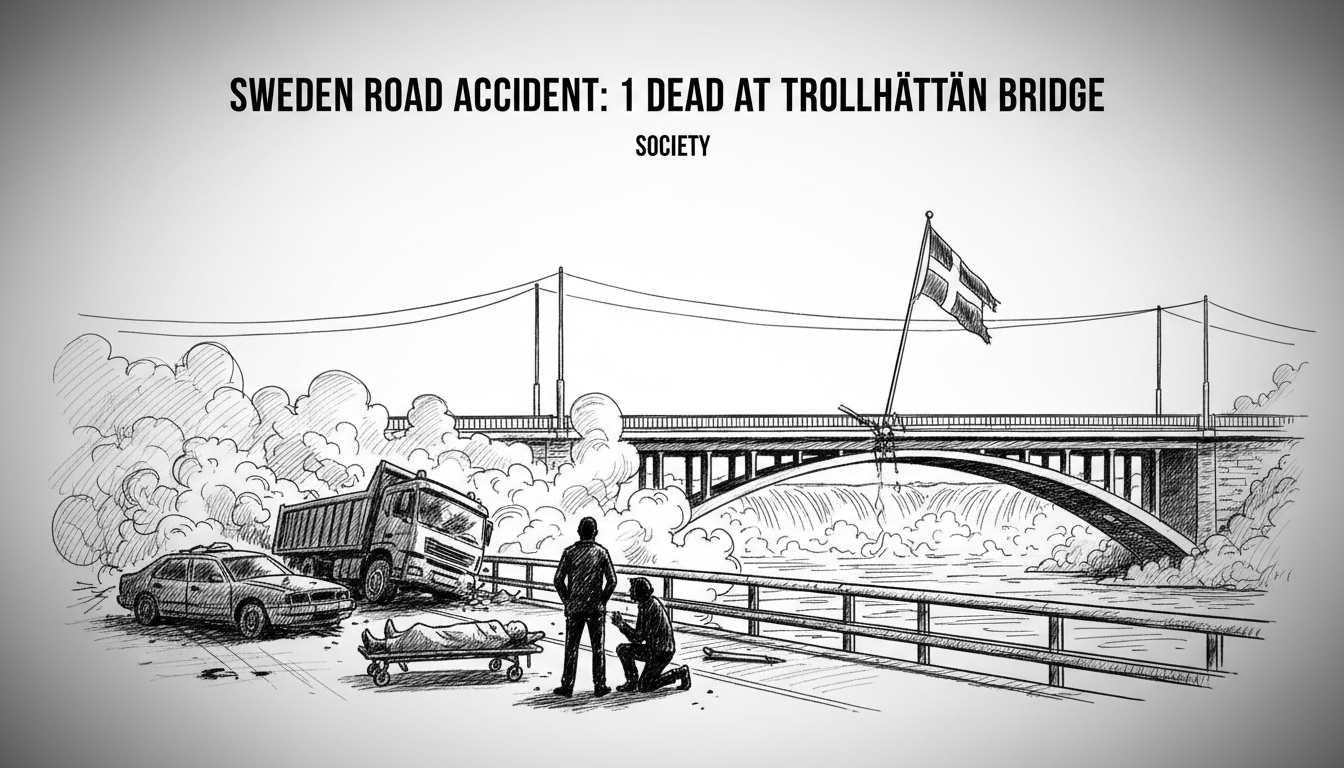
Sweden road accident investigators are piecing together the events that led to a fatal head-on collision at Klaffbron in Trollhättan. A 75-year-old man died following the crash on Thursday. Police have opened an investigation into negligent driving to understand what happened on this key bridge over the Göta älv river.
For residents of this industrial city, the news cast a pall over a familiar landmark. Klaffbron, or the 'flap bridge,' is more than just infrastructure. It is a daily crossing point for thousands, connecting parts of the city divided by the wide, slow-moving river. The bridge's distinctive lifting mechanism is a symbol of Trollhättan's engineering heritage, a city built on the power of water and the precision of manufacturing.
A Community Reacts to Tragedy
News of the accident spread quickly through the city of 50,000. While police have not released the victim's name, the tight-knit nature of Swedish towns means many will feel the loss. "You hear the sirens and you hope for the best, but your stomach drops," said Erik Lund, a local café owner whose shop overlooks the bridge approach. "This bridge is part of our daily rhythm. It's tragic to think of such a thing happening there."
The collision resulted in two people being initially transported to the hospital. The 75-year-old man later succumbed to his injuries. The police investigation into vårdslöshet i trafik—negligent driving—is standard procedure in serious accidents. It aims to rule out factors like excessive speed, distraction, or a medical episode behind the wheel.
The Crucial Role of Klaffbron
To understand the impact of this Trollhättan car accident, one must understand the bridge's role. Klaffbron is a bascule bridge, a type of movable bridge that uses a counterweight to lift a section of the roadway. It allows both road traffic and river vessels to pass, serving as a vital link in the Göta Canal system, a historic waterway connecting Gothenburg to Stockholm.
"It's a critical pinch point," explained traffic analyst Mia Pettersson, who has studied regional infrastructure. "When the bridge is raised for a boat, traffic backs up. When it closes, there's a surge. Drivers can become impatient or distracted by the unique mechanics of it. Every bridge has its own traffic personality, and Klaffbron's is defined by these intermittent interruptions."
This context is crucial for investigators. They will examine sightlines, road markings, and traffic signals on the bridge approach. They will also look at whether the bridge's status—open or closed—played any role in driver behavior leading up to the collision.
Sweden's Road Safety Landscape
This fatal accident occurs against the backdrop of Sweden's globally renowned 'Vision Zero' traffic safety policy. Adopted in 1997, Vision Zero aims to eliminate all traffic fatalities and serious injuries. The approach shifts responsibility from solely the driver to include road designers and policymakers, emphasizing that human error is inevitable but deaths are not.
While Sweden has one of the world's lowest rates of traffic fatalities, each death is a stark reminder that the goal is not yet met. "Vision Zero is a marathon, not a sprint," said Pettersson. "It relies on continuous improvement of vehicles, roads, and driver education. An investigation like this one in Trollhättan isn't just about assigning blame. It's a forensic look at the system. Could the road design be safer? Were the signs clear? Every detail matters."
The policy has led to tangible changes: widespread use of 2+1 roads with barrier separation, lower urban speed limits, and aggressive targets for drunk-driving reduction. However, rural roads and older infrastructure, like many bridges, remain challenging areas for full implementation.
Trollhättan: A City Forged in Steel and Water
The tragedy touches a community with resilience in its DNA. Trollhättan is famous as the longtime home of Saab Automobile and now hosts electric vehicle startup Polestar. Its identity is intertwined with precision engineering and transportation. The city's very existence is shaped by the waterfalls of the Göta älv, which were harnessed for industry.
This industrial past creates a population deeply familiar with both the power of machinery and the importance of safety protocols. "We are a city that builds things, that moves things," reflected local historian Jens Falk. "From the canal to the cars, we understand systems and risk. That makes a loss like this on our own bridge feel particularly sharp. It hits at our sense of competence."
Community response in such situations often follows a characteristically Swedish pattern: quiet support, respect for the investigative process, and a collective reflection on safety. There is less public speculation and more trust in the authorities to conduct a thorough inquiry.
What Comes Next in the Investigation
The police investigation will be methodical. Officers will comb through vehicle data recorders, if available, and interview witnesses. They will reconstruct the vehicles' paths and examine forensic evidence from the scene. The charge of negligent driving requires proving that a driver failed to exercise the care required by the circumstances, a standard below the more severe charge of reckless driving.
For the victim's family, the process is a painful accompaniment to grief. Sweden's strong social safety net provides support, but the sudden, violent nature of a traffic death leaves a unique scar. Local parish churches and community centers often become quiet hubs for support in these moments, even in a highly secular society.
The bridge itself, after evidence collection, will have returned to its normal rhythm. Cars will cross, boats will signal for passage, and the counterweights will rise and fall. But for those who knew the man who died, and for a city mindful of its safety record, the crossing will hold a new, somber significance.
This single accident on a Thursday in Trollhättan is a data point in Sweden's traffic safety statistics. It is also a profound human story, a reminder that behind the steady progress of Vision Zero are individual lives, familiar roads, and communities that feel each loss deeply. The ultimate test of any safety system is not just in broad trends, but in preventing the next tragedy at a specific bridge, on a specific day, for a specific person driving home.