
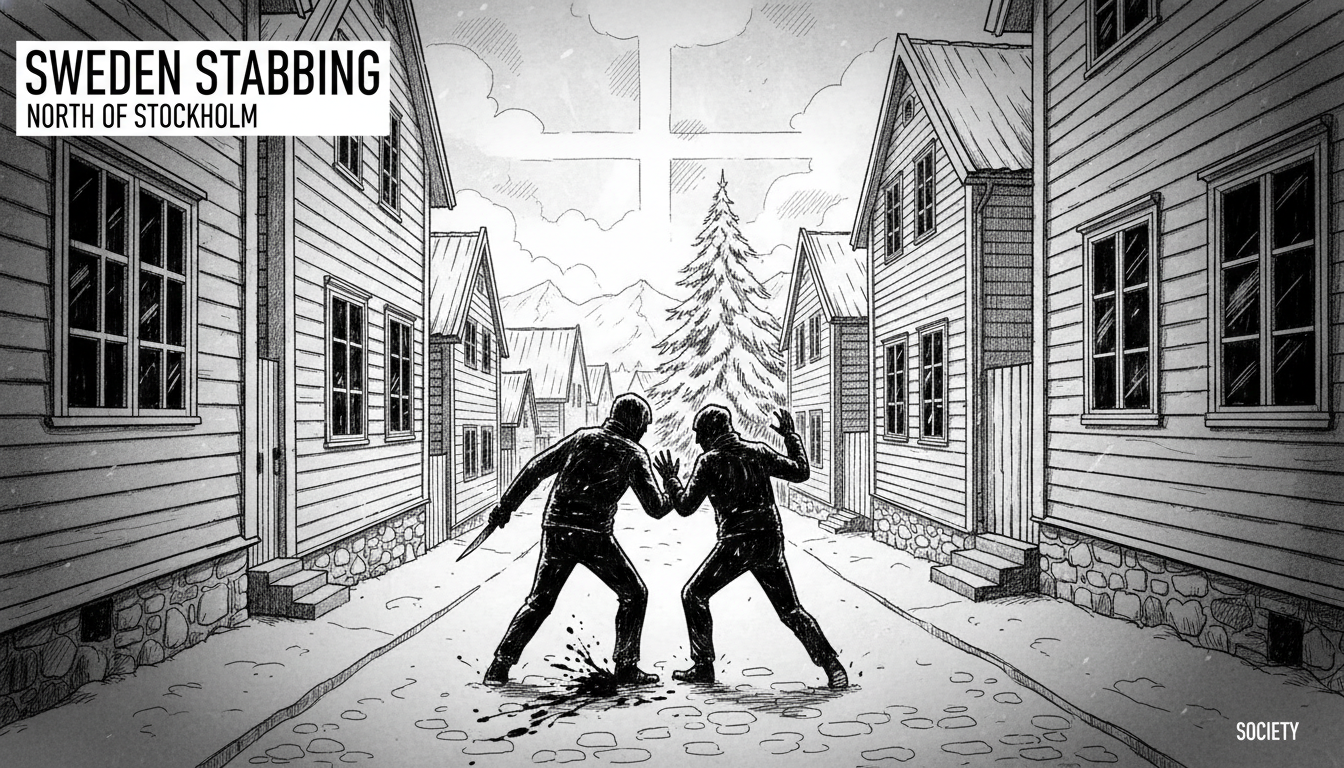
Sweden police are investigating after two men were found with stab wounds in Upplands Väsby early Wednesday morning. The alarm came in just before 7:30 AM. Both victims were taken to hospital by ambulance. Their conditions and any potential suspects remain unclear as police work to piece together what happened in this quiet suburb north of the capital.
A Quiet Morning Shattered
Residents of Upplands Väsby woke to an unusual sight. Police tape cordoned off an area as officers moved methodically through the neighborhood. The morning commute traffic flowed past, but many drivers slowed, craning their necks to see the flashing blue lights. For a municipality known more for its shopping centers and commuter trains to Stockholm than violent crime, the scene felt jarring. "You don't expect this here," said a local shopkeeper who asked not to be named, glancing toward the police activity. "It's usually very calm, especially in the morning."
Police press spokesperson Anders Bryngelsson confirmed the basic facts but little else. "Two men were found with stab wounds," he said. "Both have been taken to hospital by ambulance." When pressed for details on the severity of the injuries or whether a suspect was being sought, he emphasized the investigation's early stage. "It is too early to go into that. So far, it is a rather unclear situation." This lack of immediate information is standard procedure, allowing investigators to secure the scene and gather evidence without public speculation interfering.
The Changing Face of a Stockholm Suburb
To understand the impact of such an event, one must understand Upplands Väsby itself. It is a classic Stockholm satellite: a municipality of around 50,000 people, where rows of apartment buildings and terraced houses are interspersed with patches of forest. For decades, it has been a bedroom community for those working in the capital, a 25-minute train ride from Central Station. Its identity is tied to this practicality—affordable housing, good transport links, and large retail parks like the massive IKEA and the Mall of Scandinavia just south in Solna.
But like many suburbs in the greater Stockholm region, Upplands Väsby has changed. Population growth, driven by both internal migration and international immigration, has altered its social fabric. New residents have brought new vitality, with a diversity of shops and restaurants. Yet this rapid change has also presented challenges. Municipal services strain to keep pace. Socio-economic gaps can become visible. This context is not an explanation for Wednesday's violence, but it forms the backdrop against which any incident is perceived by both residents and analysts.
A Broader Conversation on Violence
A single stabbing incident in a suburb does not define a nation's crime rate. Sweden consistently ranks as one of the safest countries in the world by global metrics. However, in recent years, a troubling trend of gang-related violence, often involving firearms and explosives, has captured headlines and political discourse. These conflicts are typically concentrated in specific urban neighborhoods and involve rival criminal networks. The morning stabbing in Upplands Väsby may be entirely unrelated to this pattern—a personal dispute, an isolated act. But its occurrence inevitably touches a nerve in the ongoing public conversation about safety and social cohesion.
"Every violent incident is serious and creates insecurity," says Lars Trägårdh, a historian and social commentator familiar with Swedish societal trends. "The challenge for Sweden is to address the very real, but sometimes localized, problems of gang crime without eroding the broader, and still very strong, sense of trust that holds society together." He notes that the immediate, massive police response to the Upplands Väsby incident is a testament to that system's functionality. The resources are deployed; the investigation begins. The societal contract, where citizens expect protection, is being honored.
Life Goes On, But Questions Linger
By midday Wednesday, the police tape in Upplands Väsby was likely gone. The forensic teams would have completed their initial work. Children played in schoolyards. People bought groceries. The rhythm of daily life in a suburb resumed. Yet beneath the surface, a community was left with questions. Who were the two men? What happened between them? Were they locals, or did the violence come from elsewhere? The lack of answers is the hardest part.
Local social media groups buzzed with snippets of hearsay and concern. Parents messaged each other, confirming their children were safe. The overriding sentiment was one of unsettling surprise. This is not the narrative of Upplands Väsby. Its story is one of practicality, of green spaces and commuter routines, not morning stabbings. The incident creates a cognitive dissonance for those who call it home.
The Path Forward for a Community
The coming days will be crucial. Police will work to establish a motive and sequence of events. The medical condition of the two men will become clearer. The community will watch for updates, hoping for reassurance that this was an anomaly. Local politicians may face questions about police presence and prevention efforts. This is the anatomy of a local crisis in modern Sweden: a swift official response, a media spotlight that soon moves on, and a community left to process the event on its own terms.
For Sweden as a whole, the incident is a tiny data point in national crime statistics. But for Upplands Väsby, it is a story that will be told and retold. It becomes part of the local lore, a reference point. "Remember that morning when..." The ultimate impact depends on what happens next. Does it become a forgotten blip, or a catalyst for deeper conversations about conflict resolution, youth engagement, or social services in the suburb? The answer lies not just with the police investigation, but with the people who live there.
As the sun set over Stockholm County on Wednesday, the normalcy of Upplands Väsby felt both restored and fragile. The trains still ran on time. The lights in the apartment windows still came on. But somewhere, two families waited by hospital phones. And a community was reminded that safety, even in Sweden, is a precious and sometimes complex reality.