
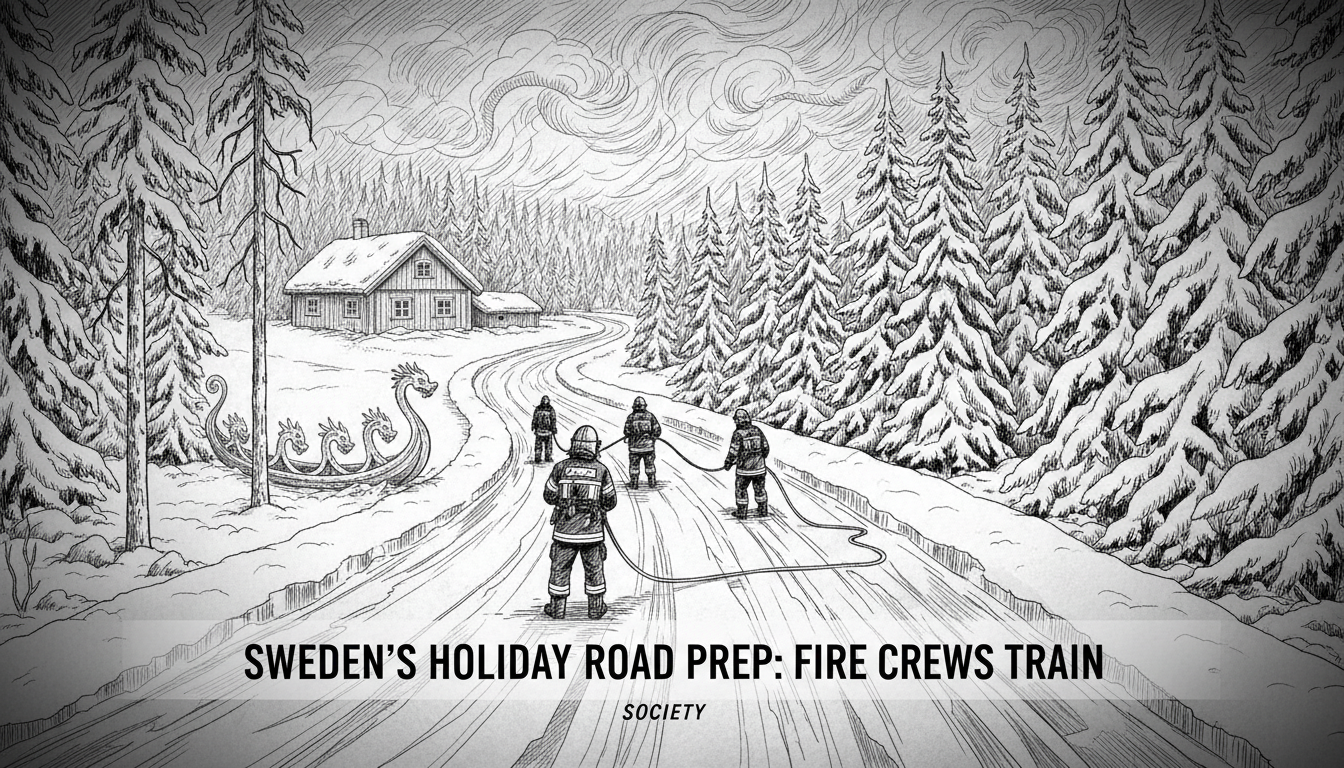
Swedish emergency crews are training intensely for the 220 annual road fatalities, a number that spikes during the high-risk Christmas travel period. At a station in the Stockholm region, the air fills with the shriek of metal. Firefighters from the Attunda department surround a mangled car, their hydraulic tools whirring as they practice peeling back the roof. Inside, a volunteer lies perfectly still, playing the role of a trapped victim. This is not a real accident. It is a meticulously planned drill, repeated across Sweden every December.
'It's unusual that we have trapped people requiring complex extrication,' says Gusten Jansson, a styrkeledare and instructor with Attunda brandkår. 'But when it happens, we need to be excellent at it.' His team is simulating the worst-case scenarios they might face on Sweden's roads over the coming weeks. The Christmas and New Year period sees a significant surge in traffic. Families travel long distances to celebrate julbord feasts in their hometowns. Icy roads and early winter darkness create a perfect storm of risk.
Behind the Scenes of a Rescue Drill
The training focuses on 'lossning' – the delicate art of freeing a trapped person without causing further injury. Firefighters must navigate shattered glass, deployed airbags, and potentially live electrical systems. They practice stabilizing vehicles, creating access points, and using specialized spreaders and cutters. The use of volunteer 'statister' is crucial. It adds a layer of psychological realism. Responding to a real person, even one who is acting, changes the dynamic compared to working on a dummy.
'You see the concentration on their faces,' observes Jansson. 'They're communicating with the person inside, assuring them while they work. That human element is something you can't fully replicate otherwise.' This training happens in communities from Malmö to Kiruna. It is a core part of Sweden's renowned Vision Zero approach to road safety. The policy aims to eliminate all traffic fatalities and serious injuries. It acknowledges that human error happens, so the system must be forgiving.
Why the Holidays Are a High-Risk Period
Sweden boasts one of the world's lowest road fatality rates. In 2022, there were roughly 220 deaths. This is a remarkable achievement for a country with long, dark winters. Yet, statistics show a consistent bump during the festive season. Traffic volume can double on major corridors like the E4. Drivers are often tired, stressed, or traveling in unfamiliar conditions. A quick after-work drive to a julmarknad in Stockholm's Gamla Stan turns into a long motorway journey.
'People are in a hurry to get home, to start their holiday,' says Lena Andersson, a road safety analyst based in Uppsala. 'They might be driving after a work party or a late night. The conditions are challenging. This combination requires extra vigilance from both drivers and emergency services.' The response system is a point of national pride. Local fire departments, medical services, and police coordinate closely. Regular, joint exercises ensure seamless cooperation when minutes count.
Expert Analysis: More Than Just Tools
Dr. Erik Malmsten, a professor of emergency medicine at Karolinska Institutet, stresses the importance of this training. 'Technical proficiency with equipment is just the baseline,' he explains. 'What these exercises build is situational awareness and decision-making under pressure. A trapped victim might have unseen spinal injuries. The team must work out the optimal sequence of cuts. They must manage the patient's pain and fear. It’s a high-stakes puzzle.'
He connects this directly to Vision Zero's success. 'The Swedish model isn't just about safer cars or better roads. It's about the entire chain of survival. From the moment the call comes in to the moment the patient reaches the hospital, every link must be strong. This training strengthens one of the most critical links.' Public awareness campaigns also ramp up in December. Authorities remind drivers to check winter tires, plan for delays, and never drive impaired.
A Cultural Commitment to Safety
This preparedness reflects a broader Swedish societal trait: a deep-seated commitment to collective safety. The concept of 'förebyggande arbete' – preventive work – is valued. Spending resources to train for emergencies, even for statistically rare events like complex extrications, is seen as a public duty. It is the practical application of the welfare state principle. For the firefighters, the hope is always that their skills won't be needed.
As the Attunda crew wraps up their drill, the 'victim' is carefully placed on a stretcher. The team debriefs, discussing what went well and what could be sharper. They will do this again before the holiday rush. Their readiness is a quiet promise to the millions who will take to the roads. A promise that if the worst happens on a dark, icy road this Christmas, skilled hands will be there to help. The real goal, shared by every crewmember and road safety expert, is for families to gather safely around the candlelit tree, with no emergency calls interrupting the festive silence.