
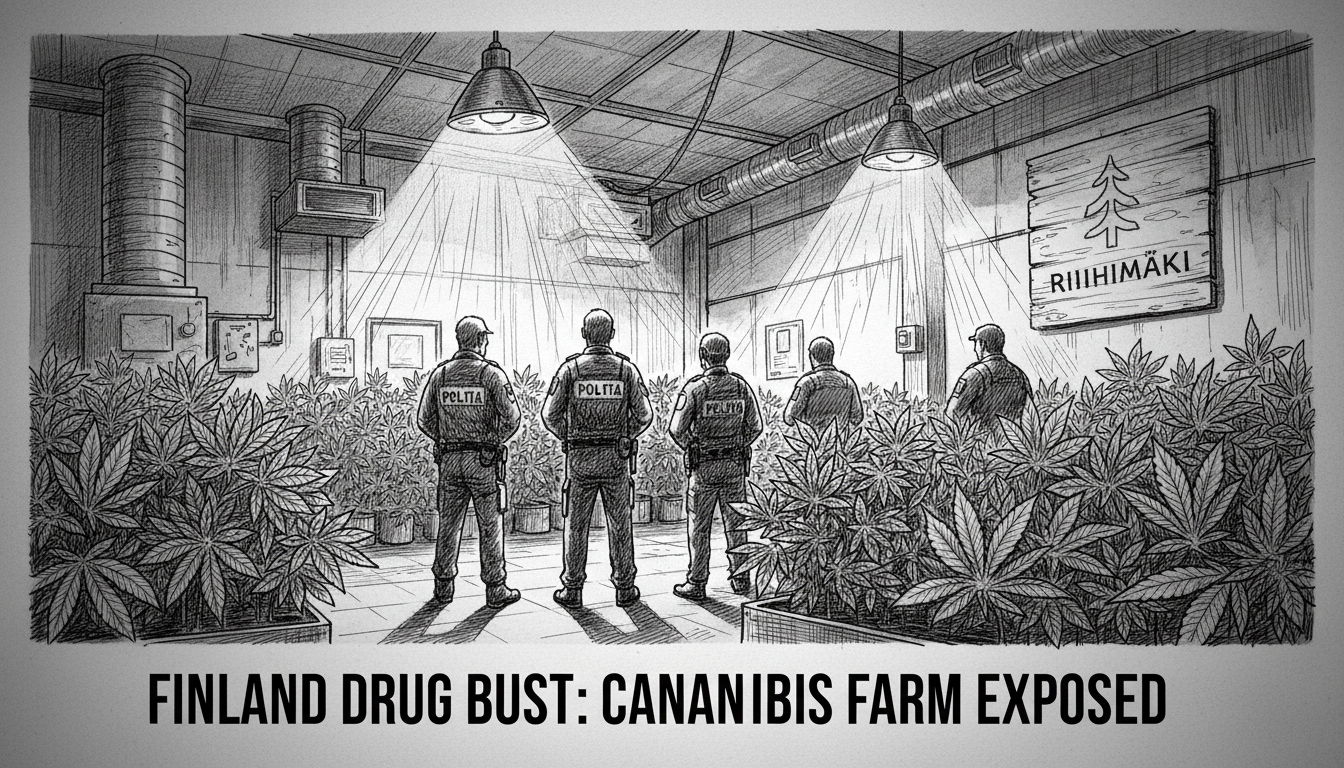
Finland drug crime investigations often start with one call and uncover a much larger operation. Police in the town of Riihimäki arrived at a detached house in the Jukola district to investigate a reported assault. What they found behind the door was a significant indoor cannabis cultivation facility, linking violent crime directly to narcotics production in a quiet residential neighborhood. This case highlights the complex challenges facing Finnish authorities as drug offenses climb nationwide.
A woman under thirty years old received a conviction for a narcotics crime related to the farm's operation. Three men were separately convicted for assaults that occurred on the property, directly connecting the violence that prompted the police call to the drug production activity. The discovery in Riihimäki, a commuter town north of Helsinki, shows how organized drug production has spread beyond major urban centers.
From Assault Call to Drug Farm Discovery
The sequence of events in Riihimäki demonstrates how different criminal activities frequently intersect. Officers from the Häme Police Department were dispatched following reports of a physical altercation. While securing the scene and interviewing those involved, evidence of the cannabis cultivation operation became apparent to investigators. This led to a full search of the premises under Finland's Narcotics Act.
Finnish police procedures mandate a thorough investigation when signs of drug production are found. The discovery of lighting systems, irrigation, and a large number of cannabis plants transformed a routine assault call into a major narcotics case. This incident is not isolated. Authorities note a growing trend where drug production sites are linked to other crimes, including violence, theft of electricity, and financial fraud.
Analyzing Finland's Rising Drug Crime Statistics
This case fits into a broader national pattern of increasing drug-related crime. Official statistics show a steady rise in narcotics offenses over the past ten years. Cannabis-related crimes constitute a substantial portion of this increase. In 2022 alone, Finnish Customs seized a record-breaking 1,600 kilograms of cannabis, indicating both heightened enforcement and greater supply flows.
Law enforcement agencies report that domestic cultivation has become more common, partly to avoid international border controls. Small-scale farms like the one in Jukola can produce significant quantities for local distribution networks. The Finnish National Police Board's annual reports consistently flag drug crime as a primary threat to public order and safety, consuming considerable investigative resources.
The Legal Framework and Policy Response
Finland prosecutes drug crimes under its Narcotics Act (Laki huumausaineista 373/2021). The law penalizes manufacture, production, and distribution, with sentencing guidelines that consider the scale and sophistication of the operation. The woman convicted in the Riihimäki case was sentenced under these provisions. The simultaneous assault convictions show how prosecutors can address multiple criminal strands from a single police intervention.
Finland's drug policy operates on a dual track of harm reduction and law enforcement. The Ministry of Social Affairs and Health oversees prevention and treatment services, while the Ministry of the Interior and the Police lead enforcement. This model aims to reduce both supply and demand. However, experts debate its effectiveness as seizure numbers and related crimes continue to rise. The government's current strategy emphasizes early intervention and targeting organized criminal groups behind production and trafficking.
Expert Perspectives on Crime and Policy
Criminologists point to the Riihimäki case as a textbook example of the nexus between drug crime and violence. "These operations are not victimless or peaceful," says Dr. Lena Koski, a researcher at the University of Helsinki's Institute of Criminology. "They exist in a shadow economy where disputes are settled with violence, not courts. The police response to the assault was the critical entry point that uncovered the larger crime."
Other analysts question whether current policies adequately address the root causes. "Record seizures show we are intercepting more, but the market persists," notes policy analyst Marko Tuominen. "There is an ongoing debate about whether resources are best spent on high-intensity enforcement against users and small-scale producers, or if a greater focus on high-level trafficking networks and social support would yield better long-term results." This debate is active within the Eduskunta, Finland's parliament, especially as neighboring countries reassess their cannabis policies.
The Local Impact in Riihimäki and Beyond
For residents of Jukola, the discovery was a shock. Such neighborhoods are typically characterized by low crime rates and family homes. The presence of a drug production facility undermines community safety and property values. It also raises concerns about electrical fire hazards and potential exploitation of vulnerable individuals, which are common in such operations.
The case has prompted local officials to call for stronger cooperation between police, social services, and customs. The focus is on identifying properties that may be used for criminal purposes through irregular energy consumption or unusual visitor patterns. Municipalities are increasingly aware that drug crime is not confined to city centers, requiring a vigilant approach across all regions.
Looking Ahead: Challenges for Finnish Law Enforcement
The Riihimäki cannabis farm discovery underscores a persistent challenge. Finnish police must balance reactive responses to calls about violence with proactive intelligence-gathering on drug networks. The integration of EU-wide law enforcement cooperation through Europol is crucial for tracking cross-border aspects of drug trafficking that supply domestic markets.
Future efforts will likely involve more sophisticated financial investigations to follow the money generated by such farms. The National Bureau of Investigation has prioritized dismantling the economic foundations of organized crime. As long as demand exists, the incentive for criminal groups to establish production sites in towns like Riihimäki remains strong. The success of Finland's approach will depend on its ability to adapt to evolving criminal methods while maintaining focus on community safety and harm reduction. Will the blend of enforcement and social policy eventually reverse the trend of rising drug crime, or does this case in a quiet district signal a deeper, more entrenched problem?