
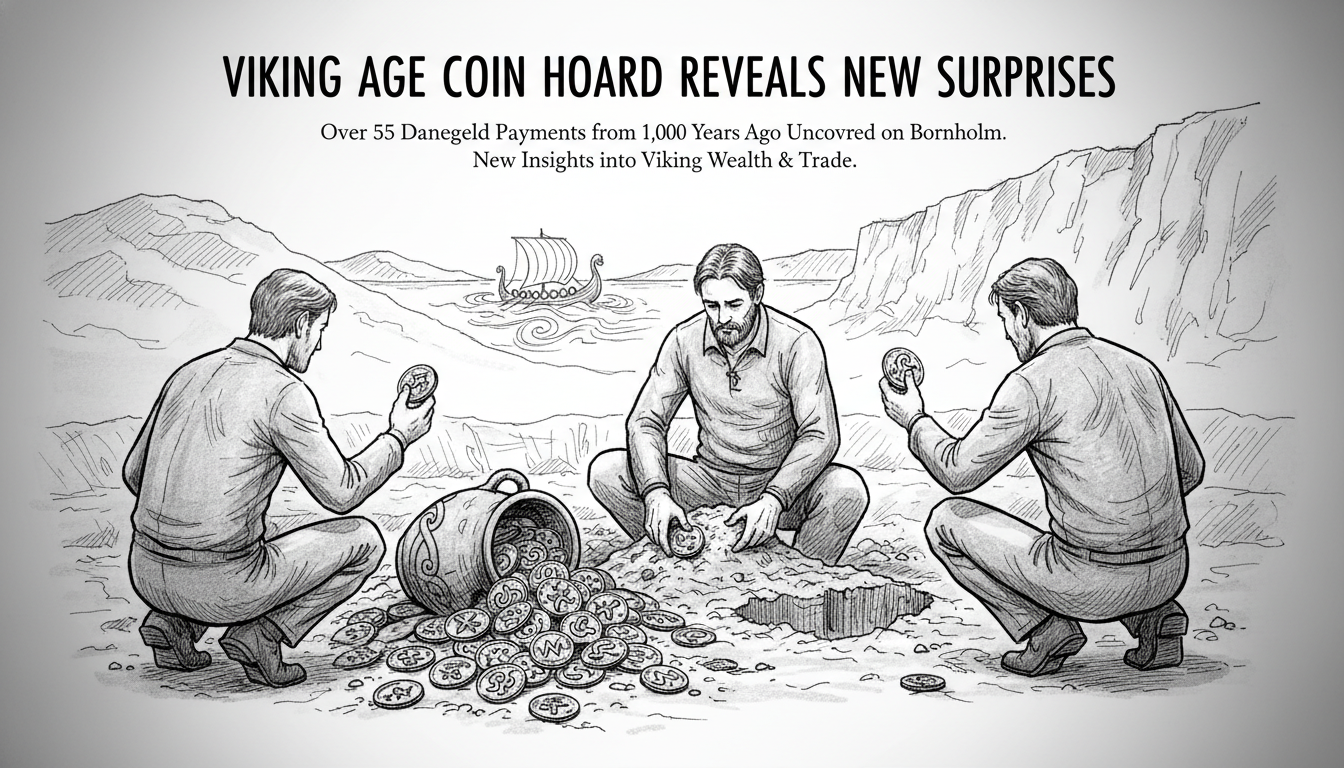
Archaeologists continue to uncover surprises from a major coin hoard discovered earlier this year between Sorte Muld and Svaneke on Bornholm. The size of the treasure has exceeded all expectations.
René Laursen carefully works to free silver coins from a large lump of earth using a small wooden stick. His current project involves excavating this significant coin collection.
An amateur archaeologist initially found a bucket-sized clump of earth containing silver coins earlier this year. Neither he nor the museum knew how many coins were hidden inside.
"We only had four visible coins at the start, and it has developed from there," said René Laursen, a treasure registrar and conservator at Bornholms Museum.
The coins in the earth clump form part of a larger discovery in a field where archaeologists found more coins of the same type scattered across the area.
The museum believes the coins originated from Danegeld payments about 1,000 years ago. Danegeld was money paid by other countries to Viking kings to avoid raids and plundering.
How these numerous coins ended up buried in the earth remains unknown. The discovery could provide valuable insights for archaeologists studying Viking Age trade and wealth.
The coins show remarkable preservation despite their age. "Some are completely uncirculated. They look like new," Laursen explained while gently washing one coin in a water bath.
Other coins bear marks and were deliberately bent. "People tested the silver this way to verify its quality," Laursen noted. "And it is good quality silver."
The excavation seeks more than just silver coins. The real historical value lies in the stories hidden within the soil.
"These coins likely traveled extensively. They went on expeditions," Laursen suggested.
In October, the museum displayed the earth clump and invited visitors to guess how many coins it contained. Estimates varied widely.
"There were many guesses. Some went up to several thousand, which I don't think we'll approach," Laursen commented.
His own prediction fell short. "We've now passed 50 coins. I wasn't optimistic and said there were 13. That's far below the actual number," he admitted with a wry smile. "I'm obviously pleased there are substantially more."
During initial excavations of the clump, Laursen and chief archaeologist Jens Berthold counted their findings. "55 so far," Laursen concluded.
"There's room for at least 10 more," Berthold added. Both men nodded in agreement.
Once fully excavated, the coins will go to the National Museum for registration. Bornholms Museum hopes to eventually display the coins locally.
The discovery highlights how much remains unknown about Viking Age commerce and wealth storage practices in the Baltic region. The excellent condition of these coins suggests they were carefully hidden rather than lost in conflict.