
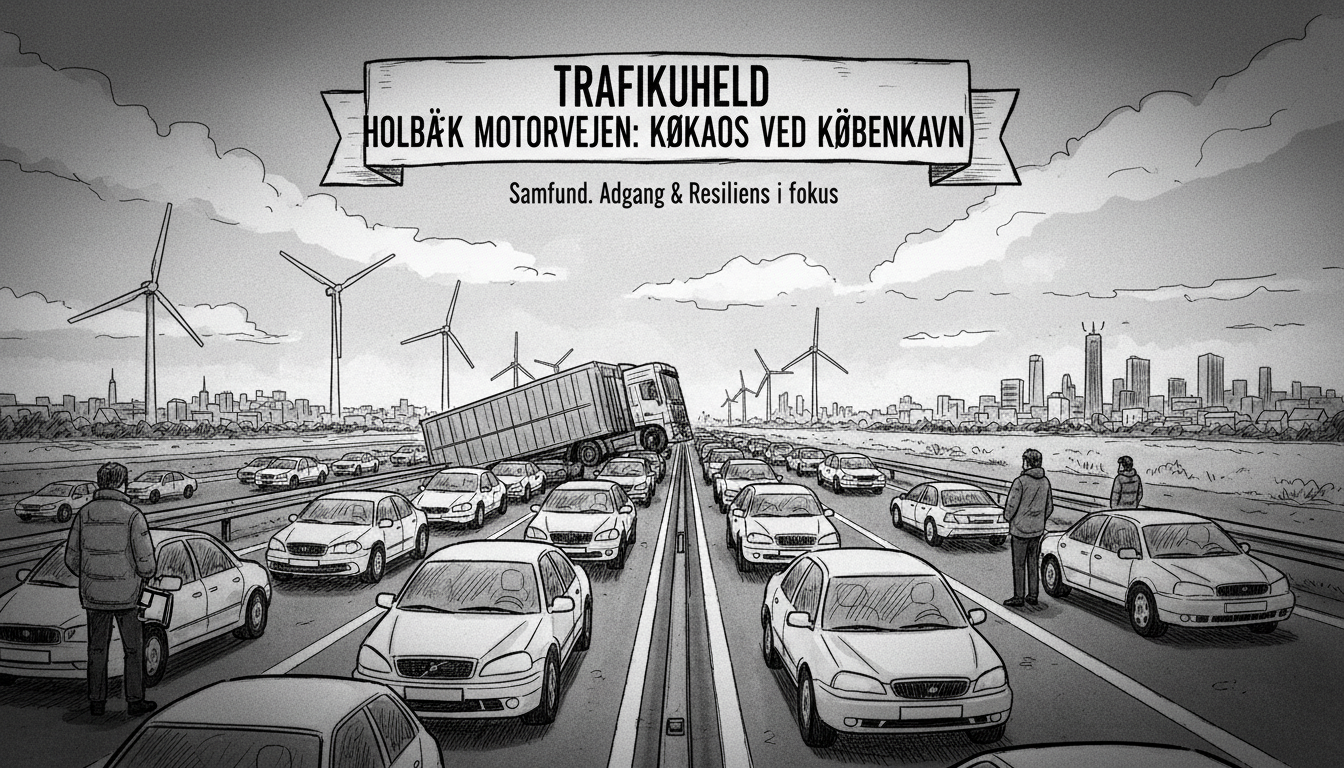
A serious accident on the Holbæk Motorway created major traffic disruptions for commuters traveling from Copenhagen towards Roskilde on Friday. A truck left the roadway and ended up in the roadside verge, triggering several kilometers of congestion during the morning commute. Emergency services responded to the scene between the Høje Taastrup C and Høje Taastrup S exits. Traffic authorities reported rescue units were on site managing the incident. The disruption highlights the vulnerability of key transport corridors around the Danish capital and their impact on daily life.
For international observers and new residents, such traffic incidents reveal more than just temporary inconvenience. They underscore the interconnected nature of Danish infrastructure and urban planning. The Holbæk Motorway is a critical artery connecting Copenhagen's western suburbs and major satellite cities like Roskilde. Delays here ripple through the entire regional transport network, affecting buses, delivery schedules, and regional train connections that many rely on. This is particularly relevant for commuters living in these suburban municipalities, where integration often hinges on reliable access to employment and education centers in the capital.
From a social policy perspective, consistent transport access is a silent pillar of the Danish welfare model. The ability to get to work, language schools, or community centers on time is not a trivial matter. Studies from the Ministry of Immigration and Integration show that transportation barriers are a frequently cited obstacle for new citizens seeking to establish themselves. When major roads fail, it disproportionately affects those with less flexible work hours or those traveling longer distances from more affordable housing areas outside the city core. Municipal social centers in places like Høje Taastrup often note that clients list commuting as a primary concern during their integration process.
So what does this mean for Copenhagen integration efforts? Reliable infrastructure is a prerequisite for social cohesion. When systems everyone depends on falter, it tests the social contract. The incident serves as a real-time stress test for the region's preparedness. It also raises questions about contingency planning and public communication during crises, especially for non-Danish speakers who may not follow local traffic radio. Officials have been working to improve multi-language alert systems, but real-world events prove their necessity. The response to this single truck accident, therefore, becomes a small but telling indicator of systemic resilience.
The broader conversation in Danish society news often centers on grand policy, but daily life is built on these mundane realities. A blocked motorway is a tangible event that connects high-level discussions about Danish welfare system sustainability with the lived experience of thousands. It reminds us that social policy is not just about laws and budgets, but about the functional infrastructure that allows people to participate fully in society. For a nation proud of its efficiency and design, such disruptions are more than traffic news—they are moments where the underlying systems are laid bare for public examination and, ultimately, public judgment.