
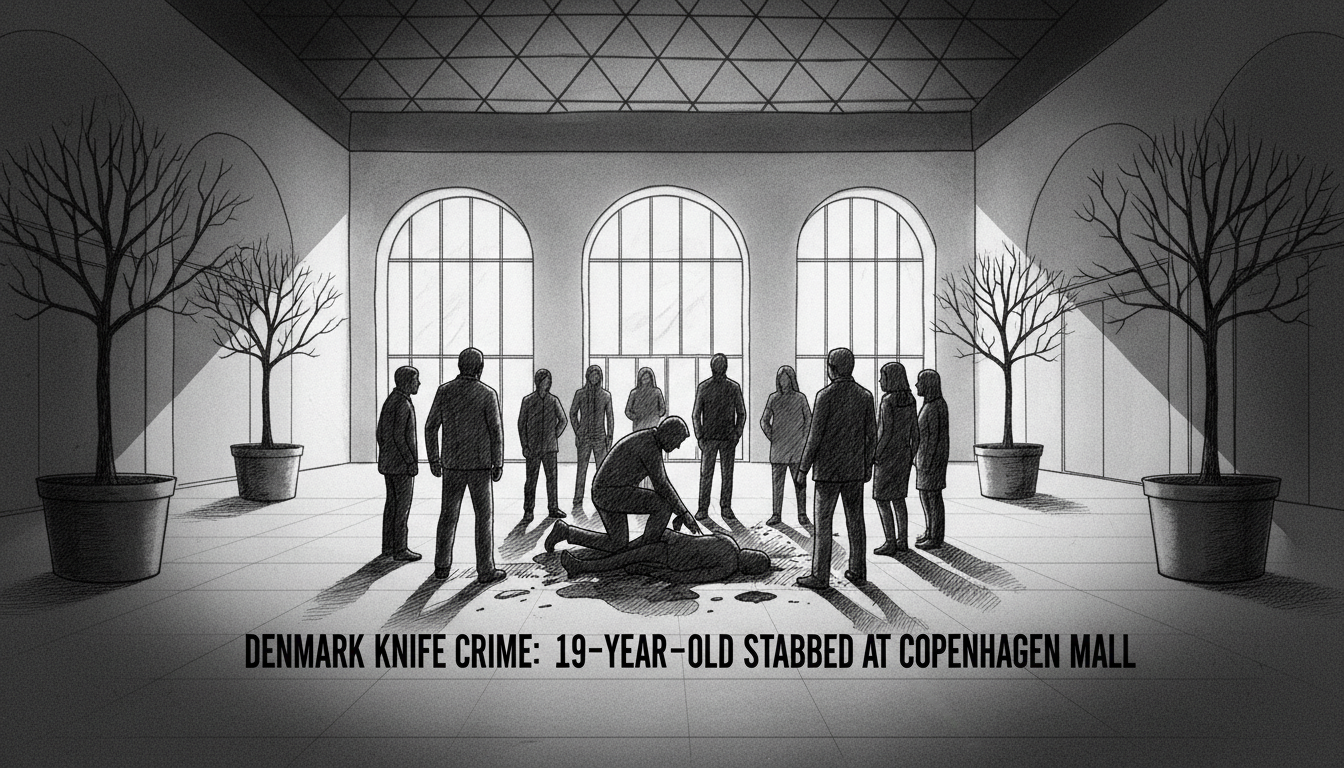
Copenhagen police are investigating a Friday evening stabbing at Amager Centret that left a 19-year-old woman injured. A 20-year-old man, known to the victim, is in custody following the attack inside the busy shopping center. The incident has ignited familiar discussions about public safety and the social roots of violence in the Danish capital.
The victim, described by police as "lightly injured," was treated at the scene and is now in stable condition. Copenhagen Police watch commander Rasmus Nielsen stated the two individuals were previously acquainted. "We have a presumption that the two people had prior knowledge of each other," Nielsen said. Officers remained on site conducting investigations, though no wider evacuation of the mall was necessary. Police assessed there was no major public disturbance linked to the event.
A Friday Night at Amager Centret
Amager Centret is a sprawling retail hub serving a diverse community in south Copenhagen. On a typical Friday evening, its corridors are filled with families shopping, teenagers socializing, and residents running errands. The sudden violence pierced this routine. While such knife attacks are not an everyday occurrence in Denmark, they resonate deeply when they happen in communal spaces. The location amplifies public anxiety, transforming a place of commerce and connection into a site of potential danger. This incident disrupts the sense of security many Danes associate with their well-ordered public squares and welfare society.
The Known Acquaintance Factor
The police's quick assertion of a prior connection between victim and suspect is a crucial detail. It shifts the narrative from a random act of public terror to a more personal, possibly targeted, conflict. This distinction is vital for public perception but does little to diminish the trauma for mall patrons or the broader community concern. Interpersonal violence spilling into public view challenges the Danish social contract, where the private and public spheres are often kept distinct. It forces a confrontation with domestic disputes, relationship violence, and mental health crises that can erupt beyond the home.
Copenhagen's Knife Crime Context
Knife crime in Denmark, particularly in Copenhagen, exists at a lower frequency than in some major European cities, yet it remains a persistent concern for law enforcement. The Copenhagen Police have long prioritized tackling gang-related violence, where knives are frequently used. Initiatives have included increased patrols in hotspot areas, weapon amnesties, and targeted operations against known groups. The Amager Centret stabbing, given the alleged personal connection, may fall outside typical gang violence patterns. This complicates the prevention picture, suggesting a need for strategies that address broader societal issues beyond organized crime.
Statistical data provides a backdrop. According to Statistics Denmark, police recorded 68 homicides in 2022. The preliminary figure for 2023 shows a decrease to 58. While not all homicides or violent assaults involve knives, these numbers indicate the overall scale of serious violence in a nation of 5.9 million people. Each case represents a profound failure, a point where social and preventive systems did not reach those in crisis.
Seeking Solutions Beyond Policing
Experts consistently argue that lasting solutions require looking beyond law enforcement. "Police intervention is essential for immediate safety, but it is a reactive tool," notes a Copenhagen-based social researcher specializing in urban conflict. "Sustainable prevention requires investing in our social infrastructure—youth clubs, mental health services, conflict mediation, and integration programs. We must catch problems long before someone picks up a knife." This view echoes within many Danish municipalities, which operate extensive social services aimed at early intervention. Copenhagen's district councils fund outreach programs, school psychologists, and community centers designed to provide support networks.
Integration policy is frequently part of this conversation. Areas like Amager have diverse populations, including immigrant communities facing higher risks of social marginalization. Effective integration, through language education, job training, and social inclusion initiatives, is seen as a critical long-term crime prevention strategy. The Danish welfare model is predicated on inclusion and equal opportunity; where those pillars weaken, social tensions can rise.
The Community Pulse in Amager
Local community leaders in Amager stress resilience but acknowledge worry. "Our community is strong, but people are naturally shaken," says a volunteer at a nearby community house. "Parents ask if the mall is safe for their kids. We must address these fears directly, through dialogue and visible community cohesion, not just police reports." This sentiment highlights the dual challenge: restoring a sense of security while tackling the complex causes of violence. The shopping center management, like many public space operators in Denmark, now constantly balances open access with security considerations.
A Path Forward for Danish Society
The stabbing at Amager Centret is a single, acute event. Its resolution appears straightforward with a suspect in custody. Yet its echoes touch on enduring questions for Danish society. How does a nation with a strong welfare state and high social trust prevent interpersonal violence? Can community policing and social programs work in tandem to identify and help individuals on a destructive path? The answers are not found in a single ministry or police directive but in the day-to-day work of teachers, social workers, community volunteers, and yes, police officers, building trust and providing pathways away from conflict.
For now, Copenhagen Police continue their investigation. The victim recovers. The mall resumes its daily rhythm. But the underlying search for a safer, more cohesive society continues, a task that remains central to the Danish project. As one city councilor put it, "Our ambition is not just to solve crimes, but to prevent the conditions that make them thinkable in the first place. That is the harder, longer work we are all engaged in." This incident serves as a stark reminder that this work is never truly complete.