
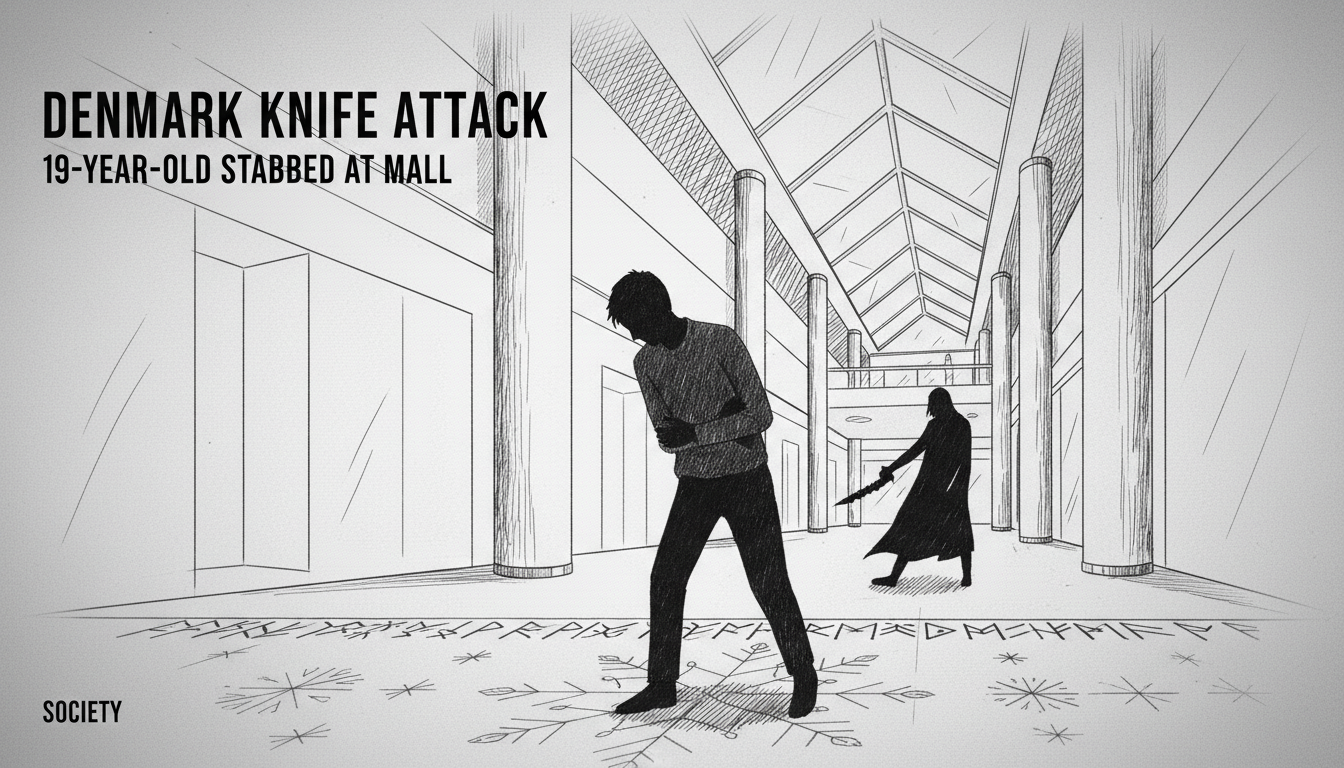
Denmark crime news this weekend centers on a stabbing at a Copenhagen shopping center that has left a community unsettled. A 19-year-old woman was stabbed with a knife at Amager Centret on Friday evening. Police have arrested a 20-year-old man in connection with the attack. The victim is in stable condition with what authorities describe as minor injuries. The incident occurred in a busy public space, yet police say it did not cause major public disturbance. Their initial assessment suggests the victim and suspect knew each other prior to the violent encounter.
This act of violence inside a familiar community hub strikes a particular chord. Amager Centret is not just a mall; it is a central meeting point for families, teenagers, and seniors in the borough. The fact that such an attack could happen there, on an ordinary Friday evening, challenges the sense of security many Danes associate with their well-ordered public spaces. While the victim's physical injuries may be minor, the psychological impact on witnesses and the local community can be profound. It raises immediate questions about safety, conflict resolution, and the underlying social dynamics that lead to violence among young people.
A Community Hub Disrupted by Violence
Amager Centret is one of Copenhagen's largest shopping centers, serving as a commercial and social anchor for the island of Amager. It is a place where daily life unfolds—grocery shopping, meeting for coffee, children playing in designated areas. The stabbing incident, therefore, feels like a violation of a shared communal space. Police were quick to secure the scene and conduct their investigation without needing to evacuate other visitors. This indicates a contained event, but its location ensures it reverberates widely. Copenhagen Police duty officer Rasmus Nielsen stated the investigation is ongoing at the scene. He emphasized the police's working theory of a prior connection between the individuals involved. This detail is crucial for public understanding and fear. It suggests this was not a random attack on a stranger, which statistically are far rarer, but likely stemmed from a personal dispute.
For residents, the distinction between targeted and random violence offers little immediate comfort. The visual of police tape in a shopping center, a place designed for leisure and convenience, is deeply disruptive. It momentarily transforms a space of normalcy into one of crisis and investigation. Local community leaders often emphasize the importance of these centers as integrated social spaces, especially in diverse urban areas. An act of violence here can feel like an attack on the very idea of peaceful coexistence and public trust. It tests the resilience of the community's shared sense of safety.
Understanding Knife Crime in the Danish Context
Knife crime in Denmark exists at a significantly lower level than in many other European nations, yet each incident generates substantial public and political attention. Danish crime statistics show that serious violent crime has remained relatively stable over the past decade, with fluctuations. Homicides using knives or sharp instruments are uncommon. When they do occur, they often, as police suspect in this case, involve individuals known to each other. This pattern is consistent with global criminological data on interpersonal violence. The fear, however, is disproportionate to the statistical risk. This is because such attacks in public places shatter the perceived social contract of safety in everyday life.
Experts point to a complex mix of factors behind youth violence, including social marginalization, group dynamics, and the accessibility of weapons. Knives, unlike firearms, are easily obtainable household objects. A criminologist from the University of Copenhagen, who spoke on background, noted that while Denmark's overall violent crime rate is low, concentrated challenges exist in certain urban neighborhoods. "The narrative often swings between two extremes," the expert said. "One is an overblown panic about lawlessness, and the other is a dismissal of real localized problems. The truth for Denmark is a generally safe society with specific, addressable pockets of conflict, often tied to social deprivation and lack of opportunity for young adults."
This incident will likely renew debates on policing, youth outreach, and weapon laws. Some political voices may call for stricter penalties for carrying knives in public or increased police patrols in shopping centers. Others will advocate for strengthened social preventive measures, arguing that addressing root causes like education gaps and youth club funding is more effective long-term. The Danish welfare model is predicated on prevention and social cohesion, making violent public incidents a particular focus for policy scrutiny.
The Human Impact Beyond the Headline
The clinical police description of the victim being "lightly injured" belies the traumatic experience. A 19-year-old woman faced a life-threatening assault in a place she likely considered safe. Her recovery will be more than physical. For other young people, especially women, who frequent Amager Centret, the incident may instill a lingering sense of vulnerability. It can change behavior, making individuals more cautious and less likely to engage freely in public spaces—a subtle erosion of social freedom.
Community reaction in the days following will be telling. Will there be calls for vigilante groups or private security, as seen in some other European contexts? Or will the response channel into existing community safety forums and dialogue with municipal authorities? Copenhagen has a network of local prevention councils and social centers that work on precisely these issues. Their role in facilitating community response and supporting youth conflict mediation is now more critical than ever. A local social worker in Amager, who asked not to be named, stressed the importance of calm. "Our job now is to listen to the young people in the area," the social worker said. "They hear the news, they use that mall. We need to address their fears and concerns directly, without amplifying hysteria. We also need to be there for any young person who might be spiraling into conflicts that could turn violent."
A Look at Security and Social Policy Responses
In the immediate aftermath, shoppers can expect a more visible police presence at Amager Centret and similar locations. Mall management will review its security protocols and camera coverage. This is a standard reactive measure. The more profound question for Danish society is proactive: How are conflicts among young people being identified and de-escalated before they reach a violent climax? Denmark's municipalities have extensive mandates for youth services, from schools and leisure clubs to specialized intervention programs for at-risk individuals. The effectiveness of these services varies across the country, often dependent on local funding and political priorities.
Integration policy also intersects with this discussion, as Amager is one of Copenhagen's most diverse boroughs. Successful integration is a powerful antidote to social alienation, which can be a factor in violence. When young people feel they have a stake in society, educational pathways, and legitimate economic opportunities, the appeal of resolving disputes through violence diminishes. Conversely, experiences of discrimination or blocked mobility can foster resentment and conflict. This stabbing is a single event with unknown specific motives, but it occurs within this broader societal framework. It inevitably becomes a data point in ongoing national conversations about social cohesion, the limits of tolerance, and the responsibilities of the welfare state to ensure safety for all.
As the police investigation continues, the story shifts from a breaking news alert to a deeper social reflection. Denmark remains one of the world's safest countries. Yet, its citizens' expectations for security and social harmony are exceptionally high. A knife attack in a shopping mall, regardless of the victim's relationship to the assailant, is a jarring reminder that no society is immune to sudden violence. The true test is not in preventing every single incident—an impossible task—but in how a community heals, learns, and strengthens its social fabric in response. Will this event lead to greater division and fear, or can it catalyze more connected, supportive, and vigilant community networks on Amager and beyond? The answer lies not with the police alone, but with every resident, educator, social worker, and local leader who believes in the promise of a peaceful public square.