
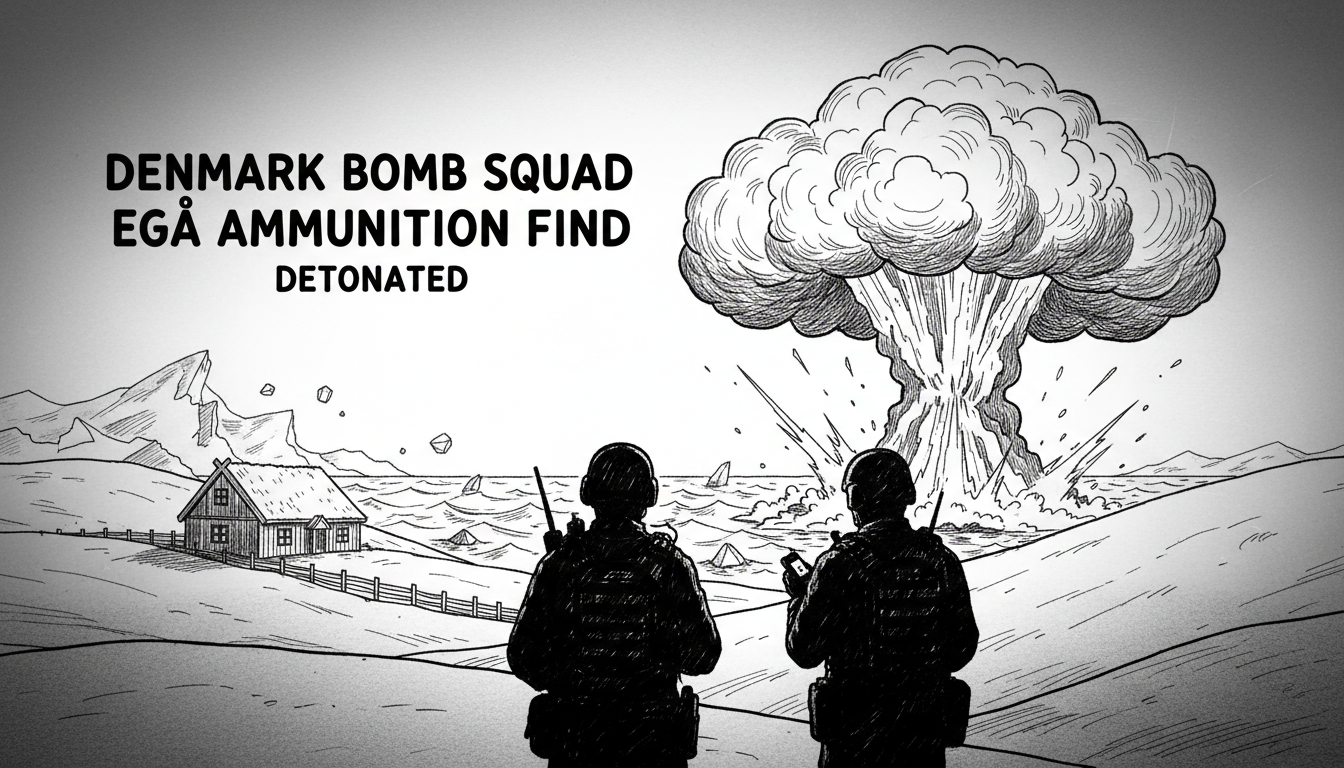
Denmark's East Jutland Police detonated a piece of old ammunition discovered by a family in Egå on Friday afternoon. The controlled explosion concluded a swift security operation that saw a green area near Åstrup Strandvej cordoned off for several hours. Police confirmed the area is now safe after the Explosive Ordnance Disposal (EOD) unit completed its work.
A family using a metal detector made the initial discovery, prompting an immediate call to authorities. "It is something that has been fired. So we suspect it is just a lump of iron. But we are not sure there is nothing inside," Mikkel Møldrup, the duty officer for East Jutland Police, explained. This uncertainty led to the decision for a controlled detonation on-site, a standard but cautious procedure.
Police used social media platform X to warn local residents about the impending blast. Their message was direct: "There will be a bang in the area." Authorities emphasized there was no danger to the public provided they respected the established safety perimeter and followed official instructions. The incident highlights the quiet, persistent legacy of military history embedded in the Danish landscape.
A Suburban Afternoon Interrupted
The scene at Åstrup Strandvej was one of orderly disruption. Police tape marked a clear boundary around a section of the grassy, public area in the quiet Aarhus suburb. For residents, the arrival of police vehicles and the distinct EOD truck signaled an unusual break in the routine of a Friday afternoon. Such discoveries, while managed with professional calm, serve as tangible reminders of past conflicts.
Metal detecting is a popular hobby in Denmark, often unearthing historical artifacts rather than hazardous materials. This find, however, fell into a category that requires immediate professional intervention. The family who discovered the item did exactly what experts and authorities consistently advise: they stopped, marked the location, and contacted the police without attempting to move or examine the object themselves.
The Persistent Shadow of Unexploded Ordnance
Discoveries of unexploded ordnance (UXO) are a recurring feature in Denmark. The country's geography and 20th-century history mean that remnants of military activity are still scattered across its territory. From World War II munitions to materials from later military exercises, these dangerous relics periodically surface, especially in coastal areas, old training grounds, and fields.
Each discovery triggers a well-rehearsed protocol involving local police and the national EOD unit. The procedure prioritizes public safety above all else, often leading to temporary road closures, evacuations, or area cordons. While most calls turn out to be for inert objects, the protocol mandates treating every potential piece of ordnance as live and dangerous until proven otherwise. This cautious approach has prevented civilian casualties for decades.
"The rule is simple: if you don't know what it is, you must assume it is dangerous," says a former EOD technician familiar with Danish procedures, who asked not to be named. "Corrosion can make old ammunition unstable and sensitive to movement. What looks like a harmless lump of rusted metal can contain live explosive material. The only safe action is to call the authorities and let professionals assess it."
Community Response and Safety Messaging
The police communication surrounding the Egå incident serves as a model for public information during such events. By clearly stating that a controlled explosion would occur and that a loud bang should be expected, they managed public anxiety and prevented misinformation. Telling residents there was "no danger" provided they stayed clear was a clear, effective safety instruction.
This transparent communication is a key part of Denmark's integrated safety approach. It builds public trust and ensures community cooperation, which is vital for the safe execution of disposal operations. In a densely populated suburb like Egå, ensuring everyone remains outside the cordon is the most critical factor for a safe outcome. The successful conclusion of this operation, with no injuries or property damage, underscores the effectiveness of this system.
Local municipalities often work with police to disseminate these warnings through official websites and social media channels. The goal is to inform without causing unnecessary alarm, a balance Danish authorities have refined through repeated experience. The message consistently reinforces that while the event is controlled, the underlying hazard is very real.
The Bigger Picture for Danish Society
While this single event in Egå was resolved efficiently, it points to a broader, ongoing national reality. Denmark allocates significant resources to its EOD capabilities, recognizing that the task of clearing historic ordnance is a long-term public safety commitment. These units are based strategically around the country to ensure rapid response times to discoveries anywhere from remote beaches to urban parks.
The financial cost of these operations is absorbed by the state as a non-negotiable aspect of national safety infrastructure. There is no bill sent to the individual who makes the discovery; the system is designed to encourage people to report finds without fear of penalty or cost. This policy is crucial for maintaining the high reporting rate that keeps communities safe.
Furthermore, incidents like the one in Egå occasionally reignite discussions about record-keeping for historical military sites and the potential for larger, undiscovered caches of munitions. Historians and demolition experts sometimes collaborate to map areas of higher risk, though the random nature of many finds makes complete prevention impossible.
Living with a Hidden Legacy
For Danes, the possibility of finding old ammunition is a minor but accepted part of life. It is a quirk of national history that occasionally interrupts a picnic, a construction project, or a family metal-detecting outing. The societal response—calm, procedural, and safety-focused—reflects a deep-seated trust in public institutions and a collective understanding of historical responsibility.
The family in Egå experienced this firsthand. Their recreational search for history suddenly became a matter for the police bomb squad. Their correct actions ensured their own safety and allowed the professionals to manage the risk for the entire community. This partnership between an alert public and a competent, responsive state system is what ultimately defines Denmark's approach to this hidden legacy.
The green area near Åstrup Strandvej is now quiet again. The EOD unit has packed its gear, the police tape is gone, and the only evidence of the event is an official report. Yet, the incident remains a potent reminder that the ground beneath Denmark's peaceful, modern society still holds echoes of a more volatile past, waiting for the next curious discovery to bring them back to the surface.