
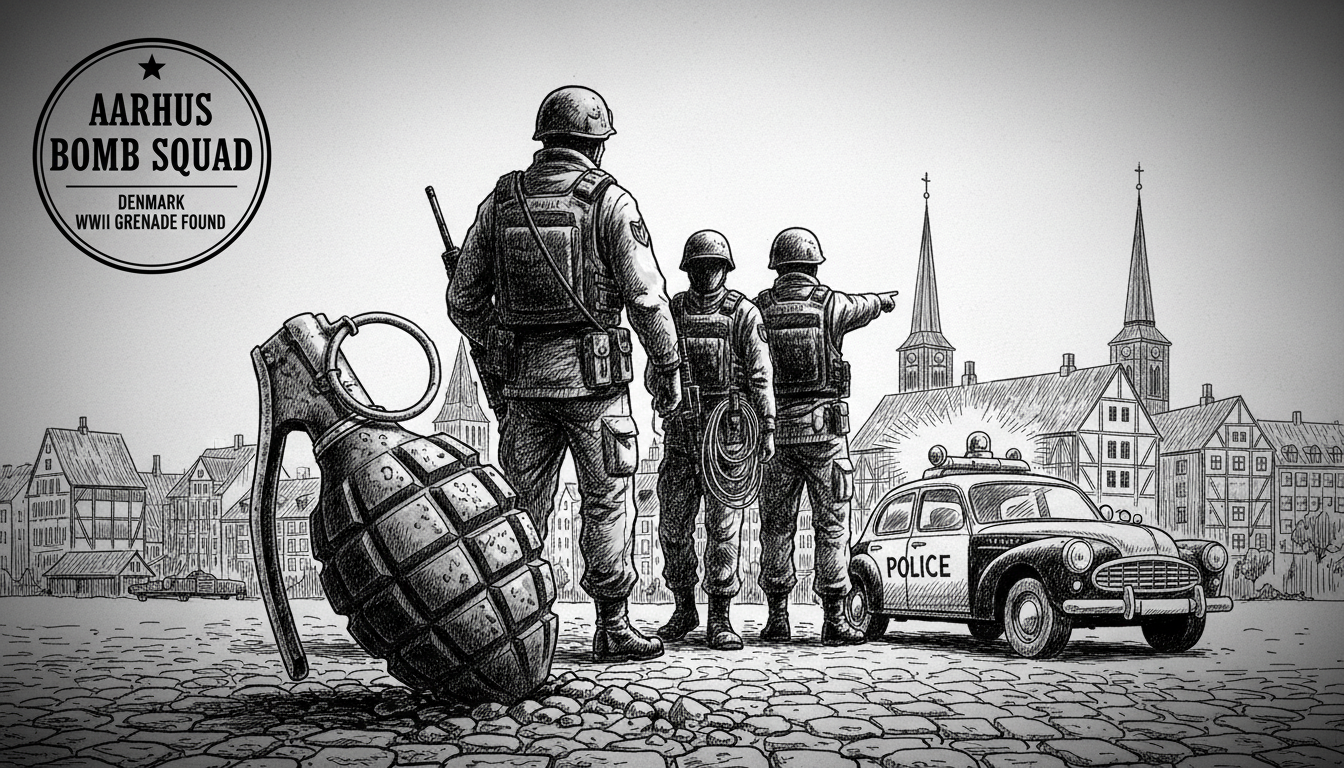
Denmark's coastal history surfaced again on Friday when a family's metal detector led to the discovery of a suspected 40mm grenade near Aarhus. A mother and son, scanning the beach at Skæring Strand north of the city, unearthed a rusted piece of old ammunition, prompting an immediate police response and the deployment of the military's Explosive Ordnance Disposal (EOD) unit. The discovery forced authorities to cordon off a green area, a stark reminder that the physical remnants of World War II still lie hidden beneath Denmark's picturesque landscapes.
Mikkel Møldrup, the duty officer for East Jutland Police, confirmed the incident. "It is something that has been fired. So we suspect it is just a lump of iron. But we are not sure there isn't something inside," he said. The police's initial assessment pointed to a 40mm projectile, a type commonly used by military forces. By 4:30 PM, police announced on social media that the EOD would conduct a controlled detonation, warning residents of an impending loud bang in the area.
A Routine Search Turns Serious
The family was engaged in a perfectly legal hobby, metal detecting with the landowner's permission, a popular pastime in Denmark. The law allows such searches, but it places responsibility on the finder to report potential archaeological or hazardous discoveries. In this case, their responsible actions prevented a potential tragedy. After digging up the object and recognizing its dangerous nature, they contacted authorities instead of handling it themselves. "It is completely rusty. It could be from as far back as the Second World War," Møldrup noted, adding that due to its age, the find did not immediately constitute a criminal case for police.
This incident underscores a critical public safety message repeated by bomb disposal experts: never touch or move a suspected explosive. Corrosion over decades can make ordnance unstable and sensitive to disturbance. What appears to be a harmless lump of rusted metal can contain live explosives or volatile chemical fillers that become more dangerous with age. The immediate police response, securing the area and calling in the military specialists, followed the standard and essential protocol for such finds.
The Persistent Legacy of War
Denmark was occupied by Nazi Germany from 1940 to 1945. During that time, coastal areas like those around Aarhus were heavily fortified as part of the Atlantic Wall defenses and saw significant military activity. While post-war clearance operations removed tons of unexploded ordnance (UXO), items were inevitably missed, buried by shifting sands or simply overlooked. Decades later, these relics continue to emerge, brought to the surface by erosion, construction work, or the diligent search of hobbyists.
Discoveries like this are not daily occurrences, but they are a recognized part of Denmark's historical landscape. They represent a tangible, and sometimes dangerous, connection to the country's wartime past. Each discovery triggers a well-rehearsed safety procedure, involving police to secure the scene and the Forsvaret's (Danish Defence) EOD experts to assess and neutralize the threat. The controlled detonation on the beach is the final, noisy step in rendering history safe.
Between Hobby and History
The case highlights the intersection of public interest, historical preservation, and safety. Metal detecting is a gateway to personal history for many Danes, a way to connect physically with the past. Danish law strikes a balance, permitting the activity while mandating that significant historical finds be reported to museums. The National Museum of Denmark provides guidelines, emphasizing that objects of potential cultural heritage value must be declared. However, the first and most urgent rule when discovering potential ordnance is clear: step back, mark the location, and call the police.
Experts in historical ordnance stress that public awareness is a key component of safety. The assumption that an object is "too old" to be dangerous is a common and potentially fatal misconception. The chemical compounds in explosives can remain potent for over a century, and the mechanisms designed to trigger them can degrade into even more unpredictable states. The EOD's decision to destroy the object in situ is almost always the safest course of action, even if it means the physical artifact is lost.
A Community's Blast from the Past
For the local community in Skæring, the event was a brief disruption and a conversation starter. Police assured the public that as long as cordons and instructions were respected, there was no danger. The controlled explosion, while loud, was a sound of safety being enforced. It served as a live demonstration of the unseen work done by police and military units to manage the dormant risks left from conflicts long ended.
This discovery near Aarhus is a microcosm of a wider reality across Europe. From the beaches of Normandy to the forests of Germany, unexploded ordnance from both World Wars continues to be found. In Denmark, with its long coastline and history of occupation, the sea and sand periodically give up their secrets. Each find is a testament to the thoroughness of past clean-ups that so much was removed, and a reminder of the sheer scale of industrialized warfare that so much still remains.
The family left the beach without a historical souvenir but with a story of civic responsibility. Their correct actions ensured a safe outcome. The rusted grenade, a silent occupant of the Danish soil for possibly eighty years, was removed in a fraction of a second. Its discovery and disposal close another small chapter in the long, slow process of healing the physical scars of war, a process that Denmark, like much of Europe, is still quietly undertaking.