
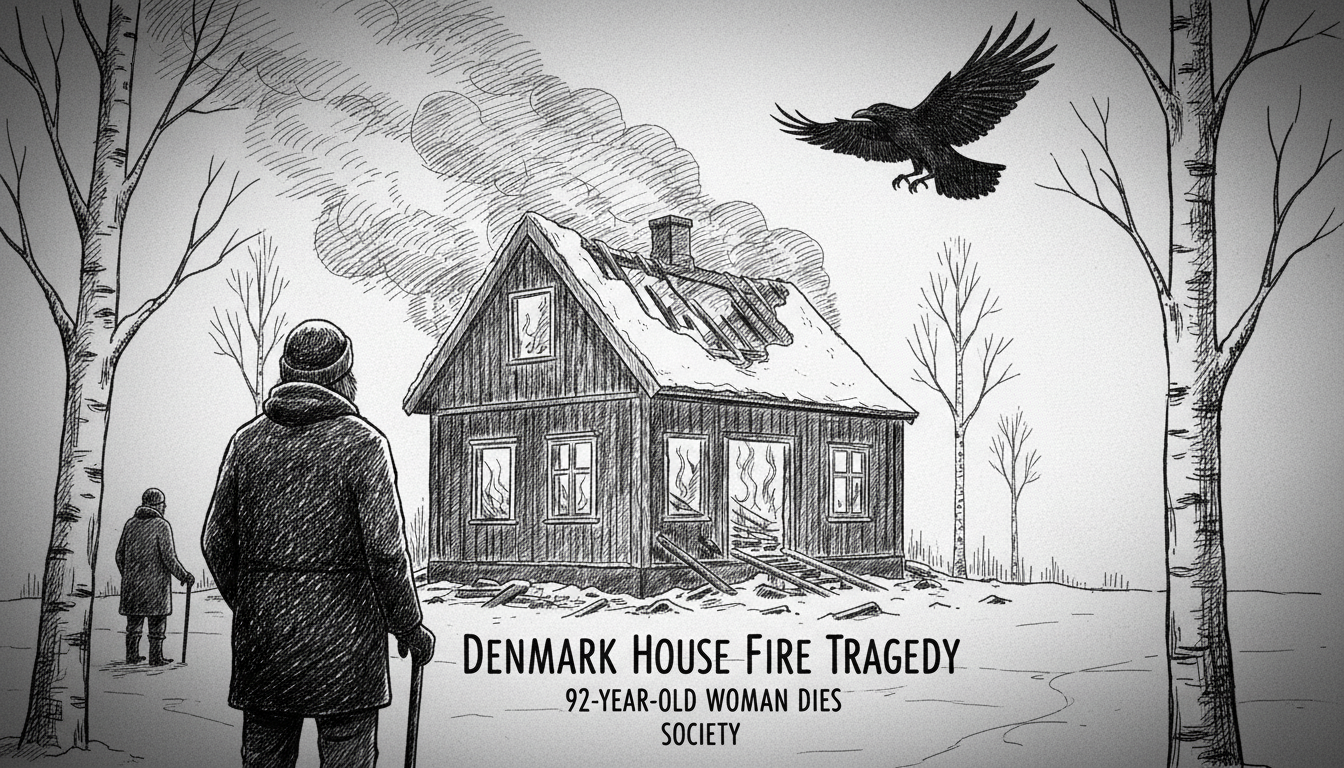
Denmark house fire death occurred Thursday in the village of Ønslev on Falster, claiming the life of a 92-year-old woman. Emergency services received the alarm at 4:51 p.m. for a blaze in a terraced house on Humlevænget. A massive response from police and fire crews could not save the resident, whose next of kin have been notified. Police confirmed they do not suspect a crime but have called in technicians to investigate the cause. This fatal fire casts a stark light on the persistent risks within Danish residential communities, particularly for the elderly living alone.
A Rapid and Tragic Response
Vagtchef Jannick Hallø of Sydsjællands and Lolland-Falsters Police detailed the urgent timeline. The call came in late afternoon, triggering a substantial deployment of resources. Crews managed to extinguish the flames quickly, but the aftermath revealed the grim outcome. 'Subsequently, it could be confirmed that there was a person inside the building who had unfortunately passed away,' Hallø stated. The speed of the response underscores Denmark's prepared emergency protocols, yet the result highlights how quickly fire can overwhelm a home. The concentration of resources in a small village like Ønslev shows the system's capacity to prioritize life safety, regardless of location.
The Silent Risk in Danish Communities
This incident touches on a critical and often under-discussed aspect of Danish society news: the safety of aging populations in common housing. Terraced houses, or rækkehuse, are a cornerstone of Danish residential planning, offering community and affordability in towns and villages nationwide. They represent a key part of the Danish welfare system's housing vision. However, their connected nature can pose specific fire safety challenges, and elderly residents may face heightened vulnerability. Statistics from the Danish Emergency Management Agency show that while fire deaths have generally declined over decades, individuals over 65 remain a disproportionately affected group. This is not just a policy issue but a human one, concerning how communities support their oldest members.
Examining Prevention and Protection Systems
Fire safety experts consistently point to smoke detectors as the first and most crucial line of defense. Danish law mandates their installation in all homes, and compliance is generally high. Yet, the effectiveness relies on proper maintenance and the occupant's ability to respond. For a 92-year-old, mobility or health issues could severely limit response time, even with a working alarm. Investigators will now meticulously examine the Ønslev home's electrical systems, potential ignition sources, and the building's materials. They will assess whether the fire spread was influenced by the structure's design. This forensic work is vital for the Danish welfare system's continuous improvement of safety standards.
The Human Impact Beyond the Flames
Beyond the immediate tragedy lies a wave of grief for the local community. Ønslev is a small, close-knit landsby where such an event resonates deeply. Neighbors in connected terraced houses might grapple with feelings of fear, loss, and what-ifs. The Danish social policy framework includes support for municipalities to provide crisis counseling and practical aid to affected communities. The local council in Guldborgsund Municipality, which encompasses Ønslev, will likely activate such services. This human impact is the true cost of the fire, a ripple effect through a community that exemplifies both the strengths and the quiet vulnerabilities within Danish society.
A National Conversation on Elderly Safety
This fatality forces a necessary conversation about integrating fire safety into broader elderly care. Denmark's integration of social and health services is advanced, but gaps can exist between home care visits and 24/7 safety. Some municipalities have experimented with enhanced technological solutions, like connected smoke detectors that alert a monitoring center or designated contacts automatically. These initiatives reflect the innovative spirit of Danish social policy but are not yet universal. The question becomes whether the system can do more to protect its most vulnerable citizens within their own homes, a core promise of the welfare state.
Lessons from a Village Tragedy
As the technical investigation in Ønslev proceeds, the broader lessons are already clear. Regular, community-focused fire safety checks, especially for elderly residents living alone, could be a powerful tool. Local fire brigades and volunteer organizations sometimes run such programs, but funding and coordination vary. This tragedy reminds us that the compact, communal nature of Danish villages and housing, while a source of strength, also requires shared vigilance. The robust Danish welfare system is built on the principle of collective responsibility, and that principle must extend actively into the realm of everyday home safety.
Looking Forward After Loss
The death in Ønslev is a somber statistic in national reports, but for a family and a village, it is a profound and personal loss. It challenges the comforting assumption that a well-ordered society has mitigated all basic dangers. The coming days will bring a funeral and a quiet process of healing for the community. For policymakers and local leaders, the work involves examining whether current protocols are sufficient. How does a society that prides itself on care and integration ensure that no one, especially in their tenth decade of life, is left behind by the very systems designed to protect them? The search for answers, as always in Denmark, will be thorough, systemic, and driven by a fundamental commitment to human dignity.