
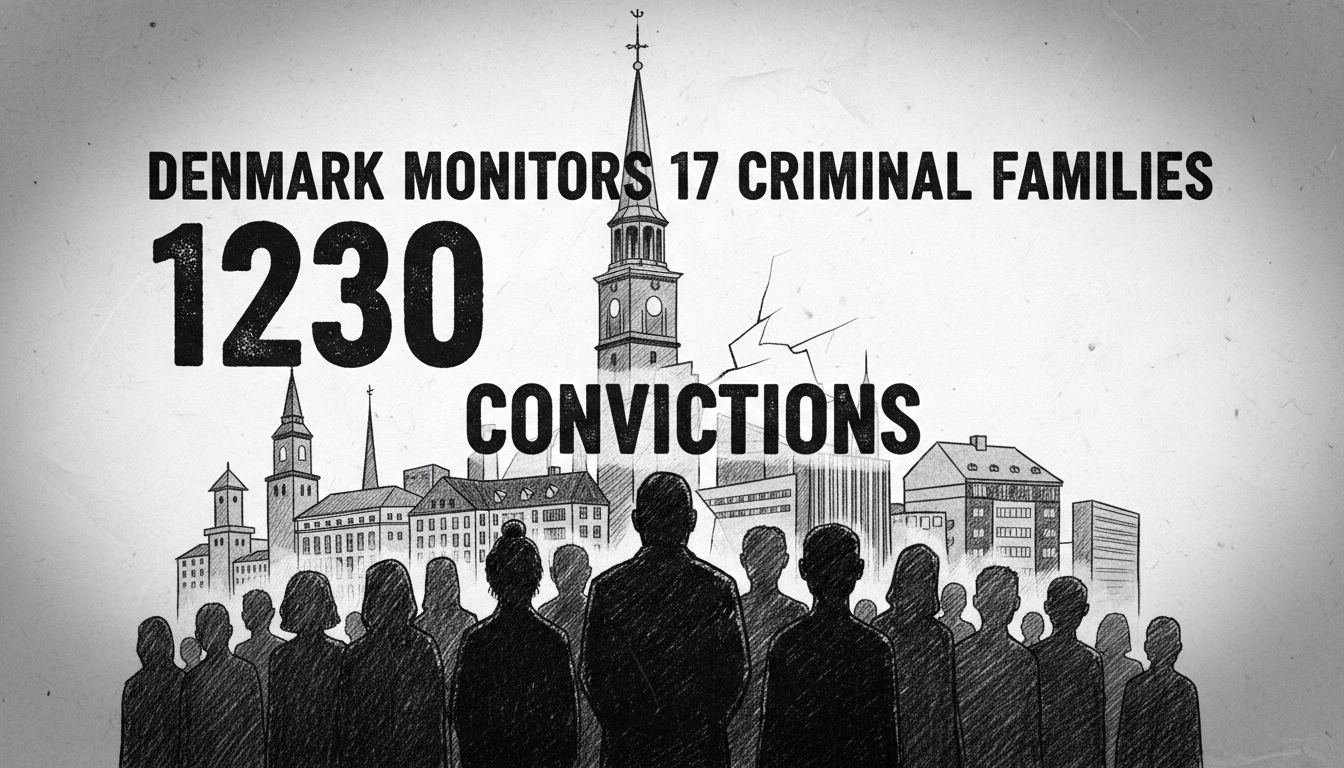
Seventeen criminal families in Denmark have collectively amassed 1,230 convictions in just five years, according to a new national police report. The Danish National Police, Rigspolitiet, has placed these families under a coordinated national monitoring scheme, marking a significant escalation in the fight against intergenerational crime. The families comprise around 700 members, a startling one-third of whom are children under the age of 15.
Police Director Lene Steen stated the initiative aims to build detailed intelligence on these networks to enable targeted investigations. "We want a reinforced police effort against these families," Steen said. "It is about finding the influential, central members who are behind the criminality." The monitoring framework is inspired by systems already used to track outlaw motorcycle gangs and criminal bands, now adapted for family-based networks.
A Strategic Shift in Policing
This move represents the latest step in Denmark's long-running strategy against organized crime. Over the past two decades, successive 'gang packages' have introduced stricter sentencing and expanded police powers. The focus on entire family units, however, signals a shift towards proactive, intelligence-led prevention. Authorities aim to disrupt criminal structures by understanding kinship ties and generational patterns, rather than just reacting to individual crimes.
The issue of 'criminal families'—extended networks where illegal activity spans generations—has become a persistent concern. These groups often operate across municipal boundaries, control local drug markets, and can use intimidation to silence communities. The national monitoring effort seeks to map these complex relationships to preempt serious violence and trafficking.
The Families in Focus
The data compiled by police paints a detailed picture of the targeted networks. Approximately two-thirds of the 700 monitored individuals hold Danish citizenship. In terms of ethnic background, about one in four is of Danish origin, while the remaining members are immigrants or descendants, primarily from non-Western countries.
Geographically, the highest concentration of family members currently resides in the Fyn police district, followed by East Jutland, North Zealand, and the combined Copenhagen and Copenhagen Suburbs districts. Beyond the 17 families under national scrutiny, an additional 50 to 100 families are being monitored at a local level by individual police regions.
| Metric | Value | Context |
|---|---|---|
| Nationally monitored criminal families | 17 | Designated by Rigspolitiet as having nationwide criminal significance |
| Total family members in 17 families | Approx. 700 | Includes adults and children; nearly 1/3 are under 15 years old |
| Total convictions (past 5 years) | 1,230 | For violent crimes, weapons offenses, and drug crimes under Danish law |
| Children under 15 in monitored families | Approx. 230 | Roughly 33% of the 700 family members |
| Additional families monitored locally | 50–100 | Handled by individual police regions, not under national oversight |
| Family members with Danish citizenship | Approx. 2/3 | Of the 700 monitored individuals; remainder are immigrants or descendants |
Police Director Steen was careful to note that not every member of these families is engaged in crime. "But those are also not the people we are initiating monitoring against," she clarified. The operational focus remains on identifying and investigating the key figures who orchestrate and benefit from criminal enterprises.
Expert Perspectives and Inherent Tensions
Criminologists acknowledge the serious challenge posed by entrenched, family-based networks. In marginalized communities where social exclusion meets limited opportunity, crime can become a normalized family trade. Some experts support the intelligence-gathering approach, arguing it is necessary to protect communities and intercept vulnerable children before they are drawn into illegal activities.
"Mapping these networks can provide crucial insights for both law enforcement and social services," notes one analyst familiar with Nordic policing. "The goal should be to surgically target the perpetrators while creating exit ramps for those who want out, especially the young."
However, other voices sound strong notes of caution. Legal scholars and civil rights advocates highlight the risks of collective stigmatization. Placing hundreds of people, including 230 children, under a national monitoring scheme based on family ties raises profound questions about privacy, proportionality, and potential discrimination.
There is concern that such policies could erode trust in public institutions within already vulnerable neighborhoods. The extensive personal data registers maintained by the Danish state, while making such monitoring feasible, also amplify worries about overreach and the long-term consequences for innocent family members.
Implications for Danish Society
The national monitoring program affects multiple layers of Danish society. For local communities, it may translate into increased but more targeted police presence. For social services and schools, it necessitates closer cooperation with police to shield children from criminal influence, a delicate balancing act between protection and surveillance.
In the short term, the initiative will likely lead to more investigations and prosecutions of key individuals. Justice Minister Peter Hummelgaard has already announced complementary plans to prevent gang members from simply relocating to neighboring municipalities when banned from certain areas.
Long-term implications could reshape Denmark's entire approach to organized crime. This pilot may evolve into a permanent legal framework for disrupting criminal networks. It also tests the limits of the Nordic welfare model, which traditionally emphasizes social inclusion and rehabilitation. The state is employing a robust policing tool while grappling with its duty to support, not just sanction, vulnerable citizens.
Internationally, Denmark's formalized approach is being watched closely. While Sweden struggles with similar gang violence and Norway emphasizes prevention, Denmark stands out for its explicit national designation of 'criminal families' and its systematic use of centralized data.
A Nordic Conundrum
For international observers, understanding this policy requires context. Denmark possesses a highly centralized, data-rich administration. The police utilize a national case system linked to personal identification numbers, enabling the detailed analysis behind this report. The term 'Rigspolitiet' signifies this national, coordinating authority.
Nordic countries have historically preferred preventive, multi-agency strategies that blend policing with social work. The explicit targeting of 'criminal families' marks a notable shift toward a more assertive law-and-order stance, driven by years of rising gang-related violence. The coming months will reveal whether this intelligence-led model can disrupt crime cycles without deepening the social divisions it aims to heal.
The success of this strategy hinges on precision. Police must demonstrate that their actions are narrowly focused on prosecutable criminal acts by specific individuals, not on blanket surveillance of families. Simultaneously, municipalities and social services must receive the resources to offer genuine alternatives to the children and non-involved members within these networks. The 1,230 convictions represent a profound societal challenge; Denmark's response will now be monitored just as closely as the families themselves.