
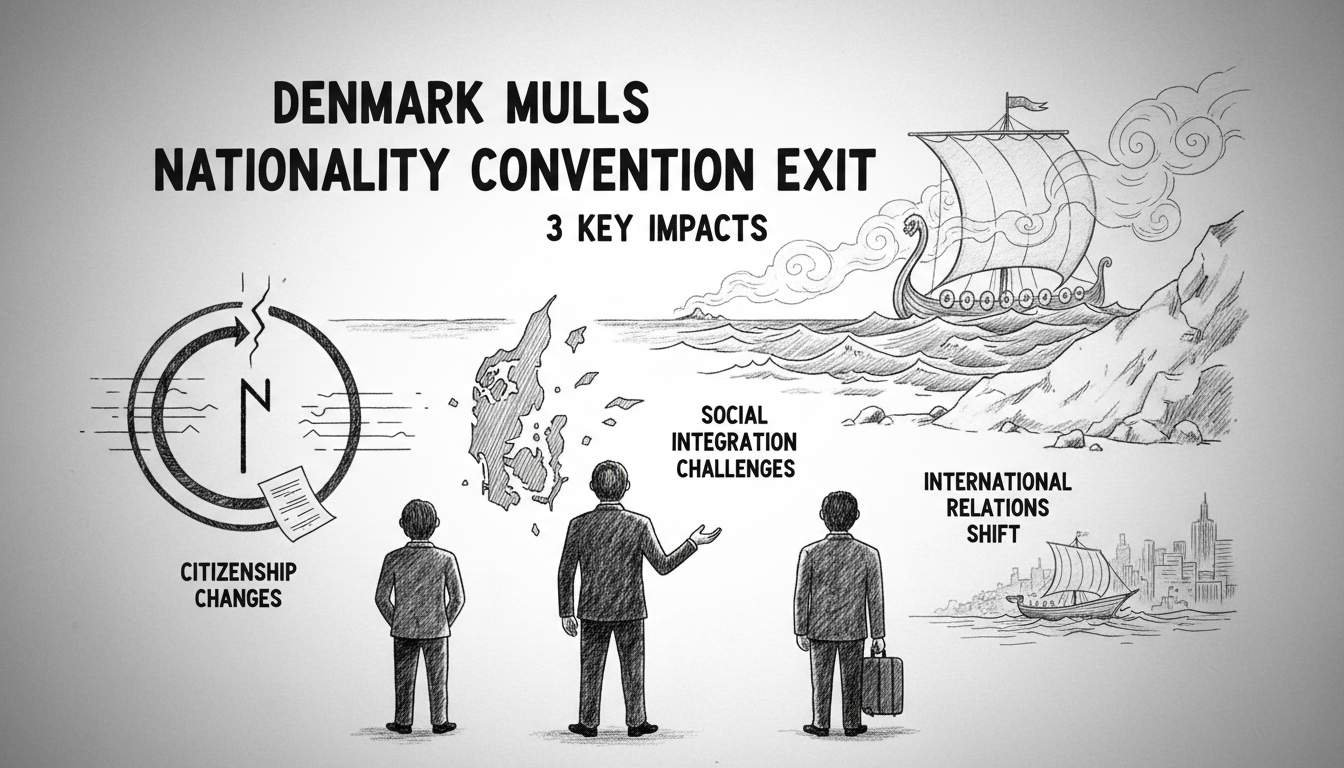
Denmark's political landscape is facing a profound constitutional and diplomatic challenge. Venstre party chairman Troels Lund Poulsen has declared his readiness to withdraw Denmark from the European Convention on Nationality. This historic announcement has created immediate division within the governing coalition and sparked a fierce debate about sovereignty, integration, and the future of Danish citizenship law. For many immigrants navigating the complex path to belonging, this move signals a potential hardening of Denmark's already stringent immigration framework.
A Political Earthquake in Copenhagen
The convention, ratified by Denmark, sets common European standards for nationality laws. It aims to prevent statelessness and ensure that decisions on citizenship are governed by clear, non-discriminatory rules. Poulsen's stance represents a direct challenge to this international framework. It places national parliamentary sovereignty above multinational agreements, a core principle for some Danish conservatives. The immediate fallout is a visible split in the government, with coalition partners expressing deep concern over the legal and diplomatic consequences of such a unilateral step. This debate touches the very heart of Denmark's relationship with broader European legal structures.
Political analysts see this as a strategic maneuver. "This is about drawing a clear line in the sand on immigration policy," says a Copenhagen University political scientist specializing in integration. "Venstre is signaling to its base a commitment to full national control, especially as discussions about citizenship revocation for certain crimes gain traction." The move comes amid ongoing public discourse about the balance between humanitarian obligations and perceived challenges to the Danish welfare model. It reframes citizenship not just as a legal status, but as a privilege governed solely by domestic political will.
The Human Cost of Legal Uncertainty
Beyond the parliamentary drama, the proposal injects deep uncertainty into the lives of thousands. Denmark's citizenship requirements are already among the most demanding in Europe, involving lengthy residency periods, language exams, citizenship tests, and a declaration of integration. The potential exit from the convention raises questions about the stability of these rules. Could future governments alter the path to citizenship more abruptly without an international framework as a reference point?
At community centers in Copenhagen and Aarhus, the news is met with anxiety. "People who have followed every rule, learned the language, and built their lives here now worry the goalposts could move again," says a leader from an immigrant advocacy network in Nørrebro. "The convention provides a layer of security, a basic standard. Removing it feels like pulling away a safety net." This sentiment is echoed by integration counselors in municipalities like Copenhagen and Odense, who report increased inquiries from permanent residents concerned about their long-term prospects.
Statistics from the Ministry of Immigration and Integration show a fluctuating but significant number of naturalizations each year. These individuals have structured their lives around a defined legal process. Legal experts warn that exiting the convention could complicate cases involving dual nationality and the rights of children born to foreign nationals in Denmark. It creates a potential for more arbitrary decision-making, eroding the predictability that is crucial for successful long-term integration.
International Repercussions and Legal Labyrinth
Denmark's withdrawal would not be a simple administrative task. It would involve formal notification to the Council of Europe and could trigger a lengthy unwinding process. Diplomatically, it would align Denmark with a very small group of European nations outside the convention, potentially isolating it on certain human rights and legal cooperation forums. "It would be a symbolic blow to European legal cohesion," notes an international law professor. "While nations have sovereignty, these conventions are the glue that prevents a race to the bottom on rights. Denmark has been a respected voice; this would change that perception."
The domestic legal impact could be complex. Danish nationality law would need to be scrutinized to ensure it stands alone without violating other international obligations. There are concerns about conflicts with other treaties and the principles of the Nordic Passport Union. The debate also raises a fundamental question about the direction of Danish society. Is the goal to create a more insulated legal framework, or to participate in shaping shared European standards? The government's internal conflict over this issue mirrors a larger societal split.
For the broader Nordic region, Denmark's potential exit sets a striking precedent. Sweden and Norway are also parties to the convention. A Danish withdrawal would place it at odds with its closest neighbors on a fundamental issue of legal philosophy and human rights protection. This could influence future negotiations on Nordic cooperation and shared policy initiatives, particularly regarding residency and movement across borders.
A Defining Moment for Danish Identity
Ultimately, this debate transcends legal technicalities. It is a conversation about what Danish citizenship means in the 21st century. Proponents of withdrawal argue for the absolute right of the Danish parliament to define and redefine the terms of belonging without external constraint. They view the convention as an unnecessary limitation on democratic self-determination, particularly in areas related to national security and social cohesion.
Opponents see adherence to such conventions as a hallmark of a modern, responsible state that upholds the rule of law and provides stability for all residents. They argue that international cooperation on these standards protects individuals from abrupt political shifts and reinforces Denmark's commitment to universal principles. The outcome of this political clash will send a powerful signal about whether Denmark views its future as one of collaborative engagement or sovereign isolation on critical issues of identity and rights.
The coming weeks will test the resilience of the governing coalition. Can a compromise be found, or will this issue force a political realignment? As politicians debate, thousands of residents await clarity on their future. The decision will leave a lasting mark on Denmark's legal landscape and its reputation as a nation governed by predictable, principled rules. It forces a stark choice between unfettered national control and the compromises of international community.