
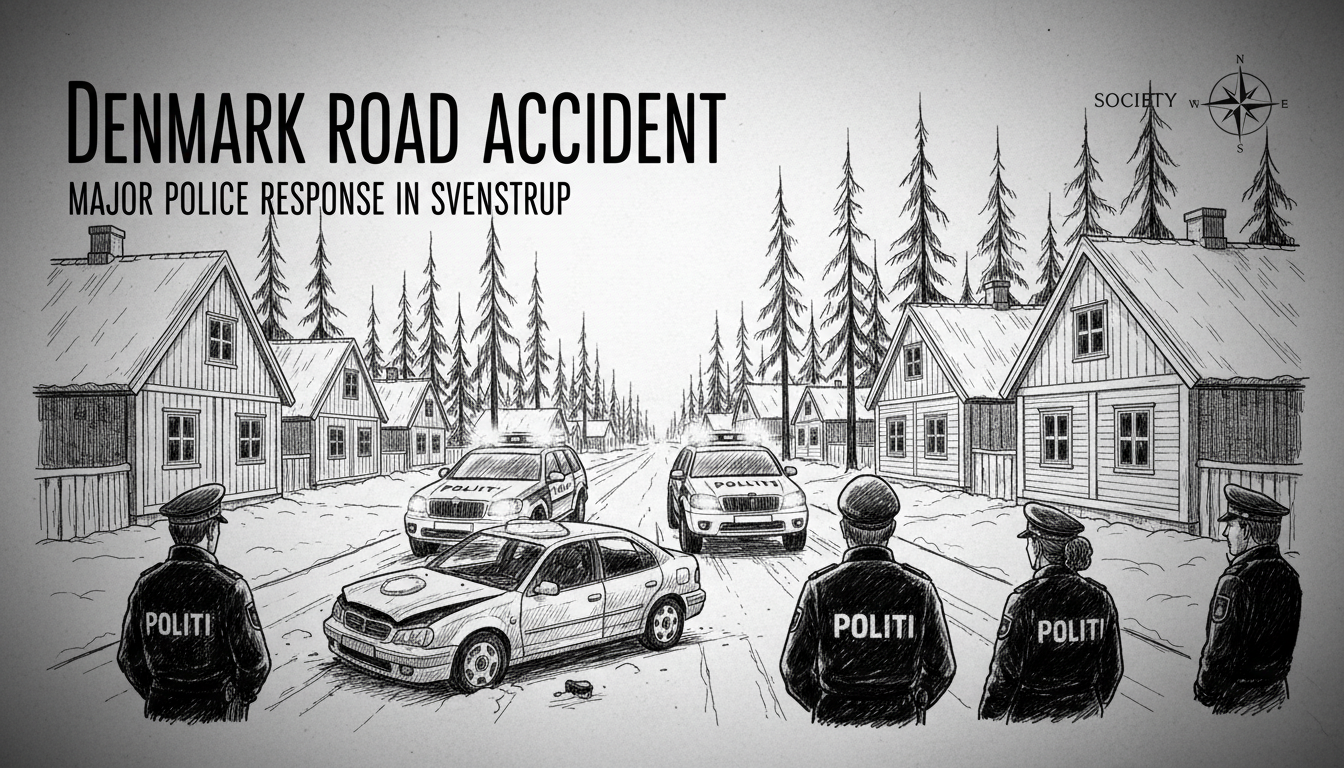
Denmark road accident response mobilized a massive police presence on Hobrovej near Svenstrup in North Jutland on Wednesday. Emergency services rushed to the scene of a serious traffic collision, leading to the complete closure of the southbound lanes of the key regional artery. The incident underscores ongoing challenges on Danish roads, where fatalities saw a troubling 14% increase in 2023.
A Sudden Halt on a Key Corridor
North Jutland Police confirmed their large-scale deployment on social media platform X, stating they were 'massively present' at the site. Hobrovej, also known as Route 180, is a vital transport link connecting towns and cities in the region south of Aalborg. Authorities diverted southbound traffic via Godthåbsvej, causing significant disruptions during the day. The police vagtchef, or duty officer, stated they had no further information available initially, a standard refrain in the chaotic early hours of a serious investigation. For residents of Svenstrup and daily commuters, the sight of flashing blue lights and cordoned tarmac became an abrupt reminder of road travel's inherent risks.
The Immediate Aftermath and Emergency Protocol
The precise circumstances of the crash remain under investigation by Nordjyllands Politi. The term 'alvorligt færdselsuheld' used by authorities denotes a serious traffic accident, typically involving severe injuries or potential fatalities. Such incidents trigger a coordinated response protocol. First responders focus on securing the scene, providing urgent medical aid, and preventing secondary collisions. Traffic management is a critical component; closing the road allows forensic teams to document evidence and clear wreckage safely. This procedure, while disruptive, is a cornerstone of Denmark's systematic approach to road safety management. Experts note that efficient scene management can influence both survival outcomes and the quality of the subsequent investigation, which aims to determine cause and prevent future similar incidents.
A Broader Look at Danish Road Safety
This single event occurs against a backdrop of national concern. After years of steady improvement, Danish road safety statistics have shown worrying signs. Preliminary figures for 3,4 indicated 179 road deaths, a rise from 157 the previous year. This 14% increase has sparked renewed debate among policymakers and safety advocates. The Danish Road Directorate (Vejdirektoratet) and the government have long pursued a 'Vision Zero' strategy, aiming to eliminate fatal and serious injuries on the road network. This strategy encompasses infrastructure design like safer pedestrian crossings and cycle paths, stringent enforcement of speed and alcohol limits, and public education campaigns. Yet, as this accident on Hobrovej suggests, the human and mechanical factors leading to collision remain persistent challenges.
Local Impact and Community Response
For the local community in Svenstrup, incidents like this resonate deeply. Small towns often feel the impact of a major accident more acutely, as victims could be neighbors or familiar faces. The closure of a main road also has immediate practical effects, isolating areas and delaying essential travel. Local municipal authorities often work in tandem with police during such crises, assisting with traffic diversions and public communication. While the national statistics present a macro-level view, each accident carries a profound micro-level story of personal tragedy, emergency response, and community disruption. The psychological impact on first responders and witnesses is also a recognized factor, with post-incident support being an integral part of the emergency services' mandate.
Analysis: The Persistent Challenge of Rural Roads
A significant portion of serious accidents in Denmark occur on rural roads like Hobrovej, outside the major urban centers. These roads, often straight and encouraging higher speeds, can be deceptively dangerous. Factors like animal crossings, agricultural vehicle traffic, and lower lighting contribute to the risk profile. Safety improvements here are costly and logistically complex, involving wider shoulder installation, better signage, and possibly median barriers. Investment must be balanced across the entire national network. Traffic safety experts continually analyze accident blackspots, using data to advocate for targeted infrastructure upgrades. The investigation into the Svenstrup accident will feed into this vast dataset, informing future decisions on where to allocate safety funding in North Jutland and beyond.
The Path Forward from the Scene
As the tow trucks cleared the final debris from Hobrovej and traffic began to flow again, the questions remained. The police investigation will work meticulously to reconstruct the event. Were speed, impairment, distraction, or vehicle failure factors? Could road design have played a role? The answers will take time. Meanwhile, the national conversation about reversing the rising fatality trend continues. Proposals often include lowering speed limits on select highways, increasing the use of automated speed cameras, and enhancing driver education for young people. Each serious accident amplifies the call for action. While Denmark's roads are among the safest in the world statistically, the goal of zero fatalities makes every single life lost a policy failure. The incident at Svenstrup is not just a local news brief; it is a data point in a national safety equation, a sudden tragedy that reflects a complex, ongoing struggle to protect people on the move. The true measure of the response will be seen in the lessons learned and the preventive actions that follow, ensuring such massive police presences become less frequent occurrences on Denmark's highways and byways.