
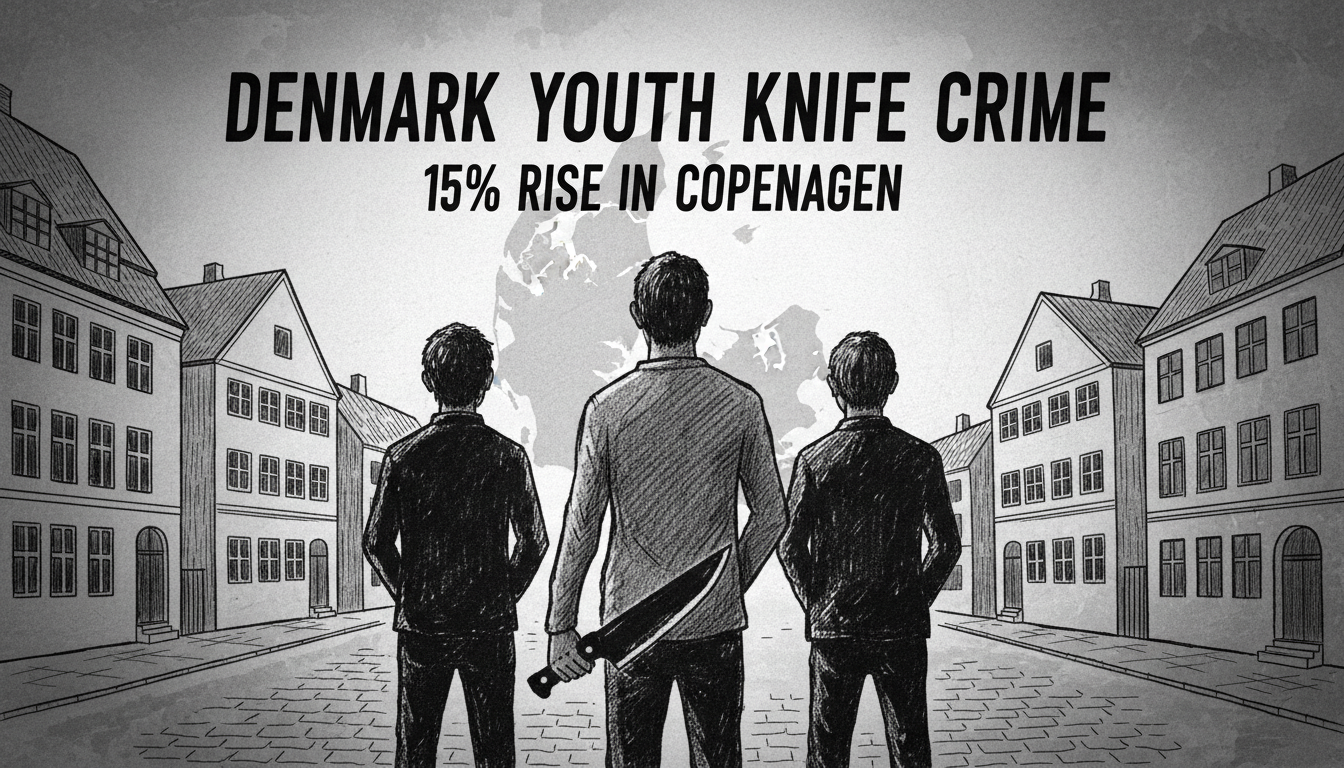
Denmark youth violence has again surfaced at a major transport hub, with a teenager stabbed at Copenhagen Central Station in the early hours of Monday. The male victim, under 18 years old, sustained superficial cuts and was transported to a hospital for treatment. Copenhagen Police confirmed the incident but reported no arrests, leaving a community to grapple with another act of violence in a public space. This event fits into a concerning pattern of weapon-related incidents in the capital, challenging the nation's self-image of safety and social cohesion.
A Recurring Scene at the Heart of the City
Copenhagen Central Station is more than a transit point; it's a microcosm of the city, used by commuters, tourists, and young people. The stabbing occurred here, a location meant to symbolize connection, not conflict. Police were present on the scene, a detail that underscores the station's status as a monitored yet vulnerable area. The victim's injuries were described as superficial, a medical term that belies the profound psychological and social impact such an attack carries. For the young man involved, the journey to the hospital was likely filled with more fear than pain, a sudden rupture in the ordinary life of a teenager.
These incidents force a difficult conversation about safety in Denmark's urban centers. The station should be a gateway, not a crime scene. When violence touches such a foundational piece of civic infrastructure, it sends a ripple of unease through the entire community. It raises immediate questions for parents, for commuters, and for the authorities tasked with maintaining public order. This is not an isolated pocket of trouble; it is the heart of the capital.
The Statistical Reality of Weapon Violence
While Denmark maintains lower violent crime rates than many nations, the trendline for weapon-related incidents is moving in the wrong direction. Copenhagen police reported a 15% increase in weapon-related incidents in 2023 compared to the previous year. This statistic provides a stark backdrop to the Monday morning stabbing. Nationally, Statistics Denmark recorded 78 incidents of 'violence against a person with a knife or other sharp object' per 100,000 inhabitants in 2022. Each data point represents a life altered, a family shaken, and a community's sense of security chipped away.
The numbers tell a story of concentrated risk. Young men are disproportionately both victims and perpetrators in these statistics. This points to complex underlying issues that go beyond policing. Experts consistently highlight factors like social inequality, gang recruitment of vulnerable youth, and the alarming ease of access to knives and other weapons. The challenge for Danish social policy is to address these root causes while ensuring immediate public safety. The welfare system, renowned for its support, is being tested by new forms of urban alienation and conflict.
Seeking Solutions Beyond the Police Tape
When the police tape comes down, the harder work begins. Community leaders and social experts stress that enforcement alone cannot solve youth violence. "A police response is necessary for immediate safety, but it is a reactive tool," one Copenhagen integration project manager told me, requesting anonymity to speak freely. "The preventive work happens in schools, in youth clubs, and in social centers long before a young person ever considers picking up a weapon. We need to reach them before the streets do."
This philosophy is central to many municipal programs in Copenhagen and Aarhus. Early intervention initiatives focus on mentorship, educational support, and providing positive alternatives to gang affiliation. The Danish model, with its strong municipal governance, is theoretically well-placed to deliver these tailored, local solutions. Social workers in districts like Nørrebro and Vestegnen operate on the front lines, trying to build trust with at-risk youth. Their success is critical, but it is often undermined by funding uncertainties and the sheer scale of the challenge.
The Personal Cost in a System Built on Trust
As a reporter covering Danish society, I see the tension between national confidence and local fear. Denmark is built on a profound social trust; we believe our public spaces are safe and our institutions will protect us. An incident like this, in such a prominent location, fractures that trust. For immigrant communities and marginalized youth, the impact is double-edged. They are often unfairly stigmatized when crime occurs, yet they also frequently bear the brunt of the violence themselves. They live with the fear of both crime and profiling.
The human impact extends far beyond the physical wound. The teenage victim will carry this experience forward. Witnesses and residents who use the central station may now look at its corridors with a new sense of caution. The social contract feels slightly more fragile. This is the true cost of knife crime—it doesn't just injure individuals; it injures the communal sense of security. It asks whether the famous Danish welfare state is equipped to handle the fractures in its modern, diverse cities.
A Look Ahead: Prevention or Prosecution?
The immediate question for authorities is finding the perpetrator. The longer-term question for society is how to prevent the next incident. Will the response focus primarily on heightened police presence and prosecution? Or will it trigger a renewed investment in the social infrastructure that supports vulnerable young people? The answer likely needs to be both, but the balance is delicate. An overemphasis on enforcement can alienate the very communities needed as partners in prevention.
Danish municipalities have the tools—youth outreach programs, after-school activities, family support services. But these require consistent funding and political will. As Copenhagen grows and changes, its social policies must evolve with it. The stabbing at Hovedbanegården is a symptom of a larger challenge. Can Denmark's renowned integration and social welfare models adapt to prevent the next young person from becoming a victim, or a perpetrator? The statistics show a 15% increase. The community feels the anxiety. The policy response will define the safety of Copenhagen's streets for years to come. The next chapter in this story won't be written by the police alone, but in city council meetings, school classrooms, and local community centers across the capital.