
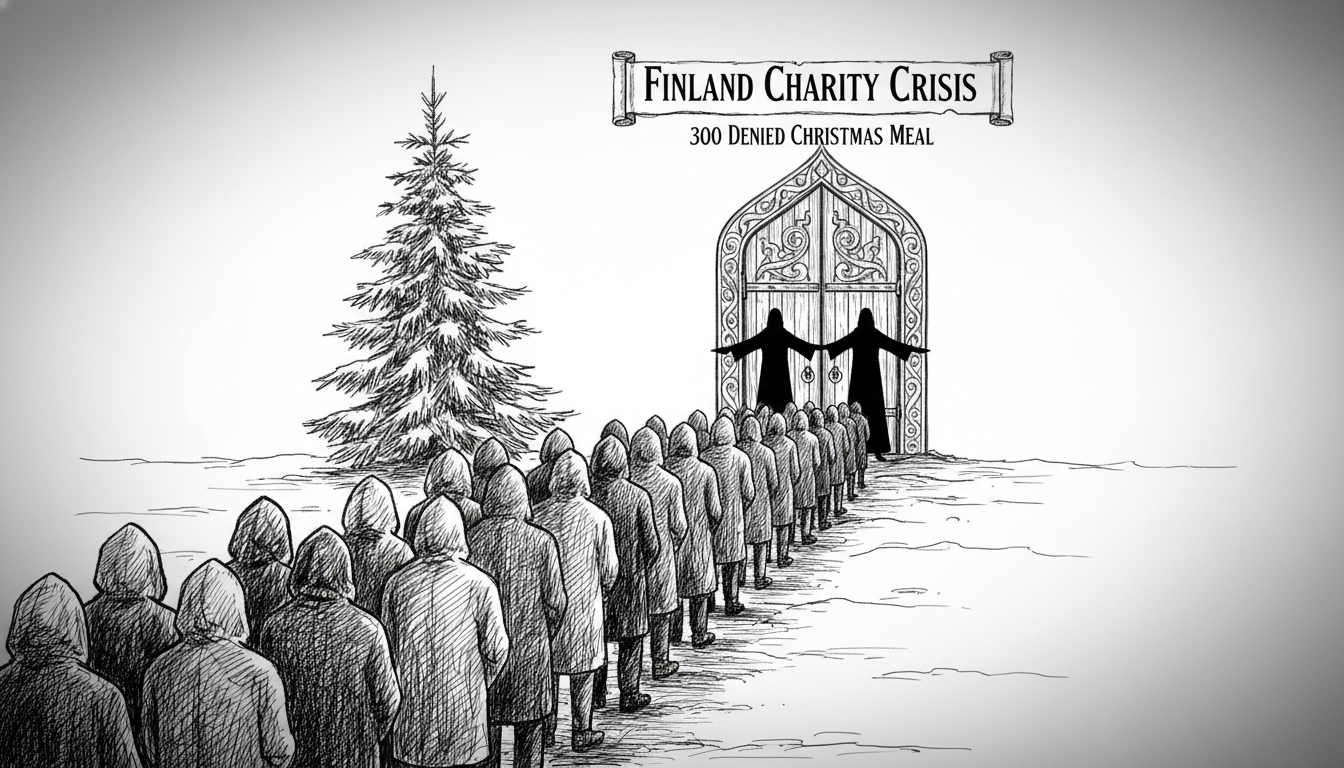
Finland's renowned Hurstinapu charity turned away approximately 300 people from its traditional Christmas celebration at the Helsinki Exhibition and Convention Centre on Sunday. The event, a cornerstone for the lonely and financially struggling during the holidays, reached its 2,000-person capacity, leaving a significant crowd outside in the cold. This visible shortfall has ignited a public debate about the depth of need in one of the world's most comprehensive welfare states.
"Over 2,000 came inside and roughly 300 were still left outside, and they could not get in," said Sini Hursti, executive director of the Hurstinapu association. Her statement underscores a growing and palpable tension between the capacity of private charities and the escalating demand for their services. The scene at Messukeskus, a venue typically associated with trade fairs and conferences, presented a stark contrast between Finland's economic facade and the hidden reality for many of its residents.
A Legacy of Charity Meets Modern Hardship
The Hurstinapu organization carries a profound legacy in Helsinki's social fabric. Founded by Heikki Hursti, it continues the work of his parents, Pastor Veikko Hursti and Lahja Hursti, who dedicated their lives to aiding the poor and marginalized in the capital city. For decades, their Christmas celebration has been more than a meal; it is a symbol of community and respite from isolation during a season that amplifies loneliness and financial strain. This year's overflow crowd signals that this legacy is being tested as never before.
Social policy experts point to a confluence of factors driving this increased demand. While Finland's social safety net remains robust by global standards, it has been strained by prolonged economic stagnation, high inflation affecting food and energy costs, and rising living expenses. "Charitable organizations like Hurstinapu are increasingly acting as a critical supplement, catching those who slip through the gaps of the official system or for whom state support is insufficient to cover basic dignities, especially during holidays," explains Dr. Elina Korhonen, a sociologist at the University of Helsinki. She notes that the clientele is no longer just the traditionally homeless but includes the working poor, students, and elderly pensioners whose fixed incomes are eroded by inflation.
The Capacity Gap and Systemic Strain
The incident at Messukeskus highlights a practical and logistical crisis for Finnish charities. Planning an event for 2,000 people is a massive undertaking, reliant on volunteers, donated food, and secured venue space. The fact that demand exceeded this considerable number by 15% suggests a miscalculation of need, driven by a rapidly worsening situation for vulnerable groups. Hurstinapu and similar organizations operate on tight budgets, and scaling up operations to meet such unexpected surges is a formidable challenge.
This event also raises questions about the role of municipal social services. Helsinki city officials have long collaborated with and supported the work of trusted charities, but the visible failure to accommodate all comers suggests a disconnect between official projections of need and the reality on the ground. The queue outside Messukeskus is a powerful, visual metric of unmet social need that budget reports and welfare statistics often fail to capture. It represents hundreds of individuals who anticipated a moment of warmth and community, only to be met with a closed door.
Political Reactions and the Search for Solutions
The story has resonated in the halls of the Finnish Parliament, the Eduskunta. Opposition politicians, particularly from the Left Alliance and the Social Democratic Party, have pointed to the event as evidence of deepening inequality and called for increased social security indexing and stronger municipal safety nets. "When a charity known for never turning anyone away is forced to do so, it is a wake-up call for the entire society," said Left Alliance MP Li Andersson in a social media post.
Government coalition members, while expressing sympathy, have emphasized the complexity of the economic landscape and the fiscal constraints facing the state. They point to existing housing benefits and social assistance programs, arguing that the solution lies in economic growth and employment, not necessarily in further expanding direct transfers. This ideological divide—between increasing state intervention and fostering private economic resilience—frames the political discussion emerging from the Christmas queue.
A Look Ahead: Charity in the Nordic Model
The Hurstinapu situation forces a re-examination of the Nordic welfare model's current efficacy. The model is predicated on universalism and the state's primary role in ensuring citizen well-being, with charity historically playing a secondary, complementary role. The sight of hundreds turned away from a Christmas dinner suggests that charity is now bearing a primary load for which it was not designed, indicating potential systemic erosion.
Moving forward, the challenge for Finnish policymakers, municipal authorities, and charitable organizations will be to forge a more responsive and collaborative model. This could involve better data sharing on emerging pockets of need, more flexible public funding for crisis-response charity work, and perhaps even logistical support from cities for major outreach events. The goal must be to ensure that the safety net, a blend of public and private effort, has no holes large enough for 300 people to fall through on a single December day.
As Sini Hursti and her team begin planning for next year, the memory of those left outside will loom large. The event has served as a painful but necessary audit of social need in contemporary Finland. It asks an uncomfortable question of a famously egalitarian society: How many empty plates at Christmas are too many? The answer, currently being debated from dinner tables to the cabinet table, will define Finland's social contract in the years to come. The legacy of Veikko and Lahja Hursti continues, but it now carries a urgent, modern plea for broader societal reinforcement.