
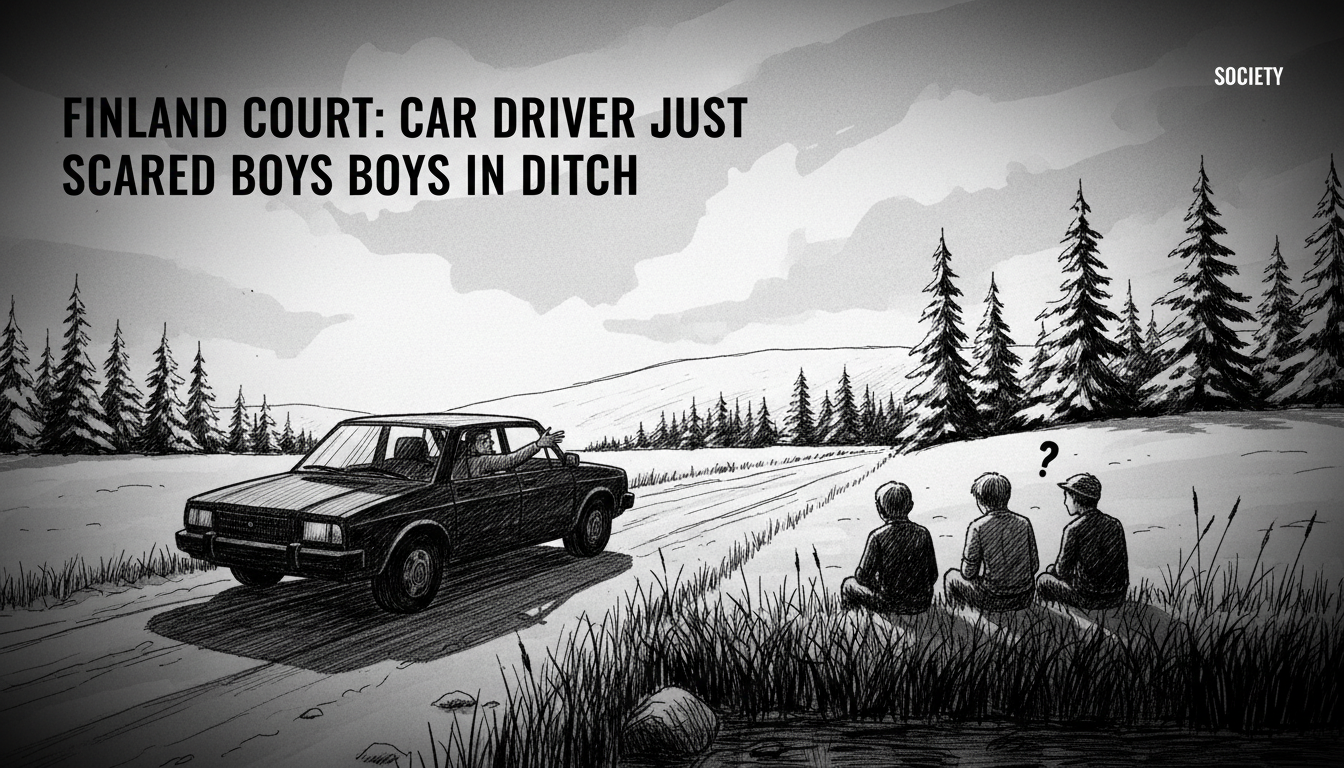
Finland's courts are grappling with a critical legal distinction after a Kymenlaakso District Court verdict on a dangerous driving case sparked debate. Four boys narrowly escaped injury by leaping into a ditch as a car accelerated toward them in Kotka last November. The court ultimately ruled the driver was merely trying to 'scare' them, a decision one lay judge strongly opposed, highlighting the complex challenge of proving criminal intent in traffic incidents.
The incident occurred on a quiet roadside in Kotka. According to court documents, the driver steered his vehicle directly at the group of youths, forcing them to take evasive action into a roadside ditch to avoid being struck. While the boys escaped physical harm, the Kymenlaakso District Court concluded the situation created 'serious danger to the life and health of the young people.' This finding of endangerment was central to the charges brought forward.
A Legal Dispute Over Intent
Despite acknowledging the danger, the court's majority did not find sufficient evidence for a conviction on attempted aggravated assault. The core of the legal argument rested on the driver's intent. Prosecutors needed to prove the driver acted with the purpose of causing bodily harm, not just reckless behavior. The driver maintained his actions were intended only to frighten the group, a claim the majority of the judicial panel accepted. However, the ruling was not unanimous. One of the court's lay judges dissented, arguing firmly that the driver's actions warranted a conviction for attempted aggravated assault, underscoring a clear divergence in interpreting the same set of facts.
This internal conflict within the court reflects a perennial difficulty in Finnish jurisprudence. 'The line between reckless endangerment and an attempt at assault can be very thin in traffic cases,' explains Professor of Criminal Law, Antero Jääskeläinen, from the University of Helsinki. 'The court must peer into the mind of the driver at that exact moment. Was the act a malicious targeting, or a grossly negligent but not intentionally violent act? Proving the former beyond a reasonable doubt is a high bar.'
The Mechanics of a Finnish Courtroom
The presence of a dissenting lay judge offers a public glimpse into the Finnish legal system's unique composition. District Courts often use panels that include both professional judges and lay judges, who are appointed citizen representatives. These lay judges participate fully in deliberations and verdicts, bringing a community perspective to the bench. Their role is particularly important in cases where societal norms and values are weighed against strict legal definitions.
'The lay judge's dissenting opinion in this case is significant,' notes legal scholar Maija Lindroos. 'It signals that, from a citizen's perspective, accelerating a car toward pedestrians is an act of violence, regardless of the claimed intent to merely scare. This tension between legal technicality and public perception is what makes these cases so challenging and socially relevant.' The split opinion may also influence any potential appeal, as it highlights legitimate judicial disagreement over the application of the law.
Navigating Finland's Traffic Penal Code
Finnish law outlines clear but distinct categories for dangerous vehicular behavior. Simple reckless driving carries lighter penalties and focuses on the deviation from standard care. Endangerment, a more serious charge, requires creating a concrete and serious risk to others. The most severe category, attempted assault or aggravated assault, hinges on proving the driver's direct intent to use the vehicle as a weapon to cause harm. The Kotka case fell between the latter two categories in the eyes of different court members.
The court's majority concluded that while the driver's actions met the threshold for endangerment—hence the conviction on that count—the prosecutorial evidence stopped short of conclusively proving an intent to hit the boys. This illustrates the heavy burden of proof required for assault charges. The outcome likely means a substantial fine and a possible driving ban for the driver, but not a prison sentence, which a conviction for attempted aggravated assault could have entailed.
Broader Implications for Road Safety
This verdict arrives amid ongoing national discussions about road safety and pedestrian protection. Traffic officials often emphasize the shared responsibility of all road users, but cases like this test the limits of that principle. 'When a vehicle is used in a manner that induces panic and forces evasive action, it shatters the fundamental trust required in traffic,' says Liisa Heikkilä, a senior advisor at the Finnish Road Safety Council. 'Regardless of the legal qualification, such behavior is absolutely unacceptable and has severe psychological consequences for the victims.'
The case also prompts questions about the adequacy of penalties for extreme reckless driving that falls just short of proven intent to harm. Some legal experts argue that the gap between endangerment and assault charges is too wide, allowing genuinely malicious behavior to be downgraded if intent cannot be irrefutably demonstrated. This may fuel calls for legislative review to ensure the penal code adequately reflects the severe real-world impact of such actions.
For the four boys in Kotka, the legal nuances likely offer little consolation. Their experience—the sudden roar of an engine, the split-second decision to jump—represents a traumatic event that the court recognized as creating a serious danger. The dissenting lay judge's opinion validates the perception that they were more than just scared; they were targeted. As the case potentially moves through the appeal process, it will continue to serve as a critical reference point for how Finnish society and its legal system define the moment when a car ceases to be a vehicle and becomes an instrument of threat. The final word from the courts will determine which interpretation of that terrifying moment in Kotka prevails.