
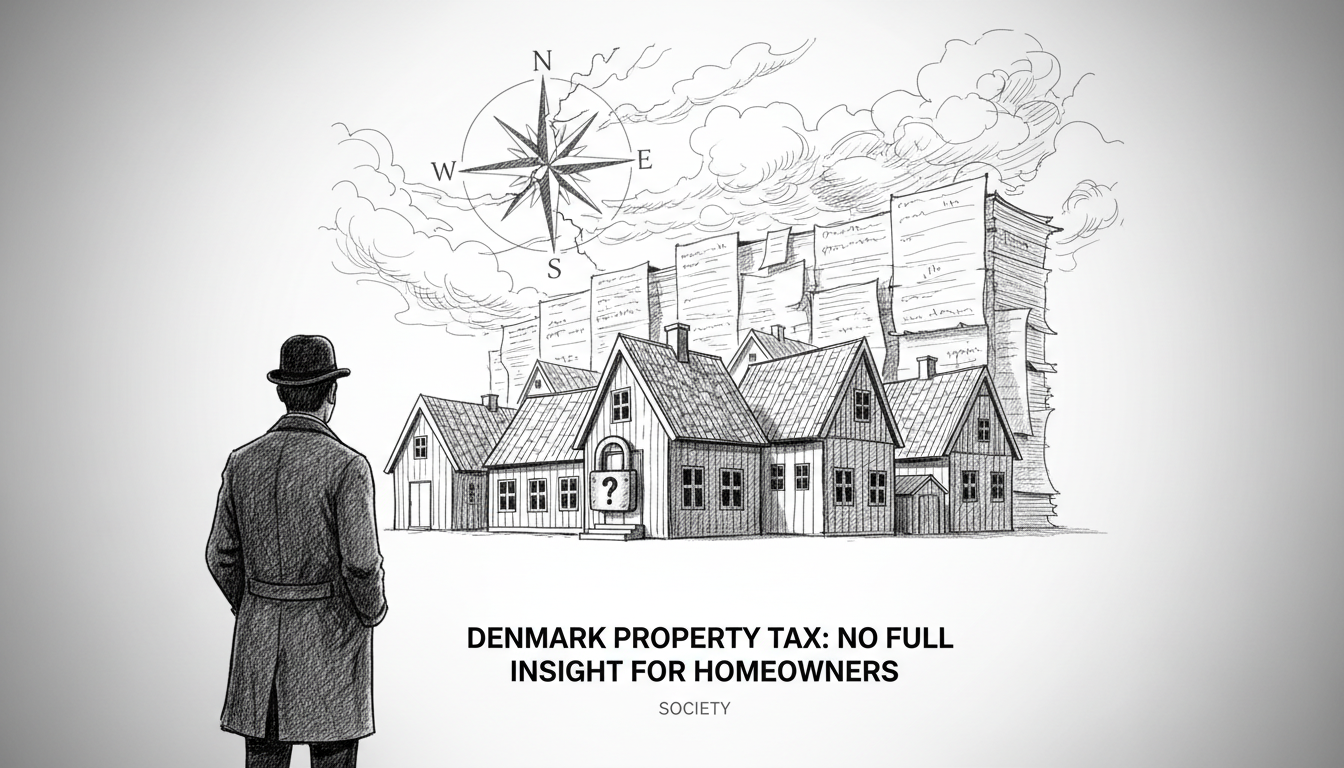
Denmark property valuation authorities have delivered a blunt message to homeowners. The Vurderingsstyrelsen has officially stated that citizens will not gain full insight or control over the assessments of their own properties. This definitive position was outlined in a report to the Parliamentary Ombudsman, confirming fears about the transparency of the new national valuation system. For hundreds of thousands of Danish families, their property tax bill hinges on a calculation they are not permitted to fully understand or verify.
A System Rebuilt from Scratch
The current situation stems from a systemic failure. The previous property valuation model was suspended in 2017 after widespread errors rendered it legally and practically untenable. This collapse triggered a massive, costly overhaul. Billions of kroner have since been invested in developing a new, digital valuation framework intended to be more accurate and equitable across municipalities. The core promise was fairness. Yet the agency's recent communication suggests a fundamental trade-off: accuracy for transparency. Homeowners are essentially told to trust the algorithm, even as it directly impacts their personal finances.
Experts in public administration and tax law express deep concern over this approach. "Transparency is not just a nice-to-have feature in a system that determines tax liability; it's a cornerstone of legal certainty and public trust," says Professor Lars Bo Langsted, a tax law expert at Aalborg University. He notes that when citizens cannot scrutinize the basis for a state demand for payment, it challenges foundational principles of the Danish legal system. The risk, analysts warn, is a surge in appeals and legal challenges from homeowners who feel they have no other recourse, potentially clogging the court system.
The Black Box of Property Valuation
So, what exactly are homeowners being denied? The Vurderingsstyrelsen uses a complex mass appraisal model, processing vast datasets on property sales, locations, sizes, and building characteristics. The agency argues that revealing the precise weighting of these factors or allowing manipulation of individual data points would compromise the system's integrity. Homeowners might, for instance, attempt to undervalue their property by incorrectly reporting features. The agency's stance is that the output—the final valuation figure—is what matters, not the public's understanding of the computational recipe.
This creates a palpable sense of powerlessness. Imagine receiving a tax bill based on a secret formula. You can see the data inputs, like your home's square footage or postcode, but you cannot see how they were combined or weighted to reach the final number. If a neighboring, nearly identical house receives a significantly different valuation, proving an error becomes nearly impossible. "The lack of insight means the burden of proof in an appeal shifts almost entirely onto the homeowner," explains a municipal caseworker from the Copenhagen area, who requested anonymity. "You are arguing against a black box."
Public Trust on the Line
The implications extend beyond individual tax bills. Denmark's welfare model relies heavily on high levels of public trust and voluntary compliance. Citizens generally accept high taxes because they believe the system is reasonably fair and transparent. A opaque property valuation system, perceived as arbitrary or unaccountable, can erode that social contract. It feeds a narrative of a distant bureaucracy making impactful decisions without meaningful citizen oversight.
This tension is not unique to Denmark, but the country's deep-rooted principle of 'offentlighed' or public access makes it particularly acute. "There is a cultural expectation in Denmark that the workings of the state should be open to scrutiny," says Karen Andersen, a social policy researcher. "When a major agency like the Vurderingsstyrelsen says 'you can't see how we did this,' it goes against that grain. It feels like a departure from a key democratic value."
The Parliamentary Ombudsman, who received the agency's report, plays a critical role as the watchdog for public administration. Their investigation was likely prompted by citizen complaints. The Ombudsman's ultimate assessment of whether this limited transparency constitutes 'good administrative practice' will be a significant political and legal moment. A finding against the agency could force a major policy shift.
Navigating an Uncertain Future
For now, Danish homeowners are left in a difficult position. The new valuations are rolling out, determining future property tax obligations for years to come. The advice from consumer organizations is meticulous documentation. Homeowners should carefully review all the data the agency does provide about their property and formally contest any factual errors, such as wrong room counts or building materials. However, challenging the valuation's methodology or outcome remains a daunting prospect.
The Vurderingsstyrelsen faces its own challenge: balancing operational efficiency with democratic accountability. Can a fair system truly be built behind a veil? The coming years will test this proposition, as the first wave of valuations under the new model faces real-world scrutiny. The number of appeals will be the first concrete metric of public acceptance or rejection. If dissatisfaction grows, political pressure will mount for legislative changes to mandate greater openness.
This story is ultimately about more than property taxes. It is a case study in how modern, data-driven governance interacts with traditional demands for transparency. As algorithms increasingly determine facets of our lives—from credit scores to social benefits—the Danish property valuation debate asks a universal question. How much insight do citizens deserve into the digital systems that govern them, and at what point does operational secrecy undermine the very legitimacy it seeks to preserve? Denmark, with its strong welfare state and tradition of openness, may well provide the answer.