
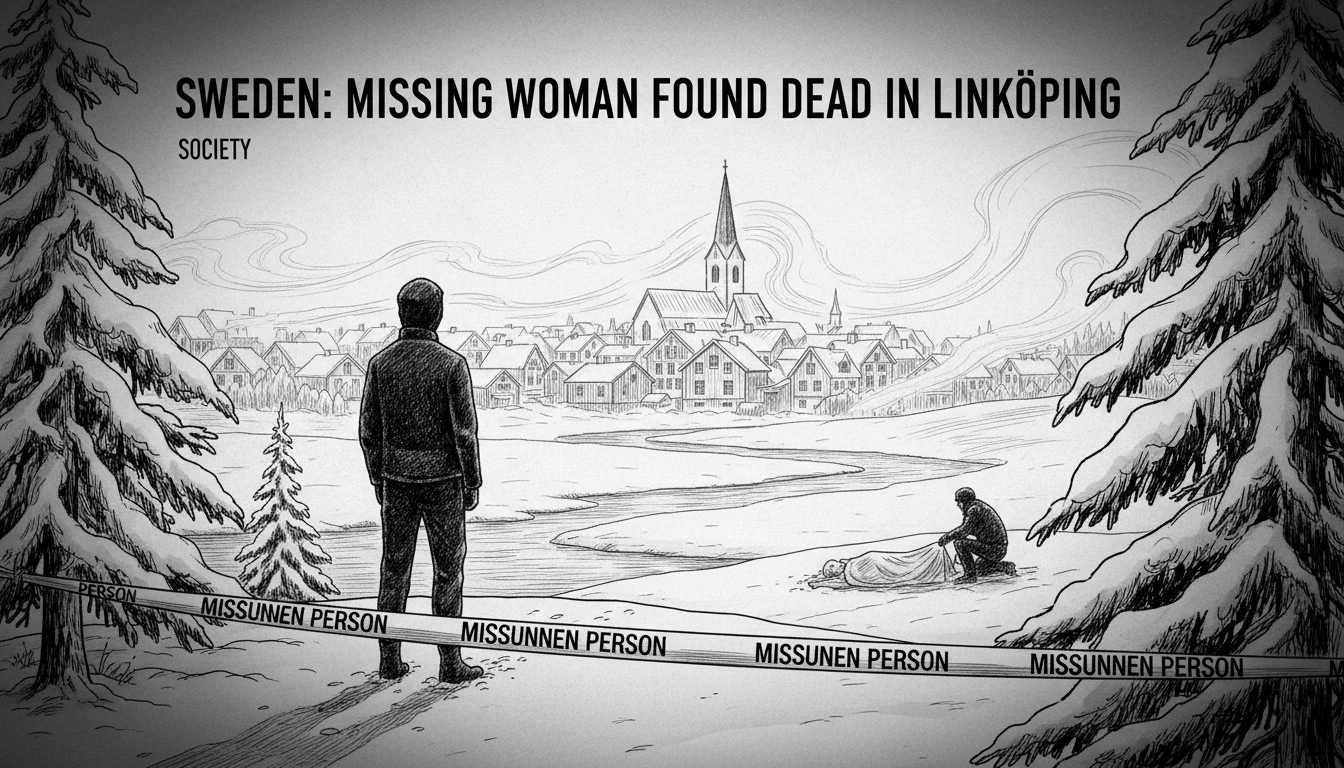
Swedish police have confirmed a missing woman was found dead near her home in Linköping. The discovery ends a search that began earlier this week in the Sätra and Bestorp areas. Authorities are currently investigating the death as an accident, and the woman's next of kin have been notified.
It’s a quiet news day in Stockholm. The sun is trying to break through a thin layer of cloud over Kungsträdgården. People are out for lunchtime walks, and the city hums with its usual, orderly energy. Yet, 200 kilometers to the southwest, in Linköping, a community is grappling with a quiet, private tragedy. The brief police statement—just a few lines—belies the human story behind it: a woman reported missing, a search, and a life lost.
As a society reporter, these are the stories that often linger. Not the grand political dramas, but the personal losses that ripple through neighborhoods and families. They speak to the vulnerabilities hidden beneath Sweden's stable surface. Linköping is known for its prestigious university and thriving tech sector, a symbol of modern Swedish innovation. But today, its name is connected to a more somber event in the residential areas of Sätra and Bestorp.
The Search and a Somber Discovery
The woman had last been in contact with someone over the weekend. By Wednesday, concern had grown into official action. The Swedish Police Authority initiated a search operation, focusing efforts on Sätra and Bestorp. These are not dense urban cores but quieter, community-focused localities within Linköping Municipality. The search would have involved local police officers, possibly checking with neighbors, reviewing local CCTV, and combing nearby green spaces.
Such operations are a standard but critical procedure. "Every missing person report is taken seriously," explains a former police officer familiar with missing persons protocols, who spoke on background. "The initial hours are crucial. Teams work methodically, often starting from the person's last known location and expanding outward." While high-profile cases sometimes involve national resources or volunteer groups like Missing People Sweden, many searches are handled diligently and locally, away from the media spotlight.
In this case, the search ended with the worst possible outcome. The woman was found deceased not far from where she lived. The police have stated the death is being investigated as an accident. This is a standard legal classification in the early stages of an investigation. It allows the forensic and technical teams to work without presupposing a crime, examining all evidence to understand the precise sequence of events that led to her death.
The Human Story Behind the Headline
The police statement is necessarily sparse, respecting the family's privacy during a devastating time. We know she was a woman who lived in Linköping. She had people in her life who cared enough to report her missing when they lost contact. Now, those people—her family, her friends—are in the process of being notified and beginning their grief.
This is where the clinical language of a police bulletin meets the raw reality of human experience. A home in Sätra or Bestorp now has an empty space. There are unanswerable questions and a future suddenly altered. Swedish society, with its strong emphasis on communal well-being and trygghet (security/safety), is deeply affected by these individual losses. They remind us that safety is not just a statistic but a personal feeling that can be shattered in an instant.
"The focus now, beyond the investigation, will be on supporting the family," says Karin Lundström, a grief counselor based in Stockholm. "In Sweden, we have structured support systems, but the immediate shock and pain are deeply personal. The community around them, their neighbors and friends, will play a vital role in the coming days and weeks."
Understanding the Swedish Response
For an international audience, the Swedish approach to such incidents can seem notably reserved. There is no sensational press conference, and the victim's identity is protected. This stems from a strong cultural and legal framework around personal integrity (personlig integritet) and a principle of public access that is balanced with individual protection. The police work systematically, and information is released when it is confirmed and does not hinder the investigation.
The collaboration in search operations is also a key feature. While the police lead, organizations like Missing People Sweden (Svenska Försvunna) provide vital support. They assist families, help coordinate volunteer searches, and offer a channel for public tips. It’s a model that reflects the Swedish concept of folkhemmet—the people's home—where civic responsibility is shared.
This incident, while currently classified as an accident, also touches on broader conversations in Swedish society about mental health, community support, and the safety of individuals, particularly women, in public and private spaces. Each unexplained death prompts quiet reflection on these issues in community centers, around kitchen tables, and in local newspaper comment sections.
A Community Reflects
Back in Linköping, life continues, but with a subdued tone. At a café in the city center, not far from the majestic Linköping Cathedral, the news is discussed in hushed tones. "You never think it will happen so close to home," says Erik, a local student who did not want to give his full name. "It makes you check in on your friends a bit more."
This reflexive community care is a Swedish trait. The concept of lagom—not too much, not too little—applies even to grief. It is often quiet, dignified, and supported by close-knit social circles. There won't be a large public memorial unless the family chooses one. Instead, support will flow through private channels and established social services.
The police investigation will continue its meticulous work. Forensic experts will work to determine the exact cause of death. The final classification may remain as an accident, or the investigation may take a different turn based on evidence. That process, though invisible to the public, is a cornerstone of the rule of law here.
The Stories Between the Lines
As journalists, we report the facts given to us: a woman found, an investigation opened, a family notified. But the true story exists in the space between those lines. It's in the worry that preceded the missing person's report. It's in the diligent work of the police officers who conducted the search. It's in the profound silence that has fallen over a family's home.
Sweden is a country that often makes international news for its political models, its innovation, or its cultural exports. Yet, the fabric of daily life here is woven from millions of ordinary stories. Some are stories of success and comfort. Others, like this one in Linköping, are stories of sudden, tragic loss. They remind us that behind every brief news alert is a human narrative with deep roots in a community.
For now, the people of Linköping, and particularly those in Sätra and Bestorp, will carry on with that distinct blend of Swedish resilience and quiet empathy. Flowers may appear anonymously at a location near where she was found—a simple, powerful Scandinavian gesture of remembrance. And the rest of us are left with a reminder to appreciate the fragile trygghet of our own ordinary days.
What makes a community feel safe, and how do we look out for one another when that safety is broken? The search in Linköping is over, but the questions it quietly raises linger long after the news cycle moves on.