
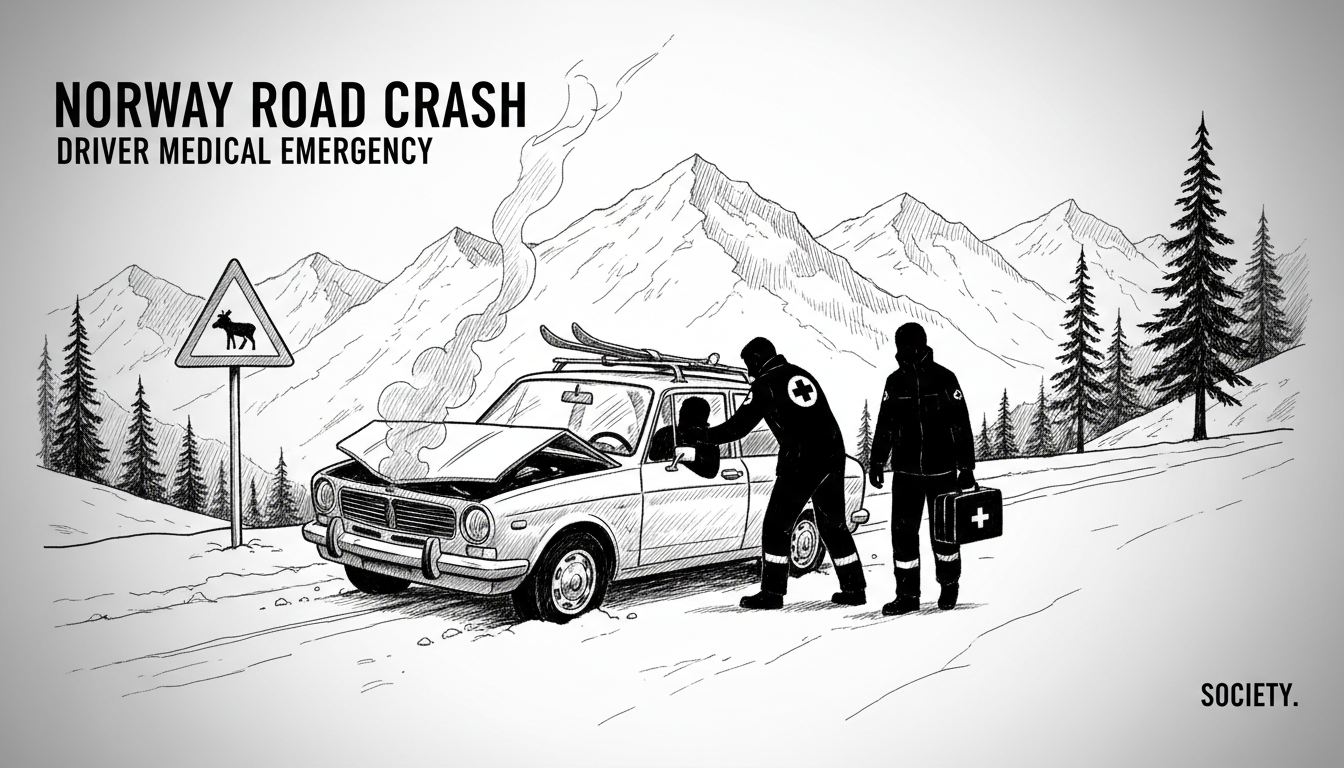
Norway traffic accident responders faced challenging conditions in the Vesterålen archipelago after a single-vehicle crash in Hadsel municipality. Emergency services raced to the scene on Monday, where life-saving first aid was administered. The Nordland Police District reported the road was closed following the incident.
Initial police hypotheses suggest the driver may have suffered a sudden medical episode while at the wheel. "Life-saving first aid had to be administered, but the hypothesis is that the driver experienced a medical emergency while driving," said Mads Bernhoft of the Nordland Police District in a statement.
A Remote and Rugged Scene
The incident occurred in Hadsel, a municipality spanning several islands in the Vesterålen chain. This region north of the Arctic Circle is famed for its steep mountains, deep fjords, and fishing communities. Roads here often weave through isolated terrain, connecting small towns and villages.
Response times in such areas differ markedly from urban centers like Oslo. While Norway maintains a well-developed emergency network, geography plays a defining role. The population density in Nordland county is just 6.5 people per square kilometer, compared to over 1,500 in the capital region.
This sparse distribution means police, ambulance, and rescue services may travel significant distances. Their response is further complicated by variable weather, which can include sudden fog, high winds, or winter storms, even outside the deepest winter months.
The Investigation and Immediate Response
Police have launched a standard investigation to determine the crash's exact cause. They will examine the vehicle's condition, road surface quality, and the driver's medical history. Focusing on a potential medical event is a common procedure when no other vehicles are involved and no obvious road hazards are present.
"The immediate priority was providing critical care and securing the area," a police spokesperson noted. The declaration of life-saving first aid indicates the severity of the situation faced by the first responders on scene.
Road closures are a standard protocol to allow emergency vehicles unhindered access and to permit investigation teams to work safely. It also prevents secondary incidents from occurring at the same location.
The Broader Context of Norwegian Road Safety
Norway consistently ranks among the nations with the world's safest roads. In 2022, the country recorded 117 road fatalities, a historically low number. This achievement stems from continuous investment in infrastructure, strict enforcement of traffic laws, and public safety campaigns.
However, accidents in remote regions present a distinct set of challenges. The distance to advanced medical care, often requiring helicopter airlift to hospitals in Bodø or Tromsø, is a critical factor in outcomes. The national air ambulance service, often called upon in Nordland, is a vital component of the emergency ecosystem.
Traffic safety experts point to multiple factors for driver safety in the north. "Regular vehicle checks are crucial, especially for tire condition given the changing weather," says Lars Tennøy, a researcher at the Institute of Transport Economics. "Driver awareness of one's own health is equally important, particularly on long, solitary stretches of road."
The Norwegian Public Roads Administration continuously works to improve high-risk roads. Yet, the fundamental geography of regions like Vesterålen means some routes will always be demanding to drive, requiring full driver attention.
Community Impact and Regional Resilience
For small communities in Hadsel and across Vesterålen, a serious traffic accident resonates deeply. In close-knit districts, news travels quickly, and the individuals involved are often known to many. The social fabric here is strong, with neighbors relying on each other, a resilience built into coastal and island life.
The local economy, heavily based on fishing and tourism, depends on reliable road connections. A closure on one of the main arteries, like the Rv 82 that runs through Hadsel, can disrupt daily life and commerce, highlighting the infrastructure's importance beyond mere transit.
Incidents like this also test the integrated emergency response system, from the local volunteer fire brigade to the central police dispatch and the national air ambulance service. Their coordination in difficult conditions is regularly exercised.
A Look at Prevention and Policy
While this specific investigation continues, the event feeds into ongoing national discussions about road safety. These include debates on mandatory health checks for older drivers, the placement of guardrails on winding roads, and the expansion of mobile phone coverage for emergency calls in remote areas.
The Norwegian government's National Transport Plan always allocates significant funds for road safety measures, known as "trafikksikkerhetsutgifter." These projects range from building safer crossing points for wildlife to straightening dangerous curves.
For individual drivers, the advice remains consistent. Authorities recommend planning for long trips, taking frequent breaks, and never driving when feeling unwell. This is especially pertinent on Norway's scenic but sometimes demanding rural and Arctic roads.
As the police in Nordland complete their investigation, the focus will turn from immediate response to understanding and, ultimately, preventing similar events. The goal remains unwavering: to make every journey on Norway's roads, from the bustling E6 highway to the quiet coastal routes of Vesterålen, a safe one.