
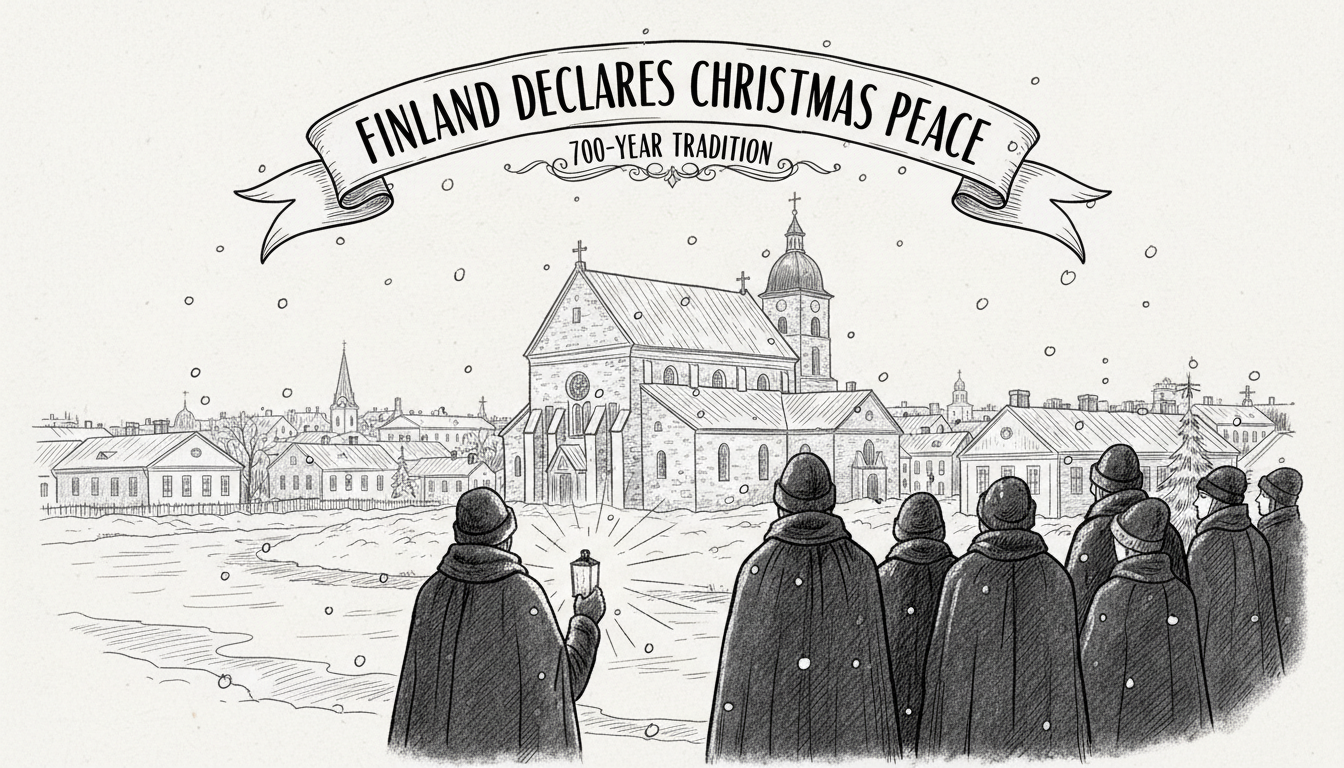
Finland's Christmas Peace declaration is a 700-year-old tradition that transforms the nation's mood at noon on Christmas Eve. The formal proclamation from the balcony of Brinkkala House in Turku marks the official start of the holiday season, calling for tranquility and goodwill. This year, City of Turku Head of Protocol Mika Akkanen will read the text that has remained largely unchanged for centuries, a ritual observed nationwide via television and radio broadcasts. The declaration's enduring power lies in its simple command for peace, a cultural reset that momentarily stills the modern world.
A Medieval Proclamation for a Modern Nation
The tradition's origins trace back to the 1320s, when Finland was part of the Kingdom of Sweden. The Swedish Code of Laws from 1340 mandated the proclamation to ensure a peaceful holiday period, threatening severe punishment for any crimes committed during the declared truce. For centuries, the declaration was a practical legal instrument, read in churches and town squares to suspend normal judicial proceedings. The continuity of this practice is remarkable, surviving the Reformation, wars with Russia, Finnish independence in 1917, and the digital revolution. Historians note only a handful of interruptions, primarily during wartime in the 19th and 20th centuries, making its annual return a powerful symbol of resilience.
Professor of Folklore Studies at the University of Helsinki, Dr. Laura Stark, emphasizes the declaration's psychological function. "It acts as a societal permission slip to stop, to rest, and to prioritize family and quiet reflection," she explained in an interview. "In a nation known for its sisu, or perseverance, the Christmas Peace is a collective exhale. It formally demarcates a sacred time separate from everyday toil and worry, a concept deeply rooted in agrarian society that has found new relevance today." The proclamation's text, which includes a reminder to treat animals with extra kindness, underscores this holistic view of peace.
The Ceremony at the Heart of Finnish Christmas
The focal point is Turku, Finland's oldest city and former capital. At precisely 12:00 PM on December 24th, the national flag is raised on the Great Square, and the Turku Cathedral bells begin to ring. Mika Akkanen, representing the city, steps onto the balcony of the historic Brinkkala House, a 19th-century building that now serves as the city's protocol venue. Before a crowd of thousands braving the winter cold, and to a national television and radio audience, he reads the declaration first in Finnish and then in Swedish, Finland's second official language.
The text is solemn and direct: "Tomorrow, God willing, is the gracious celebration of the birth of our Lord and Saviour; and thus is declared a peaceful Christmas time to all, by advising devotion and to behave otherwise quietly and peacefully, because he who breaks this peace and violates the peace of Christmas by any illegal or improper behaviour shall under aggravating circumstances be guilty and punished according to what the law and statutes prescribe for each and every offence separately." The crowd typically responds with a respectful silence, followed by a communal singing of the Finnish national anthem, "Maamme," and the hymn "Joulupuu on rakennettu" (The Christmas Tree is Built).
More Than Ritual: The Declaration's Contemporary Resonance
While no longer carrying direct legal weight, the declaration's social and cultural authority remains significant. Police statistics consistently show a dramatic drop in reported disturbances and domestic incidents on Christmas Eve and Christmas Day compared to an average weekend. Social media platforms see a noticeable shift in tone, with public discourse moving away from political debate toward shared holiday greetings and family moments. For many Finns, watching the broadcast is the definitive moment when work emails are ignored, phones are set aside, and family time begins.
This collective pause has economic dimensions as well. Public transport winds down, most shops close, and the famously busy Finnish saunas in apartment buildings see extended, quieter sessions as neighbors coordinate schedules. The recent volatility in electricity prices, a major concern in a Nordic winter, is momentarily set aside with the common-sense advice from grid operators that a Christmas sauna is a sacred right. The declaration creates a temporary but powerful social contract where communal peace outweighs individual inconvenience or cost.
EU Context and a Finnish Model of Quiet Celebration
Within the European Union's tapestry of diverse holiday traditions, Finland's Christmas Peace stands out for its formal, civic character. Unlike the commercial frenzy that marks the season in many countries, the Finnish approach is institutionalized and solemn. EU cultural policy experts have occasionally pointed to it as an example of intangible cultural heritage that actively shapes social behavior. The tradition aligns with broader Nordic concepts of janteloven and joulurauha, emphasizing collective well-being and moderation over individual extravagance.
There is no EU directive governing holiday proclamations, but the Finnish model demonstrates how a national ritual can command widespread respect without enforcement. In an era of constant connectivity and global tensions, the deliberate creation of a period of mandated peace is a radical act. It reflects a distinctly Finnish belief in the power of structured ceremony to cultivate a specific state of mind across an entire nation.
The Future of an Ancient Tradition
The tradition faces subtle challenges in a changing society. Finland's growing cultural diversity means not all citizens share the Christian background of the proclamation, though its message of universal peace is broadly inclusive. The rise of on-demand entertainment and fragmented media consumption threatens the shared, simultaneous experience of the broadcast. Yet, its popularity endures. Viewership for the YLE broadcast remains consistently high, and the square in Turku is more crowded than ever, with many young families attending.
The key to its survival may be its adaptability within a framework of permanence. The words are ancient, but the context is always contemporary. It serves as an annual anchor point in Finnish identity, a reminder of historical continuity in a fast-paced world. As Dr. Stark concludes, "It is a ritual that doesn't just commemorate peace; it performs it. For those few minutes, and ideally for the following days, the ideal of peace is not an abstract hope but a lived, collective reality. In that sense, it is one of Finland's most successful and enduring public policies." As the bells of Turku Cathedral fade and the crowd disperses into the crisp afternoon, the declared peace settles over the country, a 700-year-old wish that still defines the Finnish Christmas.