
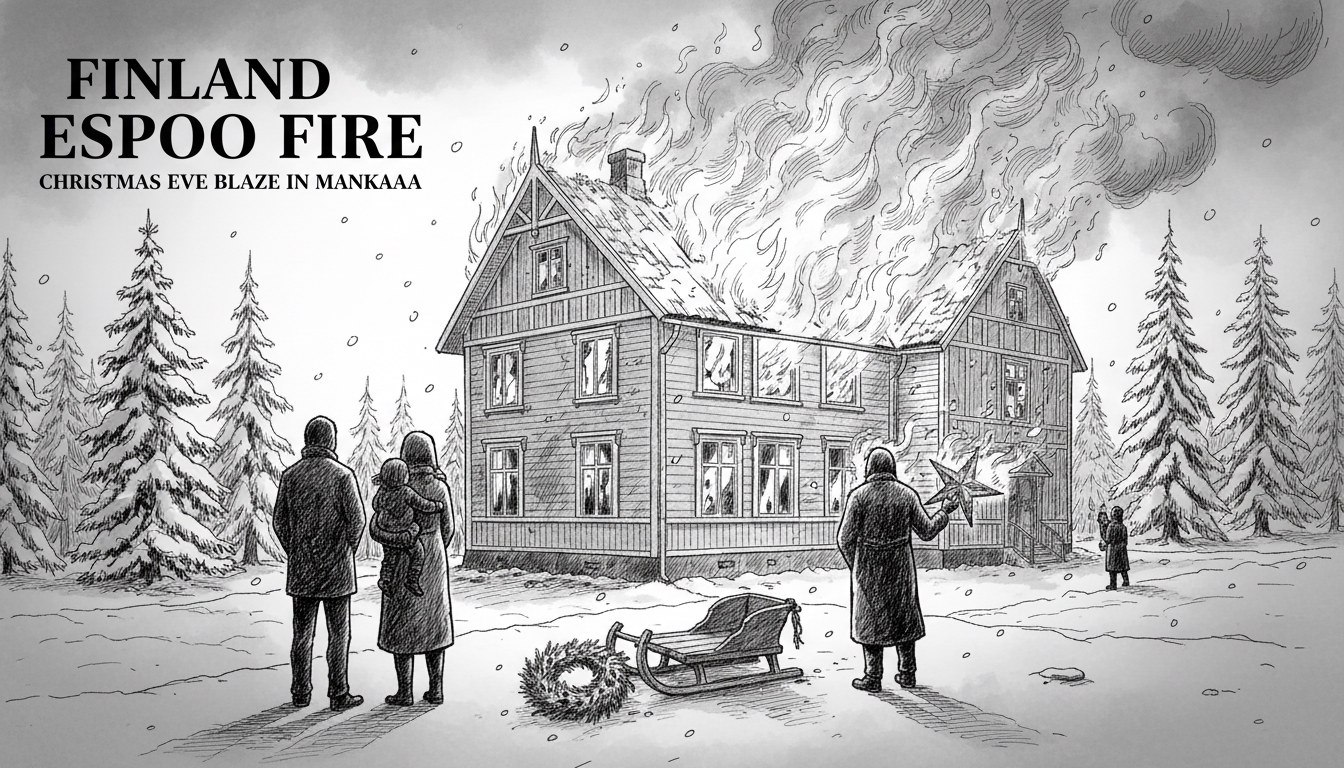
Finland Espoo fire crews battled a blaze in a semi-detached house on Christmas Eve, with the Western Uusimaa Rescue Department confirming no injuries resulted from the incident. The fire broke out shortly after 4 PM on Nygrannaksentie in the Mankkaa district, a residential area in Finland's second-largest city. Firefighters reported active flames in at least one unit of the duplex upon arrival, with suppression and clearing operations continuing into the evening on December 24th.
A Holiday Emergency in a Quiet District
The call to emergency services disrupted the quiet of Jouluaatto, the Finnish Christmas Eve, in a typical Espoo neighborhood. Mankkaa, part of Espoo's western sector, is characterized by family homes, green spaces, and a mix of older properties and newer developments. The swift response from the Länsi-Uudenmaan pelastuslaitos, the Western Uusimaa Rescue Department, highlights the 24/7 nature of emergency services, even during the country's most significant family holiday. Initial reports focused on determining occupancy, a critical and tense aspect of any residential fire call.
“The rescue department received the alarm for the fire shortly after 4 PM on Christmas Eve,” a department representative stated. They confirmed that by 5 PM, no personal injuries had occurred, a relief for responders and the community alike. The focus then shifted fully to containing the fire and preventing its spread to the adjoining unit within the paritalo, a common housing style in Finnish suburbs.
Fire Safety Under the Finnish Winter Night
This incident brings Finland's robust fire safety protocols into sharp relief. Finnish building codes are stringent, with a strong emphasis on containment and early warning systems. Most residences are required to have smoke detectors, and public awareness campaigns run frequently. However, experts note that the holiday season presents unique risks. “The Christmas period can see an increase in fire risks due to factors like candle usage for traditional decorations, extended cooking for festive meals, and potentially stressed or overloaded electrical circuits from lighting displays,” explains a fire safety expert familiar with Nordic residential patterns.
The timing of this fire, on the afternoon of the 24th, coincides with peak domestic activity as families prepare for the Joulupöytä, the traditional Christmas feast. This underscores the importance of never leaving cooking unattended and ensuring candles are placed securely away from curtains and other flammable materials. The expert emphasized that while Finnish safety standards are high, vigilance is a personal responsibility. “A working smoke detector is the simplest and most effective early warning system. It provides those crucial extra minutes to evacuate and call for help, which is exactly what seems to have happened here,” they added.
The Anatomy of a Rescue Response
The response to the Mankkaa fire illustrates the integrated emergency framework in the Helsinki capital region. The Western Uusimaa Rescue Department serves multiple municipalities, including Espoo, demonstrating a resource-sharing model that ensures coverage across a wide area. Their ability to mobilize crews on a major holiday speaks to prepared staffing rotations. The operation involved standard fire suppression tactics, but also the critical task of ventilation and overhaul—searching for hidden fire spread within walls and attics—to ensure complete extinguishment.
Property damage in such incidents can be severe, even when contained to one unit. Water and smoke damage often extends beyond the immediate fire area, and structural assessment is required before residents can return. The investigation into the cause will begin once the scene is fully safe, a process that can take days. Common origins include electrical faults, kitchen accidents, or heating appliances, though authorities have not speculated on this specific case.
Community and Aftermath in Espoo
For the residents of the affected home and their neighbors, the event is a traumatic disruption. The practical implications are immediate: displacement, potential loss of personal belongings, and dealings with insurance companies. The psychological impact of a home fire, particularly during a season centered on hearth and home, should not be underestimated. Finnish social services and local organizations, including the Finnish Red Cross, often provide support in such situations, offering emergency accommodation and essential supplies.
The incident also serves as a community reminder. It prompts neighbors to check their own smoke alarm batteries and discuss family evacuation plans. In tightly-built residential areas like Mankkaa, a fire in one unit directly threatens adjacent homes, making collective awareness a community safety issue. The successful prevention of injuries in this case will be cited by rescue authorities as a positive outcome of effective emergency response and, likely, proper safety equipment in the home.
A Broader Look at Finnish Fire Statistics
Finland maintains a strong record on fire safety compared to international averages, thanks to strict building codes, a well-funded and trained rescue service, and high public awareness. Residential fires do occur, with statistics often pointing to older housing stock or human error as contributing factors. The Finnish National Rescue Association (SPEK) runs continuous education campaigns targeting specific risks, such as fireplace safety in the winter and grill safety in the summer.
The Mankkaa fire, while ultimately not tragic, fits into a pattern of seasonal risk. Data often shows a small uptick in certain types of domestic fires during the darkest months of winter, when lighting and heating use is at its peak, and again during summer holiday months. The role of the rescue department is not only reactive but profoundly preventive. Their public outreach is a continuous effort to keep the number of incidents, and more importantly casualties, as low as possible.
As the investigation proceeds and the residents of the Nygrannaksentie home face the process of recovery, the event stands as a stark, smoky contrast to the typical peace of the Finnish Christmas. It is a testament to the unseen work of emergency services and a silent prompt for every household to pause and assess their own preparedness. The question remains: when the alarm sounds, is your plan as ready as the responders who answer the call?